

Here's how weather will impact the 2026 FIFA World Cup
From sweltering afternoons in the southern U.S. to cooler conditions in Canada and the impact of altitude in central Mexico, players, coaches and fans alike will face a wide range of environments in the coming weeks.
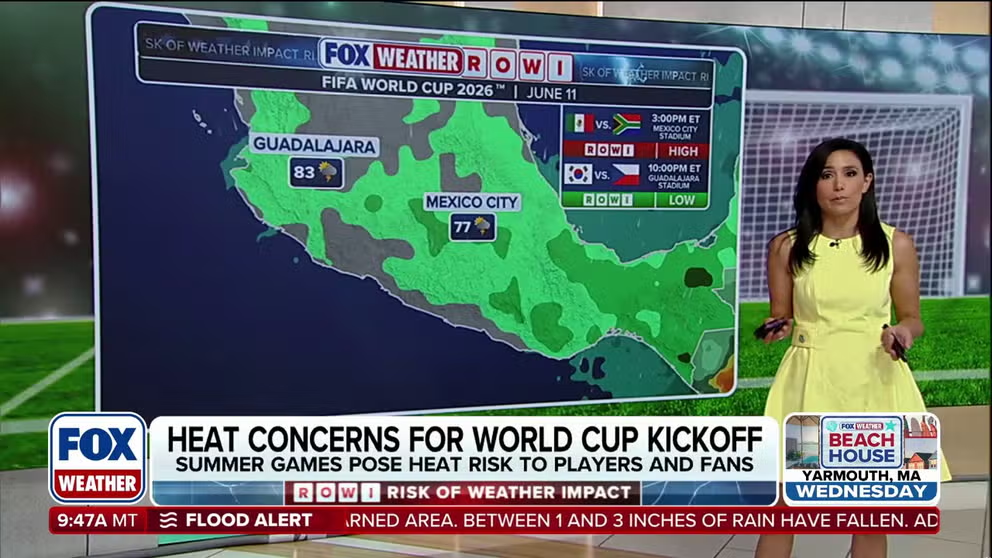
Heat concerns for fans and players at FIFA World Cup
HOT MATCHUP: As the FIFA World Cup approaches, officials are issuing precautions for players and fans attending the games. #Worldcup #FIFA #Soccer #FOXWeather
The World Cup is officially underway, bringing the world's biggest sporting event back to North America.
Beyond the sport's biggest stars, long-standing rivalries and dramatic goals, there is an undeniable factor that could help shape the tournament: the weather.
From sweltering afternoons in the southern United States to cooler conditions in Canada and the impact of altitude in central Mexico, players, coaches and fans alike will face a wide range of environments in the coming weeks.
These weather conditions could influence everything from match tempo and player fatigue to the race to crown the next world champion.

Lionel Messi may actually be one of the players best adapted to North American summer conditions. Since joining Inter Miami in 2023, he's spent multiple seasons playing in South Florida's notorious heat and humidity, regularly competing in conditions with temperatures in the 80s and 90s and high moisture levels.
(Pablo Elias/NurPhoto via Getty Images)
For the biggest sporting event on the planet, 16 cities across the United States, Mexico and Canada will welcome millions of fans.
CAN CONCERTS AND SPORTING EVENTS CAUSE EARTHQUAKES?
While the winners and the world's next champion remain unknown, one factor is guaranteed to play a role in all 106 matches: the weather.
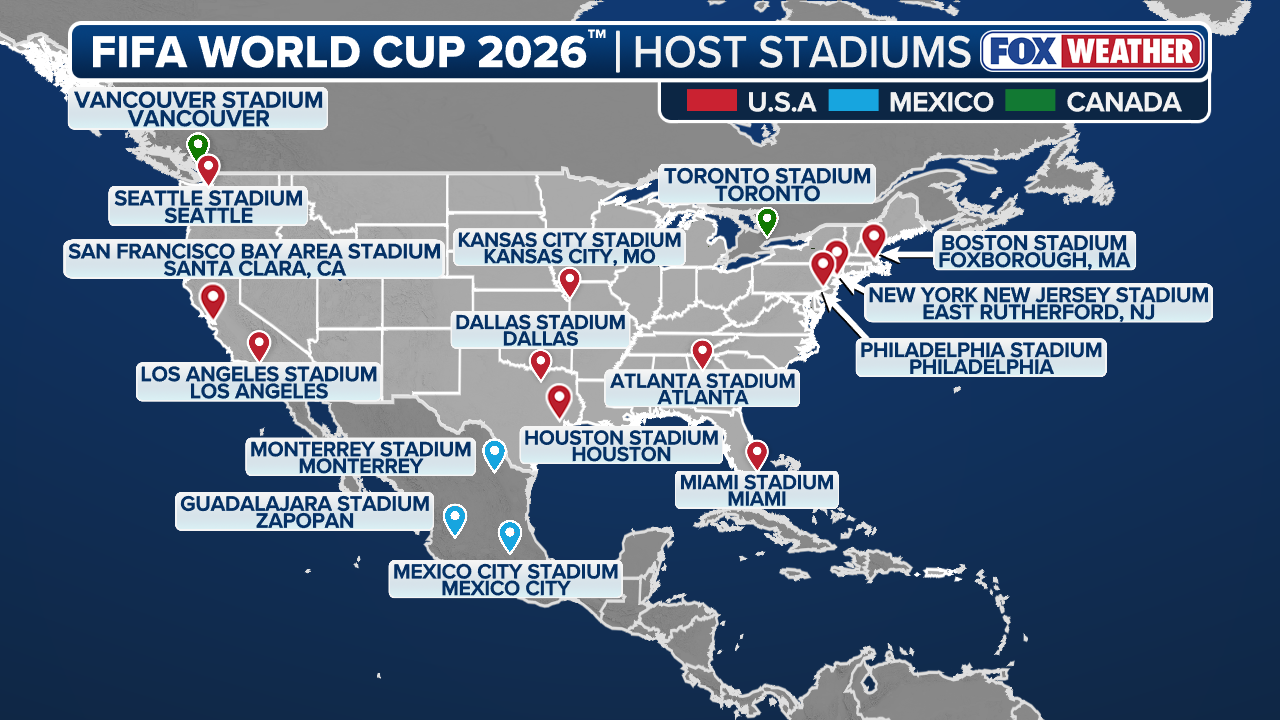 Host Cities In The 2026 FIFA World Cup.
(FOX Weather)
The World Cup brings together 48 nations from six continental confederations, sending teams across North America during the transition from spring to summer and exposing them to some of the continent's most diverse weather conditions.
From scorching heat and suffocating humidity to swift thunderstorms, visitors from Europe, Asia, Africa and South America will experience the full spectrum of North America's summer weather.

France players pause for drinks during a training session at Bentley University in Waltham, Massachusetts, on June 11, 2026. Hydration has become a major focus at the 2026 World Cup, with FIFA implementing mandatory cooling breaks in every match as teams prepare for summer heat across North America.
(FRANCK FIFE / AFP via Getty Images / Getty Images)
Of the 16 World Cup venues, only Atlanta, Dallas, Houston and Vancouver feature fully enclosed, retractable-roof stadiums, while Los Angeles' SoFi Stadium offers overhead coverage, but remains open to the outside environment, meaning weather conditions can still influence the fan experience.
EXTREME HEAT
Among the weather-related challenges facing teams, extreme heat poses a real threat to numerous locations hosting this year's tournament.
DEW POINT VS. HUMIDITY: WHICH ONE IS A BETTER MEASURE OF HOW MUGGY THE AIR FEELS?
In Monterrey, Mexico, where average high temperatures climb into the mid-90s during June and July, players and fans alike will contend with conditions that can accelerate fatigue, increase dehydration risk and test endurance over the course of a match.
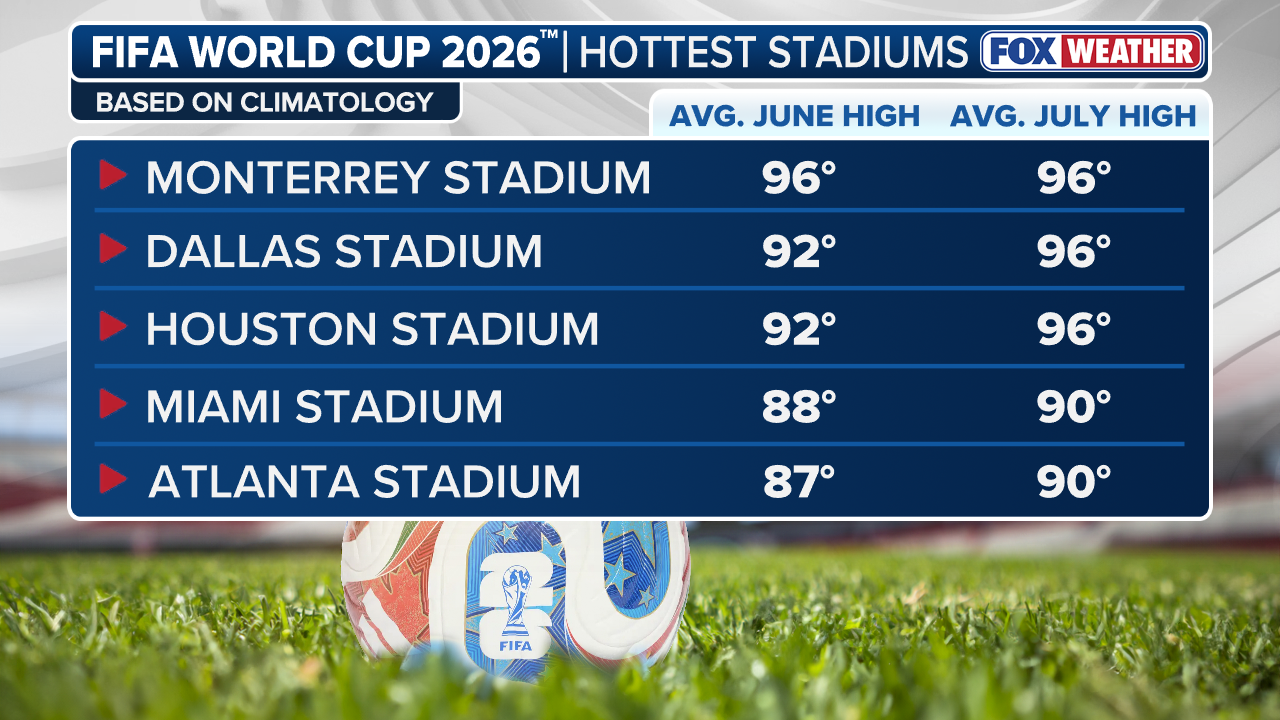 Hottest Host Cities In The 2026 FIFA World Cup.
(FOX Weather)
The Northeast's host cities — including New York City, Philadelphia and Boston — will be entering the heart of summer during the tournament, bringing rising temperatures, increasing humidity and the potential for periodic heat waves.
While daytime highs in the 80s and 90s are common this time of year, the added humidity can make conditions feel even hotter on the pitch and place additional stress on players over 90 minutes.
EXTREME HEAT SAFETY: RECOGNIZING SIGNS OF HEAT ILLNESS AND HOW TO TREAT IT
In the prime of warm weather in North America, FIFA is taking measures to mitigate the threat of extreme heat.

Cristiano Ronaldo has played World Cup matches on four continents, but the 2026 tournament will present a unique challenge given the North American weather conditions.
(Sergio Mendes/NurPhoto via Getty Images / Getty Images)
To protect players, coaches, fans and staff, FIFA has introduced several heat-related safeguards ahead of the 2026 World Cup.
EXTREME HEAT SAFETY: HOW TO PREPARE AND STAY COOL DURING A HEAT WAVE
Among them are mandatory three-minute hydration breaks in each half of every match, regardless of the weather, providing players a chance to cool down and regroup while giving coaches an additional opportunity to make tactical adjustments.

During the first hydration break of the 2026 FIFA World Cup, Mexico head coach Javier Aguirre speaks with his players during the match against South Africa at Mexico City Stadium in Mexico City, Mexico, on June 11, 2026.
(Yuri CORTEZ / AFP via Getty Images)
At the center of FIFA's heat-safety protocol is the Wet Bulb Globe Temperature (WBGT), a measurement that accounts for temperature, humidity, wind and solar radiation to assess how stressful environmental conditions are on the human body.
FIFA uses WBGT readings to guide heat-related decisions throughout the tournament. Higher values could lead to additional cooling measures, while dangerous levels can even lead to match delays, suspensions or postponements to protect players and officials.
WATCH: PARACHUTER CRASHES INTO SCOREBOARD BEFORE VIRGINIA TECH SPRING FOOTBALL GAME

Few World Cup contenders may face a greater climate adjustment than England, led by Harry Kane.
(Eddie Keogh - The FA/The FA via Getty Images)
LAST YEAR'S TROUBLING TEST RUN
The 2025 FIFA Club World Cup offered a preview of the weather challenges that could await players and fans at this year's World Cup.
THIS IS HOW TEMPERATURES IMPACT YOUR RUNNING PERFORMANCE
Extreme heat, oppressive humidity, thunderstorms and lightning delays repeatedly disrupted play across the U.S.

Jude Bellingham central midfield of Real Madrid and England pours water over his face because of the intense heat during the FIFA Club World Cup 2025 quarter final match between Real Madrid CF and Borussia Dortmund at MetLife Stadium on July 5, 2025 in East Rutherford, United States.
(Jose Breton/Pics Action/NurPhoto via Getty Images)
Several matches were delayed or suspended because of severe weather, with several hours-long delays putting the highly anticipated games on hold last summer.
While severe weather proved to be one unavoidable headache, extreme heat may have been an even greater concern. Players, coaches and staff frequently cited the physical toll of competing in temperatures near or above 90 degrees — conditions that could once again become a major storyline at the 2026 World Cup.
BEYOND THE HEAT LIES SUMMER STORMS
While extreme heat may grab the headlines, severe thunderstorms could prove just as disruptive during the 2026 World Cup. Across much of the United States, summer storms routinely bring lightning, heavy rain and the threat of lengthy match delays.
Unlike heat, which can affect players' performance throughout a match, severe weather has the potential to stop play altogether.

Dutch players during a water break during the friendly match between the Netherlands and Uzbekistan at Icahn Stadium on June 8, 2026, in New York, United States.
(ROBIN VAN LONKHUIJSEN / ANP / Getty Images)
FIFA requires host venues to adhere to local severe weather safety regulations, meaning World Cup matches in the United States will be governed by established lightning-safety protocols.
If lightning is detected within the designated safety radius of a stadium, play can be suspended until the threat has passed and conditions meet local safety requirements.
KNOW YOUR HEAT TERMINOLOGY: EXTREME HEAT WARNING, EXTREME HEAT WATCH AND HEAT ADVISORY
As the world's attention turns to North America, weather will undoubtedly become part of the World Cup story, regardless of which country comes out victorious.
Stick with FOX Weather and follow along with the Risk Of Weather Impact throughout the World Cup.