

This is how temperatures impact your running performance
When running in the heat, our bodies are in a competition between maintaining a steady pace and protecting themselves from overheating, thus making it harder to run.

FILE: Weather's impact on runners in the Walt Disney World Marathon
FOX Weather multimedia journalist Brandy Campbell spoke to marathon runners on how they trained for different weather elements leading up to the Walt Disney World Marathon.
For many, running is a year-round commitment, with a racing calendar that spans the entire year—from the holiday runs of November and December through the peak heat of summer.
Sometimes, when running in cooler air, our lungs can feel heavy and constricted, while warmer temperatures can make us feel drained or significantly weighed down.
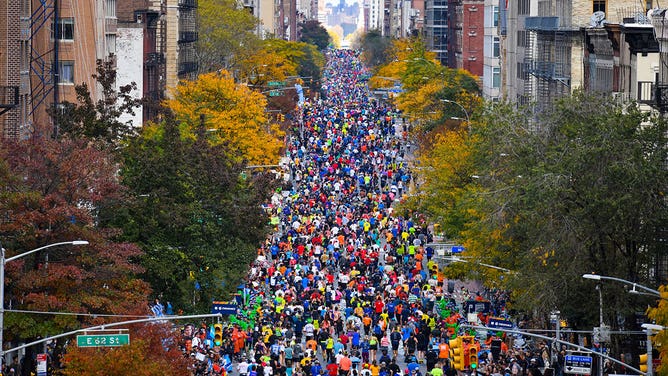
The masses run down 1st Ave. during the TCS New York City Marathon on November 3, 2019 in New York City.
(Jon Simon/New York Road Runners via Getty Images)
So, does temperature really impact your running? Let's break it down.
Temperature has a direct impact on running performance, mainly because it changes how your body regulates heat and uses energy, with performance shifting as your body prioritizes internal climate control over speed.
RUNNER COLLAPSES, DIES AFTER CROSSING BROOKLYN HALF MARATHON FINISH LINE IN 'BRUTAL' HEAT, HUMIDITY
Dr. Monica Kelly, an exercise and sport science expert at Deakin University, explains that running distances over 800 meters can be negatively impacted by temperatures higher than 77 degrees. She notes that there are "reports of slower race times by up to 3% during exercise in the heat."
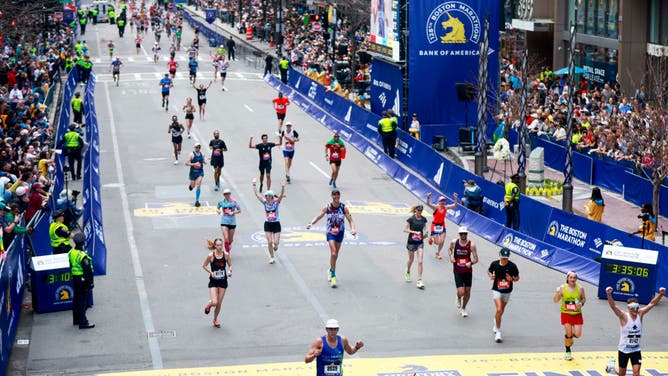
BOSTON, MASSACHUSETTS - APRIL 15: Former Boston Bruins NHL player Zdeno Chara (center #3333) looks on before he crosses the finish line of the 128th Boston Marathon on April 15, 2024 in Boston, Massachusetts.
(Photo by Omar Rawlings/Getty Images / Getty Images)
When running in the heat, our bodies are in a competition between maintaining a steady pace and protecting themselves from overheating, according to Dr. Amelia Carr, another exercise and sport science expert at Deakin University, thus, making it harder to run.
HEAT KILLS MORE AMERICANS THAN FLOODING, TORNADOES, HURRICANES OR LIGHTNING
On the flip side, cooler temperatures ranging from 50 to roughly 64 degrees can have a positive impact on pace for endurance runners.

HOBOKEN, NJ - JANUARY 26: A person jogs along a snow-covered walkway in front of the skyline of lower Manhattan and One World Trade Center in New York City on January 26, 2026, in Hoboken, New Jersey.
( (Photo by Gary Hershorn/Getty Images) / Getty Images)
In fact, it is the peak running temperature for endurance runners, according to Dr. Kelly.
However, to make this even more intriguing, "For sprinting events like 100 meters to 400 meters, air temperature can have the opposite effect, with performance often improved by 1 to 2% in hot conditions," Dr. Kelly said.
With that, it’s also good to note that other factors such as humidity or wind speed can also play a role in running performance.