

Total lunar eclipse gear guide: How to view and capture Blood Moon eclipse for best skywatching experience
When the total lunar eclipse is viewed through a telescope, the mountain ranges come into perspective, along with crater rims and ray systems that would otherwise look flat to the naked eye.
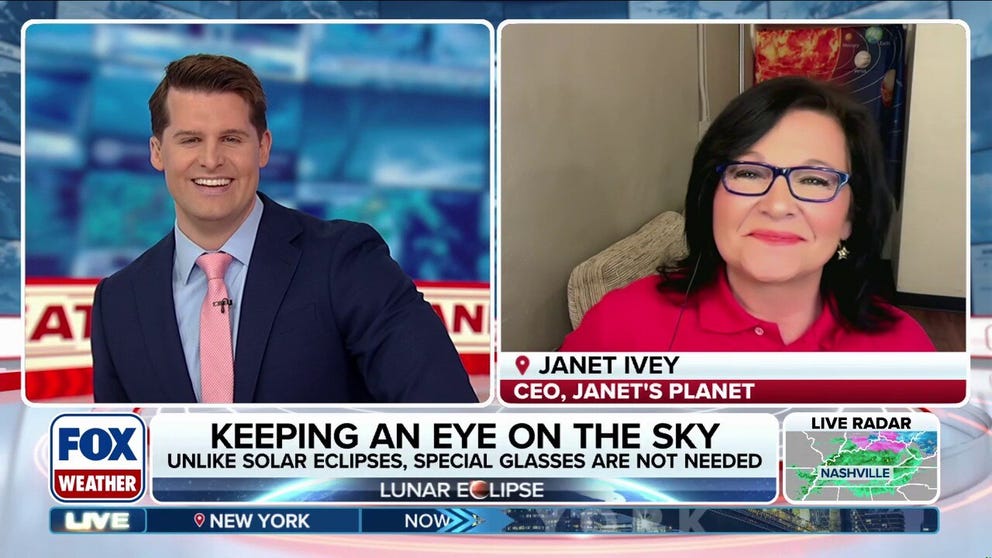
Total lunar eclipse to captivate the sky March 3
Janet Ivey, CEO and creator of Janet’s Planet, joins FOX Weather to discuss the total Lunar Eclipse on March 3. Discover why this one is so special and get expert tips on this
Keep your eyes open and look up — a total lunar eclipse, the Blood Moon is just hours away from captivating the night sky.
The phenomenon will grace the sky for nearly an hour on the early morning of March 3.
BLOOD MOON TOTAL LUNAR ECLIPSE 2026: WHEN AND WHERE YOU CAN SEE THE ASTRONOMICAL PHENOMENON
And although the orange-red glow will be visible to the naked eye, there are a few ways to enhance your viewing experience.
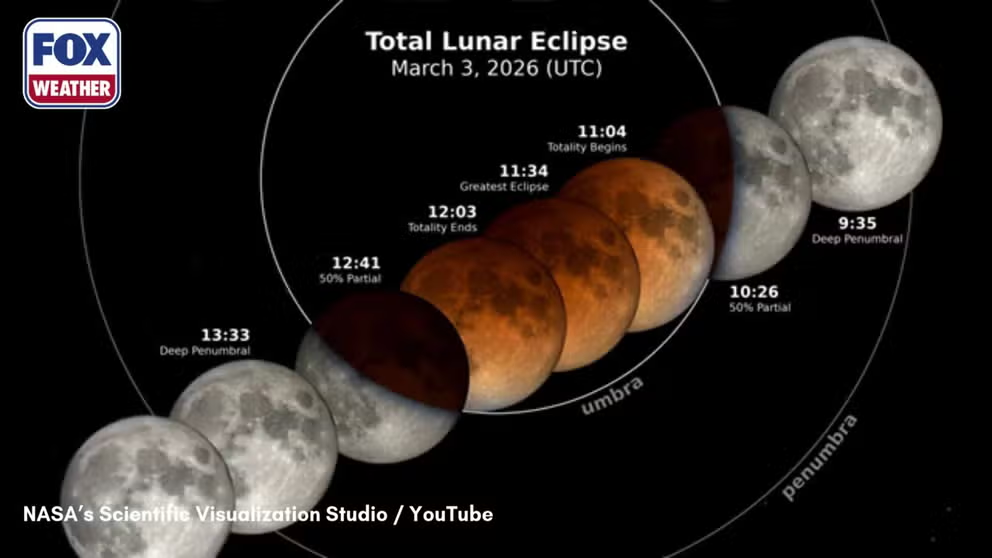
Total lunar eclipse to turn moon red on March 3
BLOOD MOON RISING 🌕: Don’t miss out! A total lunar eclipse will turn the Moon red for nearly an hour on March 3. Check out this video mapping the spectacular event!
From binoculars to tripods and telescopes, these tools can help elevate your celestial perspective.
THE BEST CELESTIAL EVENTS IN 2026 YOU WON'T WANT TO MISS
It might seem obvious, but first things first: start in a dark area and allow your eyes to adjust for about 20–30 minutes.
Once adjusted, this will allow your unaided eye to get the best view.
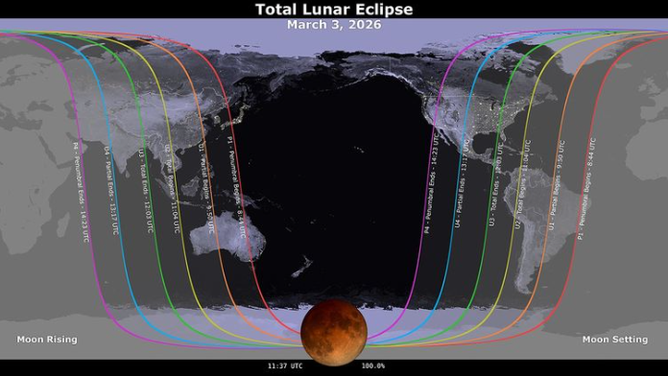
This map shows where the March 3, 2026 lunar eclipse is visible, with the contours marking the edge of the visibility region at eclipse contact times, labeled in UTC.
(NASA’s Scientific Visualization Studio / NASA)
If you’re looking to maximize the stunning experience, optics are the best way to do so, but be sure to choose ones that won’t gather dust once the moon leaves Earth’s shadow and the ordinary night sky returns.
NASA'S JAMES WEBB SPACE TELESCOPE UNCOVERS FORMER STAR THAT EXPLODED INTO A SUPERNOVA
Viewed through binoculars or a telescope, the eclipsed moon takes on a far more striking appearance.
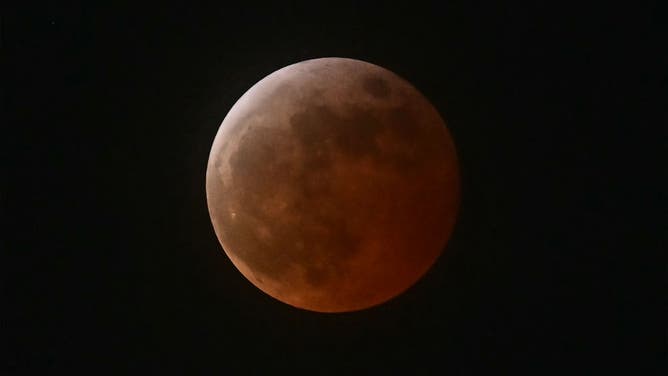
A lunar eclipse is seen during the Blood Moon Lunar Eclipse above Los Angeles, California, on March 13, 2025. (Photo by Frederic J. Brown / AFP) (Photo by FREDERIC J. BROWN/AFP via Getty Images)
According to Space.com, "Through binoculars, you’ll see the curve of Earth’s shadow as it slowly swallows the full moon."
To take it a step even further, when viewed through a telescope, the mountain ranges come into perspective, along with crater rims and ray systems that would otherwise look flat to the naked eye.
Space.com notes that modern smart telescopes and camera-equipped setups can capture highly detailed images of the fully eclipsed moon with relatively little effort.
MARCH SKYWATCHING GUIDE: CATCH A BLOOD MOON, PLANET CONJUNCTION, AURORAS, AND MORE
NASA suggests if you're taking photos, "use a camera on a tripod with exposures of at least several seconds."
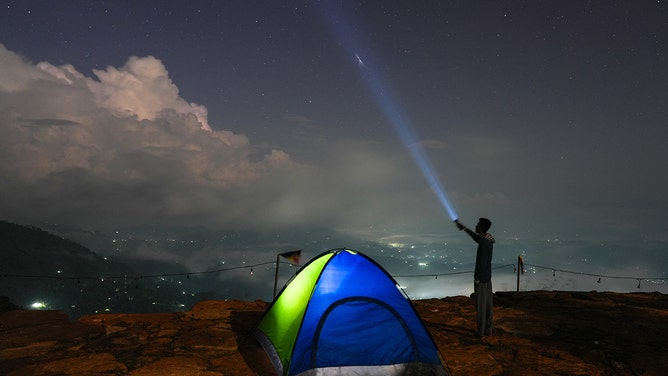
A man aims a torch toward the sky under the starry night in Rakwana, Sri Lanka, on April 21, 2025.
(Thilina Kaluthotage/NurPhoto via Getty Images / Getty Images)
With the Moon being as large as it is, Space.com said almost any binoculars should work.
They suggest that beginners try 8x42 or 10x50 binoculars for wide moon views, while 12x50 or 15x70 models reveal even finer lunar detail.
NASA DISCOVERS NEW STARLESS, DARK-MATTER ASTRONOMICAL OBJECT DUBBED 'CLOUD-9' IN SPACE
With such high magnification, your hands will likely shake and worsen the view, so it’s also recommended to use an adapter to mount it on a tripod.
When it comes to telescopes, Space.com recommends refractor or reflector telescopes.
"Small refractor telescopes with apertures between 70mm and 100mm are a great place to begin…. If you want to go really big, go for a 6-inch or 8-inch reflector telescope."
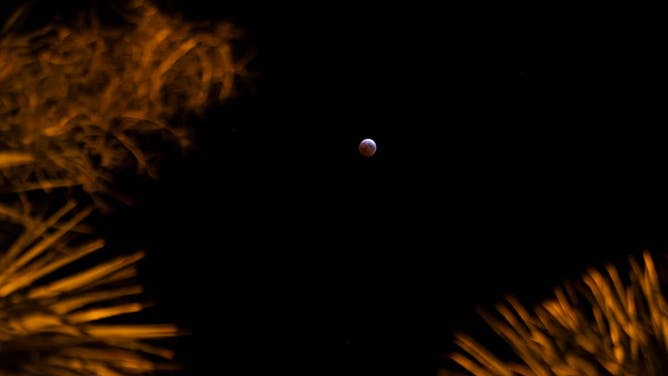
DAYTONA BEACH, FLORIDA - MARCH 14: The moon is seen during a total lunar eclipse on March 14, 2025 in Daytona Beach, Florida. The Moon will be covered by the Earth's shadow, creating what is known as the 'blood moon' as sunlight is filtered through a portion of the Earth's atmosphere. (Photo by Miguel J. Rodriguez Carrillo Getty Images)
Beyond eclipse night, this equipment is perfect for planetary observation, deep-sky exploration, wildlife viewing, and travel.
You won’t want to miss out on this celestial beauty as it will be the last total lunar eclipse until 2029.