

March skywatching guide: Catch a Blood Moon, planet conjunction, auroras, and more
A Blood Moon will headline the start of March’s celestial wonders, followed by a planet conjunction, and auroras.
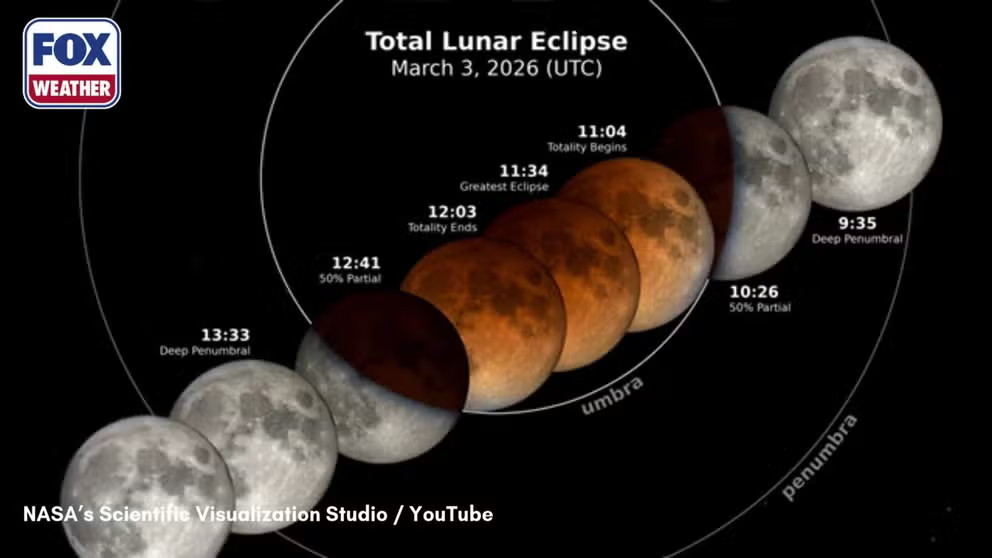
Total lunar eclipse to turn moon red on March 3
BLOOD MOON RISING 🌕: Don’t miss out! A total lunar eclipse will turn the Moon red for nearly an hour on March 3. Check out this video mapping the spectacular event!
The month of March is packed with fascinating celestial events that will be gracing skies worldwide.
From the stunning auroras of the spring equinox and the red glow of the lunar eclipse to a planet conjunction, the night sky is putting on a global show this upcoming month that you won’t want to miss.
THE BEST CELESTIAL EVENTS IN 2026 YOU WON'T WANT TO MISS
A Blood Moon will headline the start of March’s celestial wonders.
Blood Moon — March 3
The Moon will enter a total lunar eclipse phase for nearly an hour on March 3, giving the moon a reddish-orange hue; hence the name "Blood Moon".
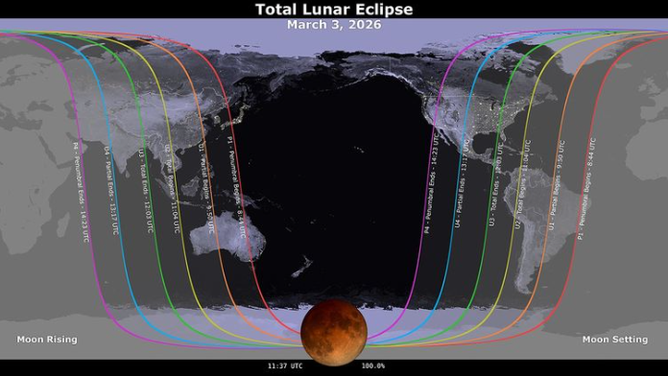
This maps shows where the March 3, 2026 lunar eclipse is visible, with the contours marking the edge of the visibility region at eclipse contact times, labeled in UTC.
(NASA’s Scientific Visualization Studio / NASA)
The total phase of the lunar eclipse will be seen at different local times around the world: in the evening across eastern Asia and Australia, throughout the night in the Pacific, and in the early morning in North and Central America as well as the far western side of South America.
BLOOD MOON TOTAL LUNAR ECLIPSE 2026: WHEN AND WHERE YOU CAN SEE THE ASTRONOMICAL PHENOMENON
This will be the last total lunar eclipse until 2029.
Venus and Saturn conjunction — March 8
Planets, Saturn and Venus will appear remarkably close on March 8.
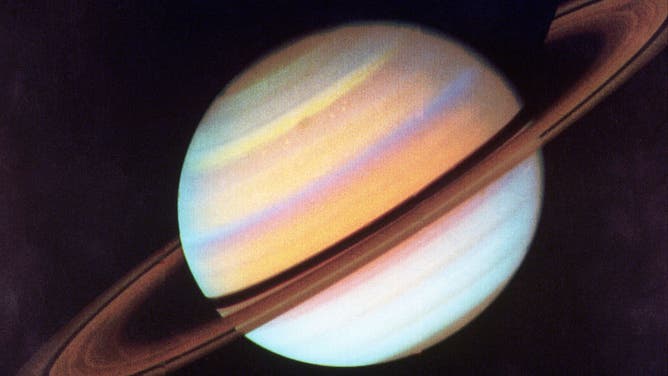
FILE: 10-28-80 Washington: Image of Saturn taken by the Voyager Spacecraft at a distance of 21.1 million miles. Color enhanced by NASA
(Getty Images)
According to the Planetary Society, the planets will appear to be "about the width of a thumb held at arm’s length."
NASA'S JAMES WEBB SPACE TELESCOPE UNCOVERS FORMER STAR THAT EXPLODED INTO A SUPERNOVA
While they will appear closer together in the sky, they’ll still be quite distant in space, and it’s suggested to look towards the Western sky after sunset for viewing.
Spring equinox auroras — March 20
The arrival of the spring equinox on March 20 often triggers a surge in geomagnetic activity, offering skywatchers a prime opportunity to see the dancing array of colors from the aurora borealis.
![Alaska Northern Lights]() Image 1 of 4
Image 1 of 4File: Aurora over Fairbanks, Alaska. (Vincent Ledvina )
![]() Image 2 of 4
Image 2 of 4(Jasim Sarker / Visit Lapland via Storyful)
![FILE: Northern lights (Aurora Borealis) illuminate the sky in Alaska's Eklutna Tailrace, United States on March 09, 2025.]() Image 3 of 4
Image 3 of 4FILE: Northern lights (Aurora Borealis) illuminate the sky in Alaska's Eklutna Tailrace, United States on March 09, 2025. (Hasan Akbas / Anadolu)
![Northern Lights over Washington]() Image 4 of 4
Image 4 of 4Northern lights over Lake Whatcom, Wash. on Feb 14-15, 2023 (Sean Wheeler / Tandem Wheels Photography)
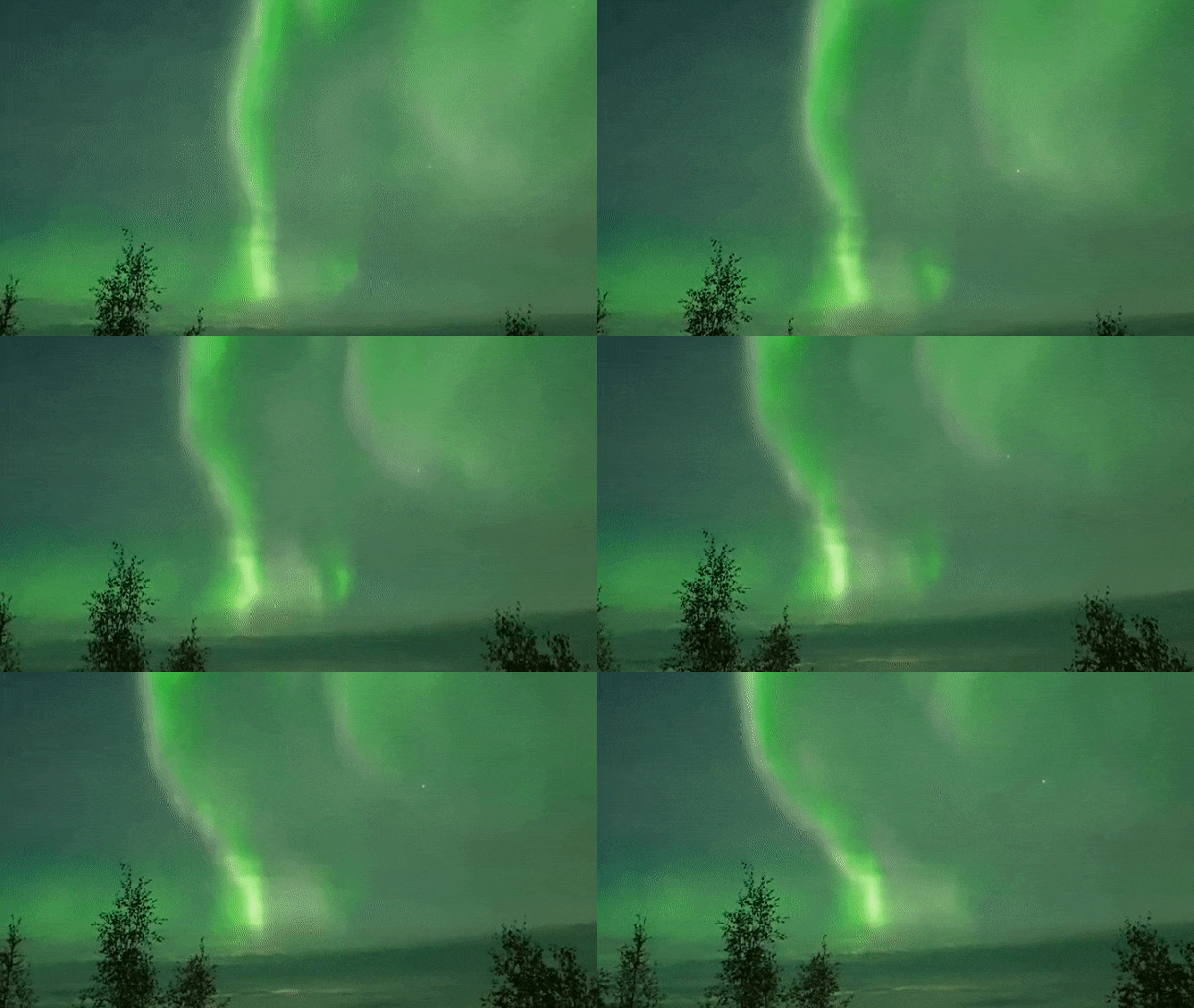
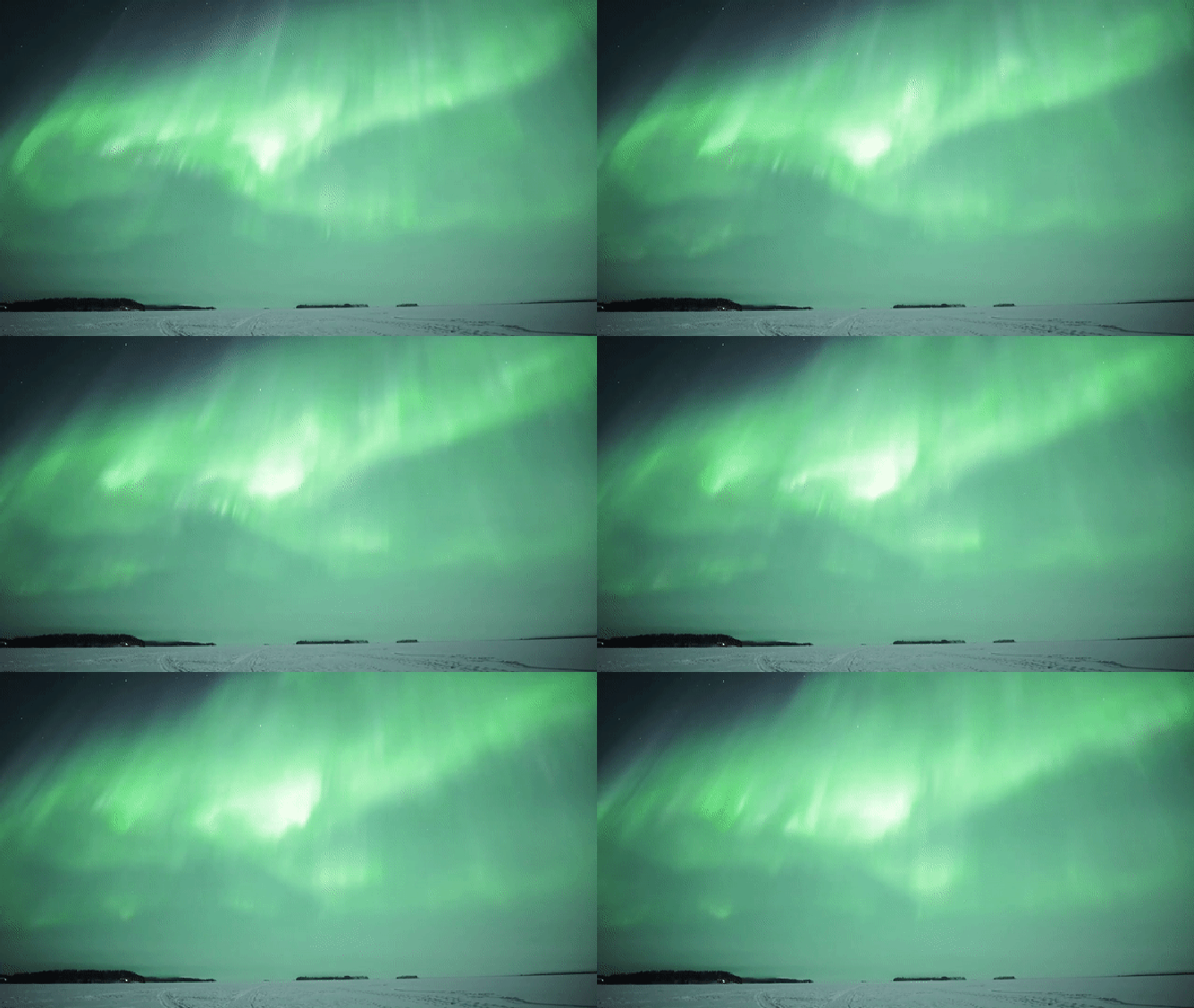


The ideal place for viewing would be Iceland, northern Norway, Sweden, Finland, Alaska or northern Canada.
Moon near Pollux — March 27
On March 27, the Moon will be in a waxing gibbous phase, approximately 64% illuminated and about close to Pollux — a bright orange-hued giant star.
NASA DISCOVERS NEW STARLESS, DARK-MATTER ASTRONOMICAL OBJECT DUBBED 'CLOUD-9' IN SPACE
It can be best viewed from the Northern Hemisphere in the evening hours after sunset and can be seen with the naked eye or a pair of binoculars to highlight the golden-orange glow of Pollux contrasting with the bright white of the Moon.