

Blood Moon total lunar eclipse 2026: When and where you can see the astronomical phenomenon
The total phase of the eclipse will be seen at different local times around the world: in the evening across eastern Asia and Australia, throughout the night in the Pacific, and in the early morning in North and Central America as well as the far western side of South America.
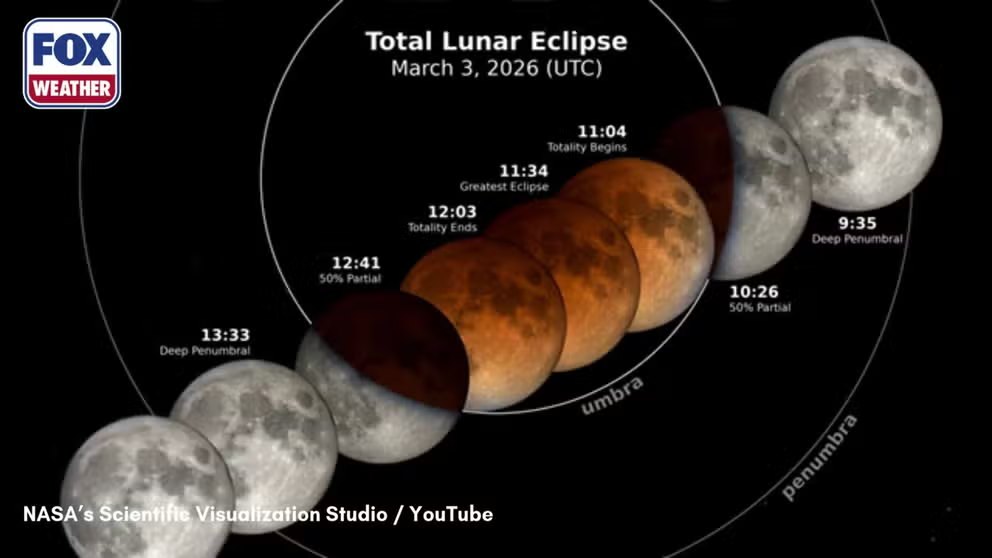
One week until total lunar eclipse turns moon red on March 3
BLOOD MOON RISING 🌕: Don’t miss out! In one week, a total lunar eclipse will turn the Moon red for nearly an hour on March 3. Check out this video mapping the spectacular event!
Skywatchers across much of the world will have the chance to witness a total lunar eclipse in the early morning hours of March 3, when the Moon will glow red for nearly an hour.
According to NASA, the total phase of the eclipse will be seen at different local times around the world: in the evening across eastern Asia and Australia, throughout the night in the Pacific, and in the early morning in North and Central America as well as the far western side of South America.
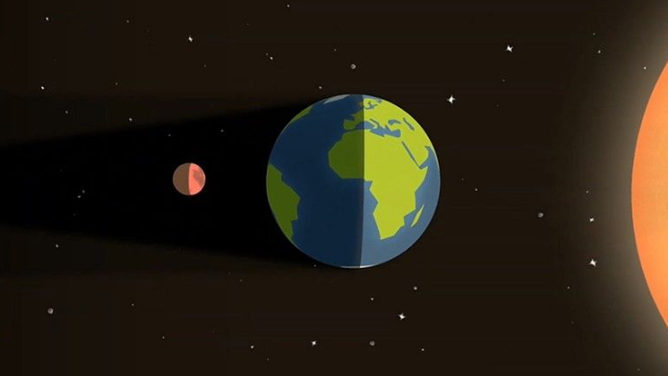
This image depicts the alignment of the Moon, Earth, and Sun during a lunar eclipse (not to scale)
(NASA's Scientific Visualization Studio / NASA)
During a lunar eclipse, Earth moves directly between the Sun and the Moon, causing the Moon to fall into Earth’s shadow and take on a reddish-orange hue; hence the name "Blood Moon".
This type of event can occur only during a full Moon.
How and when can I expect to see the lunar eclipse?
NASA said skywatchers won’t need any special equipment to observe the eclipse, just a straight-line sight of the moon, but "binoculars or a telescope can also enhance your view."
NEW IMAGE FROM NASA'S JAMES WEBB SPACE TELESCOPE GIVES INSIGHT INTO FAR AWAY GALAXY'S BLACK HOLE
The totality of the eclipse will begin at 3:04 a.m. PST (6:04 a.m. EST, 11:04 UTC) and end at 4:03 a.m. PST (7:03 a.m. EST, 12:03 UTC).
And the entire lunar eclipse will conclude at 6:23 a.m. PST (9:23 a.m. EST, 14:23 UTC).
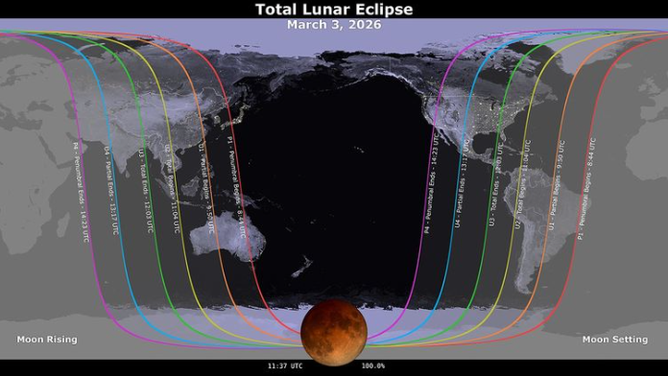
This map shows where the March 3, 2026, lunar eclipse is visible, with the contours marking the edge of the visibility region at eclipse contact times, labeled in UTC.
(NASA’s Scientific Visualization Studio / NASA)
NASA suggests if you're taking photos, "use a camera on a tripod with exposures of at least several seconds."
On the horizon, skywatchers can look forward to another event on March 8 — a conjunction of Venus and Saturn.