

The weather behind D-Day: How meteorologists influenced Operation Overlord
To successfully pull off this momentous invasion into Nazi territory, military strategists would need the expert advice of meteorologists and geologists working behind the scenes to help pinpoint the best conditions available to launch the attack.
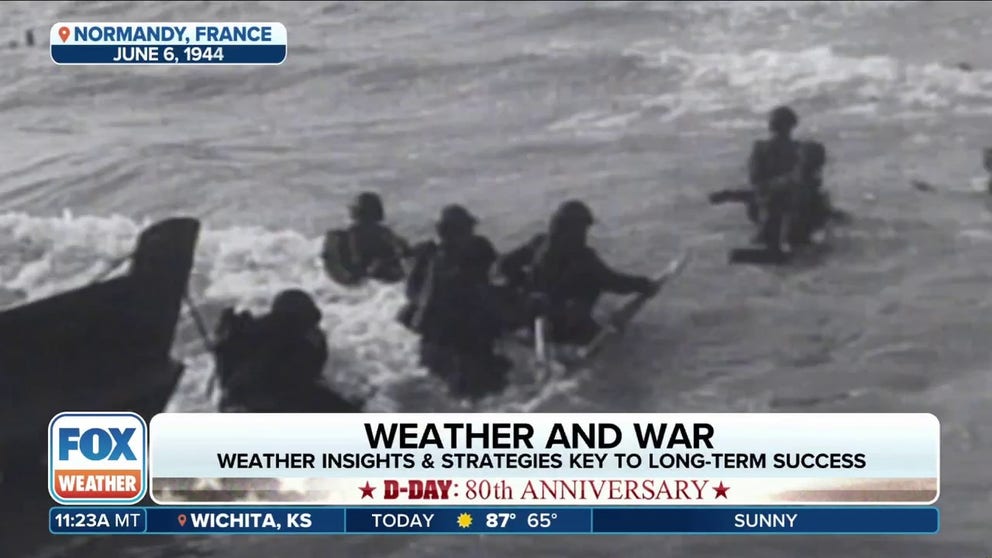
FILE: Weather and war: The pivotal role weather forecasting plays in military operations
Thursday marks the 80th anniversary of the D-Day invasion in France, and the weather forecast played a crucial role in planning and executing the operation. Paul Walsh, the Managing Director of G2 Weather Intelligence, joined FOX Weather to explain why.
NORMANDY, France – The invasion of Normandy, France, stands as a significant moment in world history, especially for Americans, as the largest amphibious attack in military history.
But have you ever wondered how the weather played a role in planning, and how different the outcome of the Normandy invasion would have been if meteorologists hadn't stepped in?
To successfully pull off this momentous invasion into Nazi territory, military strategists would need the expert advice of meteorologists and geologists working behind the scenes to help pinpoint the best conditions available to launch the attack.
15 YEARS AGO: DEADLIEST MODERN US TORNADO DEVASTATES JOPLIN, MISSOURI
Many people do not realize that the original invasion date was set for June 5, 1944, but was postponed after British meteorologists corrected the Americans’ mistake.
For a successful attack by way of the water, weather conditions must be accurately observed and predicted, as it could seriously risk the lives of more than 160,000 men who were already walking into a disaster.
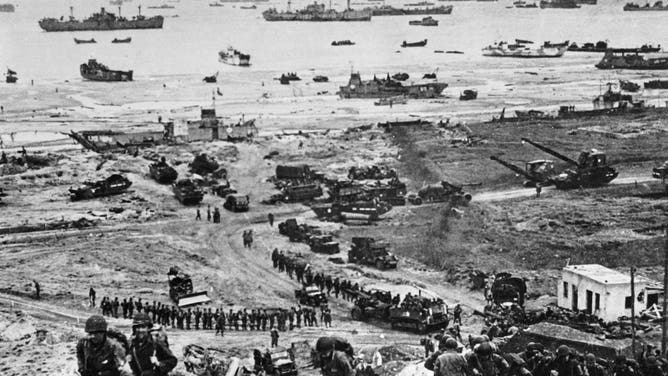
Picture taken on June 6, 1944, in Normandy showing the Allied forces soldiers involved in the landing operation aimed at fighting the German Wehrmacht as part of the Second World War.
(US National Archives/AFP / Getty Images)
In 1944, meteorology and forecasting were in their infancy, without the use of satellites, computer models or weather radar.
The U.S. Army Air Corps, the Royal Navy and the British Meteorological Office were tasked with predicting weather conditions for the operation.
SMARTER GRIDS, SHORTER OUTAGES: INSIDE NEW ENGLAND'S POWER RESTORATION TECHNOLOGY
President and Supreme General Dwight D. Eisenhower and military planners carefully chose June 5 because it was one of just three days during the month when the moon would be bright enough for paratroopers and pilots to work effectively, according to NASA.
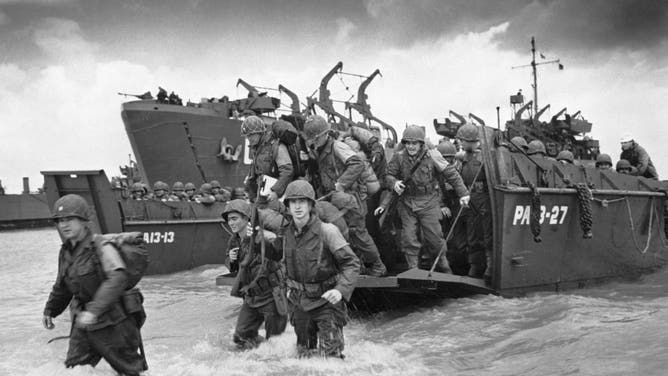
American soldiers disembark from Coast Guard landing craft at the shores of Normandy. Their arrival comes after the main allied invasion and the subsequent Nazi retreat. Their job is to reinforce and relieve the troops that secured the beachhead and then push northward to Cherbourg.
(Getty Images)
This would also result in low tides, which would be perfect for the first landing parties to see and clear mines, barbed wire and other defenses on the beaches for the invasion.
In fact, five months earlier, Allied forces sent divers on reconnaissance teams to secretly collect sand samples from the beach to determine whether it was strong enough to support tanks and other heavy equipment.
FROM SECRET SCIENCE TO PUBLIC HISTORY: MANHATTAN PROJECT PARK MARKS 10 YEARS
Given the codename Operation Overlord, this amphibious assault consisted of five naval assault divisions, with the invasion including 7,000 ships and landing craft manned by over 195,000 naval personnel from eight different allied countries, according to the Eisenhower Presidential Library.
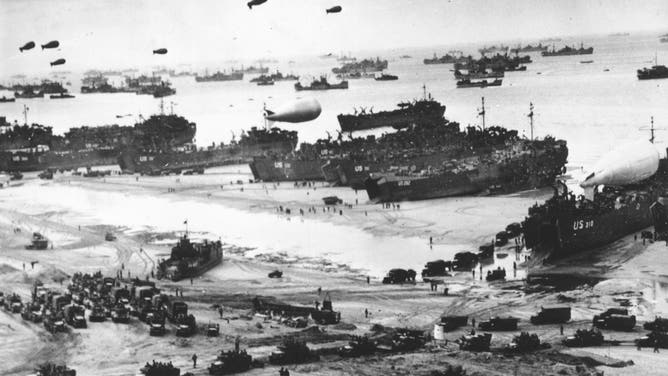
14th July 1944: Fleets of US transport and landing craft disgorge reinforcements and supplies for the US troops who liberated the Contentin peninsula, the deep-water port of Cherbourg and the communication centre of La Haye du Puits. Barrage balloons float overhead as protection against German strafing aeroplanes, which did not appear.
(Keystone/Hulton Archive / Getty Images)
As the operation approached, American meteorologists predicted fair weather on June 5. They urged the invasion on that date, using forecasting methods based on historical weather conditions for a given date and location.
British experts took a different approach than the Yankees, focusing on analyzing measurements of temperature, pressure and humidity to map out the weather fronts.
SEE IT: RARE GREEK COIN FROM 3RD CENTURY BC DISCOVERED BY 13-YEAR-OLD IN BERLIN
According to NASA, British meteorologists predicted low clouds and stormy weather on June 5, which would certainly pose a threat to the Allied invasion in dangerous waters.
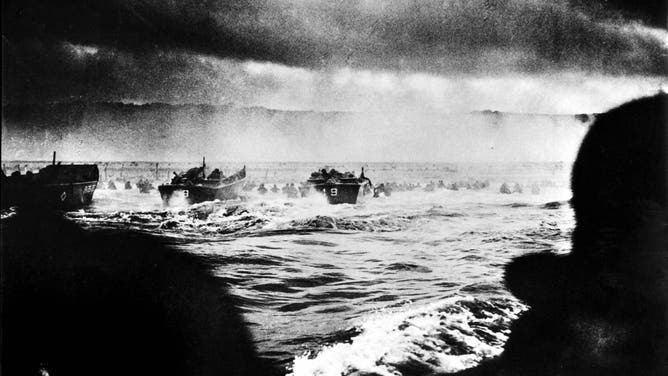
The Normandy landings: June 6, 1944: the English troops arriving on the French coast.
(Photo 12/Universal Images Group / Getty Images)
German forecasters also predicted rough seas and gale-force winds and anticipated them to persist until mid-June, and because of this, Nazi commanders thought an invasion was impossible.
EVERYDAY INNOVATIONS BORN FROM SPACE TRAVEL
In fact, many troops left the coastal defenses, including Nazi Field Marshal Erwin Rommel, who famously returned home to Germany to present his wife with a birthday gift personally.
Thankfully, at the last minute, Captain and Chief Meteorologist James Martin Stagg convinced General Eisenhower to postpone the invasion until the next day.
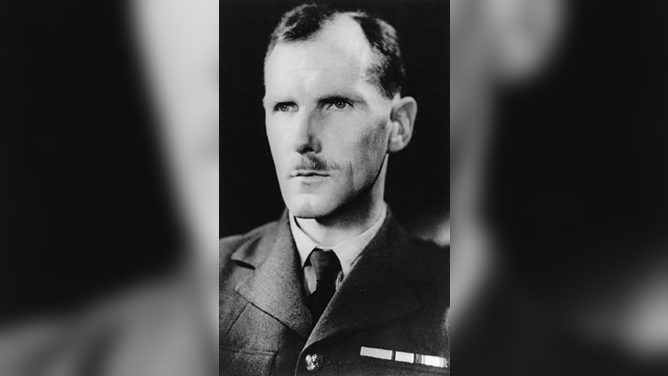
Photo of James Martin Stagg.
(National Records of Scotland)
Scientists and meteorologists pondered the little clues suggesting there would be a break in storms at some point on June 6, with experts predicting the weather would be just good enough for the invasion to go through.
Stagg and his team met twice a day, at 4 a.m. and 9:30 p.m., to choose the final invasion date with the best forecast leading up to the final days.
FROM SECRET SCIENCE TO PUBLIC HISTORY: MANHATTAN PROJECT PARK MARKS 10 YEARS
On the morning of June 5, amidst the final meeting for the operation, Stagg repeated his forecast to all, stating the break in weather should hold.
At the end of the day, only one man could make the final decision.
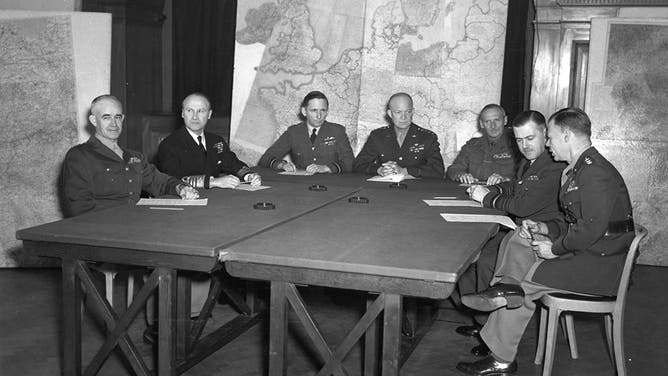
66-309-1 Allied invasion chiefs at a press conference in Allied Command Headquarters, London, England, are, left to right: Lt. Gen. Omar Bradley, Commanding U.S. Army Ground Forces; Admiral Sir B. Ramsay, Allied Naval Operations; Air Chief Marshal Sir Arthur Tedder, Deputy Supreme Commander; General Dwight D. Eisenhower, Spreme commander; General Sir B. Montgomery, Commander in Chief, British Armies; Air Chief Marshal Sir T. Leigh-Mallory; and Lt. Gen. W. Bedell-Smith, Chief of Staff. London, England, 12 February 1944.
After pacing back and forth on the war room’s blue rug, pondering the most important decision of his life, Eisenhower eventually looked at his commanders and said: "Ok, let’ er rip."
After much debate, research and a large operation hanging in the balance, General Eisenhower finally gave the order to proceed with the invasion.
ANCIENT DISCOVERY: LOST PAGES OF THE NEW TESTAMENT REVEAL LETTERS OF THE APOSTLE ST. PAUL
On the day of the landings, the weather was still not ideal, with rough seas, high winds that made it difficult for boats and tanks to operate and cloud cover, resulting in paratroopers landing in the wrong locations.
Despite this, Stagg's prediction was correct, and by noon the weather had cleared.
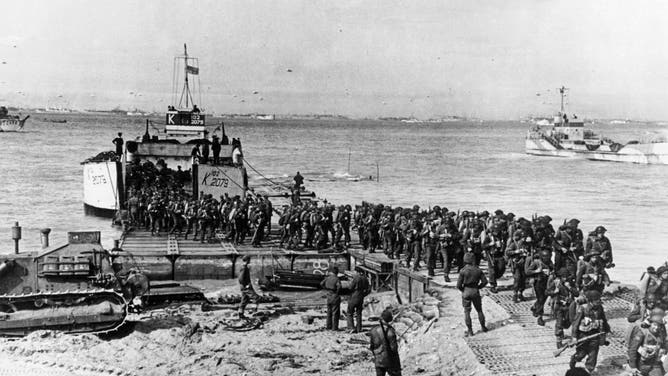
The Normandy landings were the landing operations on Tuesday, 6 June 1944 of the Allied invasion of Normandy in Operation Overlord during World War II. Codenamed Operation Neptune and often referred to as D-Day, it was the largest seaborne invasion in history. The operation began the liberation of German-occupied northwestern Europe from Nazi control, and laid the foundations of the Allied victory on the Western Front. 6th June 1944.
(Daily Mirror/Mirrorpix / Getty Images)
Allied forces landed on seven different beaches, with the British and Canadians landing on four others, each entailing a bloody battle.
The combined efforts through land, air and sea proved to be difficult, but successful against the German defenses, who at one point were confused as to why paratroopers were landing in scattered areas within the Nazi ranks.
NASA'S ARTEMIS PROGRAM: PAVING THE WAY FOR HUMANKIND'S RETURN TO THE MOON AND BEYOND
In fact, the Allies added to the confusion by parachuting dummies wired with firecrackers to the rear of German positions to draw major enemy units away from landing zones, according to the U.S. Army.
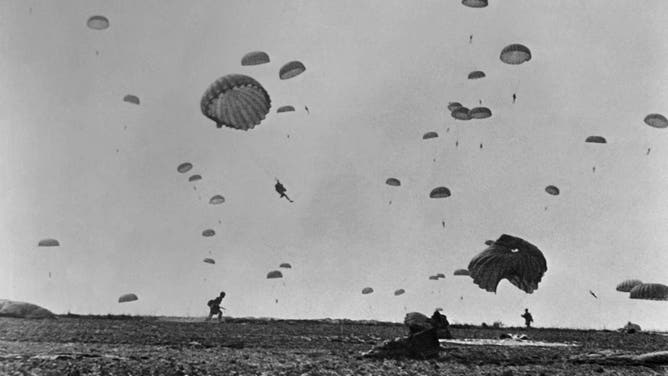
Paratroopers of the Allied land on La Manche coast, on June 6, 1944, after Allied forces stormed the Normandy beaches during D-Day.
(US National Archives/AFP / Getty Images)
According to NASA, long after the war, when President John F. Kennedy was serving the nation, he asked Eisenhower how the invasion had succeeded, to which he responded: "Because we had better meteorologists than the Germans!"
If it weren’t for this successful invasion, it would likely have taken another year to liberate Western Europe.
![American fighting men, pressing closely on the heels of retreating Germans in the Battle of Normandy, take cover in a ditch at St. Sauveur-le-Vicomte as they return the enemy fire with rifles and machine guns. | Location: St. Sauveur-le-Vicomte, France.]() Image 1 of 7
Image 1 of 7American fighting men, pressing closely on the heels of retreating Germans in the Battle of Normandy, take cover in a ditch at St. Sauveur-le-Vicomte as they return the enemy fire with rifles and machine guns. | Location: St. Sauveur-le-Vicomte, France. (© CORBIS/Corbis)
![FRANCE - JUNE 01: World War II. Normandy landings. American troops stopping near Saint-Lô, July 1944.]() Image 2 of 7
Image 2 of 7FRANCE - JUNE 01: World War II. Normandy landings. American troops stopping near Saint-Lô, July 1944. (Boyer/Roger Viollet)
![A U.S. patrol hiding behind bushes during clashes in the countryside of Normandy. Normandy, June 1944.]() Image 3 of 7
Image 3 of 7A U.S. patrol hiding behind bushes during clashes in the countryside of Normandy. Normandy, June 1944. (Photo by Mondadori via Getty Images) (Mondadori)
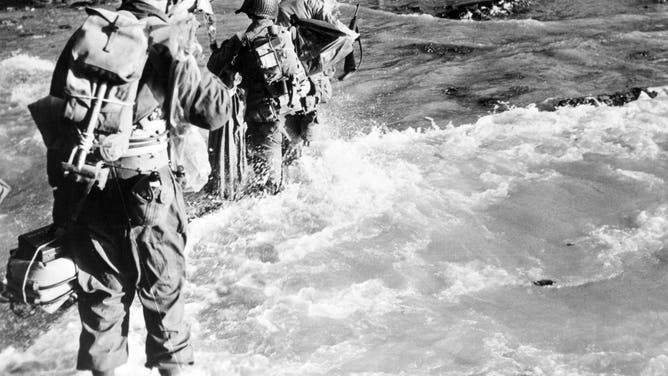
![View of a line American soldiers as they wade ashore from their landing craft, Normandy, France, June 14, 1944.]() Image 4 of 7
Image 4 of 7View of a line American soldiers as they wade ashore from their landing craft, Normandy, France, June 14, 1944. (US Army/Interim Archives)
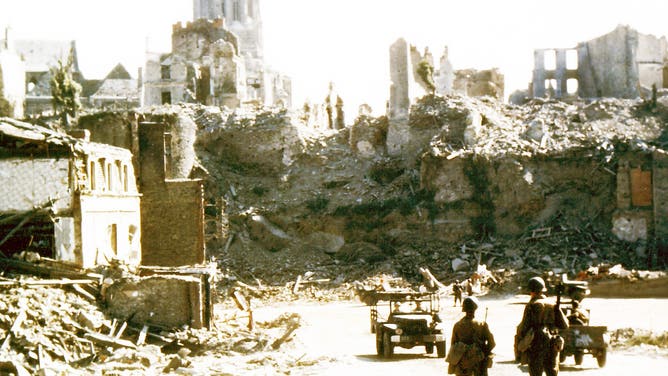
![Operation Overlord Normandy, Two American soldiers are watching two United States Army jeeps driving through the ruins of the center of Saint-Lo. August 1944. The town was almost totally destroyed by 2,000 Allied bombers when they attacked German troops stationed there during Operation Overlord in June. France.]() Image 5 of 7
Image 5 of 7Operation Overlord Normandy, Two American soldiers are watching two United States Army jeeps driving through the ruins of the center of Saint-Lo. August 1944. The town was almost totally destroyed by 2,000 Allied bombers when they attacked German troops stationed there during Operation Overlord in June. France. (Galerie Bilderwelt)
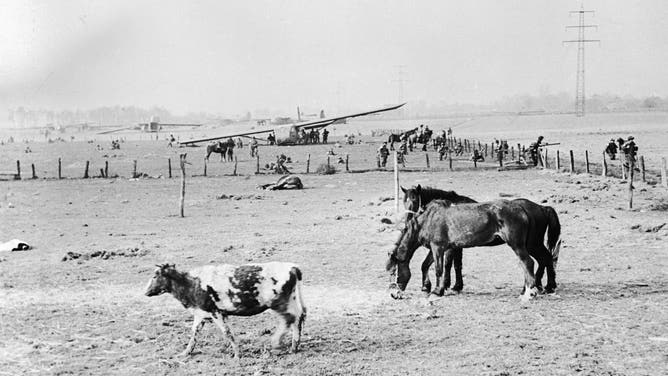
![The glider landing area, where the Allied Airborne Army are landing across the Rhine at Wesel near the Dutch border, 24th March 1945.]() Image 6 of 7
Image 6 of 7The glider landing area, where the Allied Airborne Army are landing across the Rhine at Wesel near the Dutch border, 24th March 1945. (Robert Capa/Keystone)
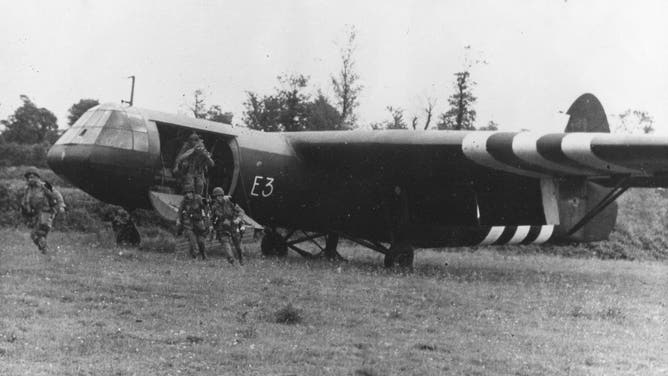
![American airborne infantry leap from a glider as they land in a field on a Franch farm to reinforce forward positions in Normandy, during the Allied landings which began June 6, 1944.]() Image 7 of 7
Image 7 of 7American airborne infantry leap from a glider as they land in a field on a Franch farm to reinforce forward positions in Normandy, during the Allied landings which began June 6, 1944. (PhotoQuest)
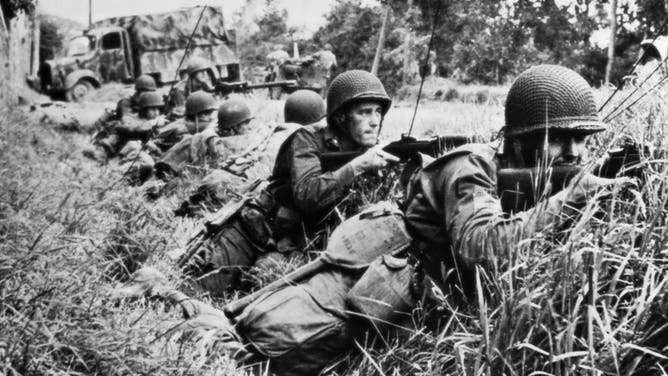
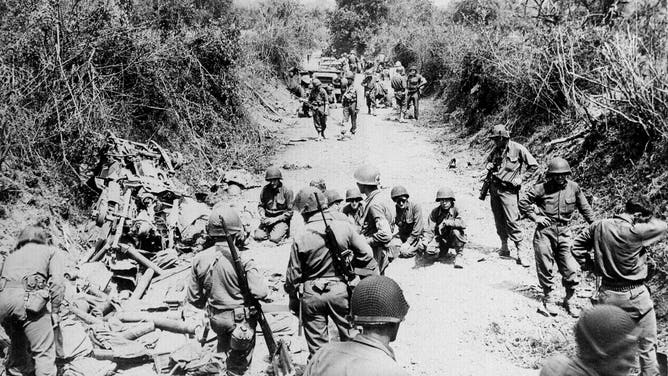
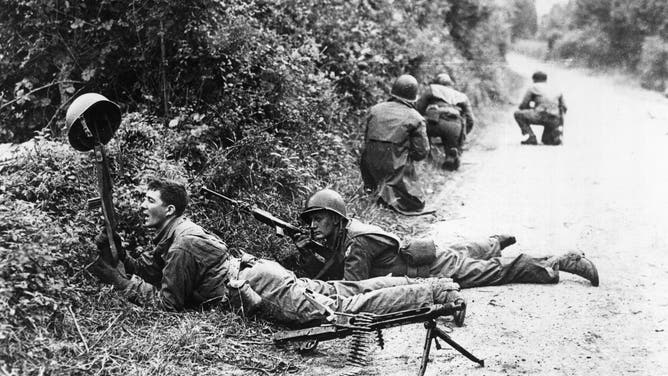
More than 9,000 allied soldiers were killed or wounded in Normandy, with the majority of them American.
SUNKEN WWI SHIP 'TAMPA' FOUND OFF ENGLISH COAST, SOLVING CENTURY-OLD MYSTERY
Thanks to the brave men fighting on the front lines and the meteorologists working behind the scenes, the Allies gained a strong foothold in Europe and ultimately conquered the continent.