

Extinction: What were conditions like on Earth when the dinosaur-killing asteroid crashed into the planet?
Despite this cataclysmic asteroid that wiped out so much life, some "dinosaurs" live on in the forms of modern-day relatives such as birds.
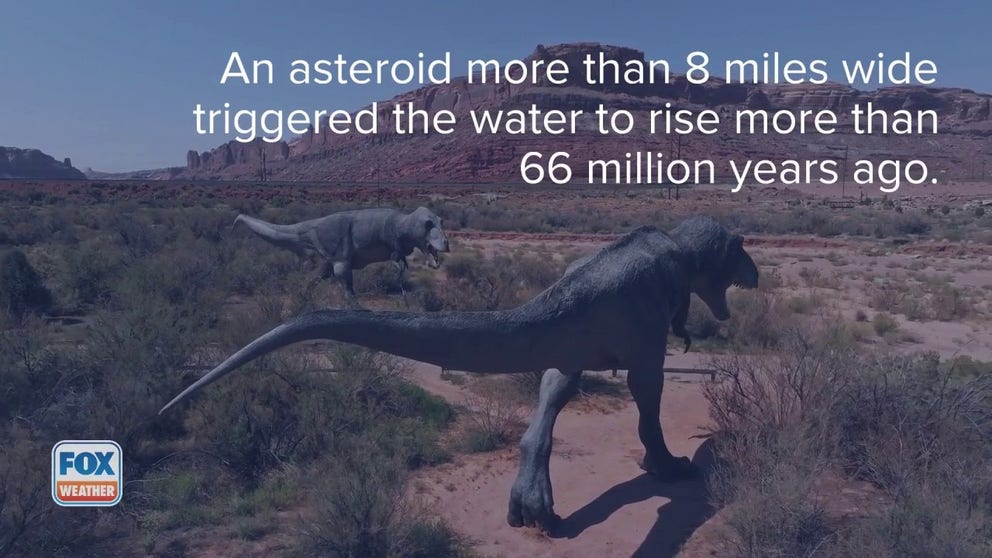
FILE: Dinosaur-killing asteroid triggered a tsunami with mile-high waves
An asteroid that struck Earth 66 million years triggered a megatsunami that wiped many of the dinosaurs
Millions of years ago, dinosaurs ruled the Earth in a very different environment than we see today, with some creatures demonstrating indomitable power, while others thrived in different ways.
As these amazing creatures thrived for millions of years, their time came to an abrupt end when a large asteroid wiped out many dinosaurs.
SEE IT: MASSIVE MEGALODON TOOTH FOUND BY DIVER OFF FLORIDA COAST
Despite this cataclysmic asteroid that wiped out so much life, some "dinosaurs" live on in the form of modern-day relatives such as birds.
As we look at the modern-day relatives of these once powerful creatures, it makes you wonder what it would be like to experience the apocalyptic dinosaur-killing asteroid that wiped out millions.
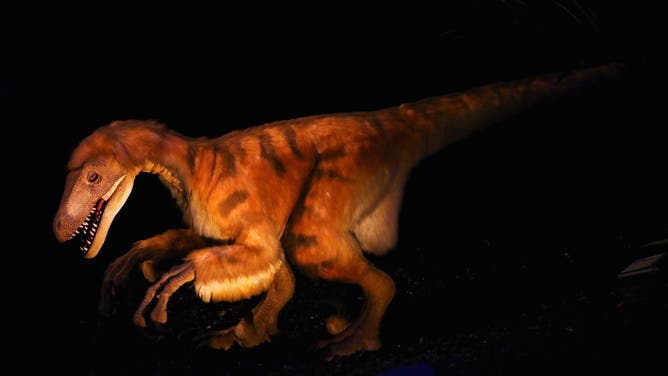
LEIDEN, NETHERLANDS - OCTOBER 17: A display of the Deinonychus antirrhopus, a genus of carnivorous dromaeosaurid coelurosaurian dinosaurs and the Tenontosaurus, a genus of ornithopod dinosaur. The genus is known from the late Aptian to Albian ages of the middle Cretaceous period and contains two species, Tenontosaurus tilletti and Tenontosaurus dossi are pictured before Trix, the female the T-Rex exhibition at the Naturalis or Natural History Museum of Leiden on October 17, 2016 in Leiden, Netherlands. The skeleton of Tyrannosaurus rex was excavated in 2013 in Montana, USA, by Naturalis Biodiversity Center. The fossil is part of the Naturalis collection and is more than 80% of the bone volume present. All essential and highvolume bones are in place. This places Trix in the top 3 ranking of the most complete Tyrannosaurus rex skeletons in the world. In addition, all the bones are extremely well preserved. The quality of this fossil is unmatched by any other large T-Rex find in the world.
(Dean Mouhtaropoulos / Getty Images)
Approximately 66 million years ago, an asteroid measuring six miles wide crashed into Earth at a speed 58 times faster than the speed of sound and landed in the area of what is now the Caribbean.
The impact produced as much explosive energy as 100 teratons of TNT, 4.5 billion times the explosion power of the Hiroshima atomic bomb, according to the U.S. National Science Foundation.
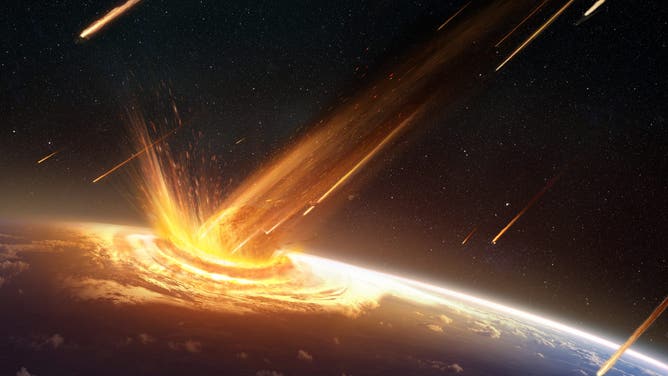
Illustration of an asteroid or comet striking the surface of the Earth, created on July 19, 2015.
(Tobias Roetsch/Future Publishing / Getty Images)
Professor of Vertebrate Paleontology, Michael J. Benton, and Professor of Planetary and Space Sciences, Monica Grady, break down what the agonizing experience would have been like on the day of the asteroid impact, and how things progressed afterward.
'ALMOST COMPLETE' DINOSAUR FOSSIL REVEALED AFTER HISTORIC FLOODING RAINS IN BRAZIL
Leading up to a week before the event, the asteroid would only be visible at night as it steadily hurled towards the planet.
In the last 24 hours before impact, the asteroid was visible during the daytime, but still appeared like a star or planet, growing brighter as landfall approached.
Day one of impact
Leading up to the impact, it was just a typical day of chaos for these early creatures, with experts noting it was a pleasantly warm, wet day, with temperatures around 78 degrees.
If you were unlucky enough to be close to the impact zone, you would have experienced a brief light and sound show, entailing crackling or fizzing noises.
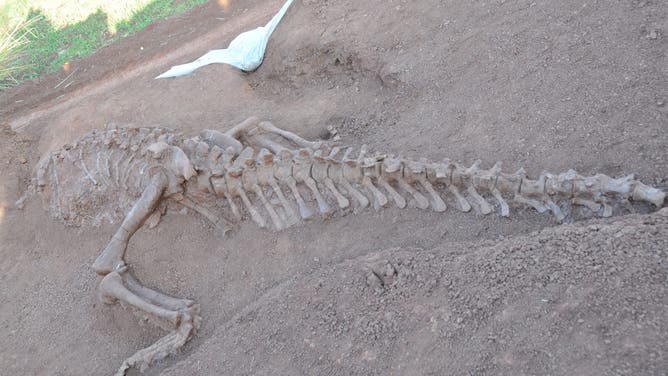
KUNMING, Dec. 8, 2015-- Newly-discoverd Lufengosaurus fossil is seen in Lufeng County, southwest China's Yunnan Province, Dec. 7, 2015. Two dinosaur fossils were unearthed in Lufeng County a month ago and they were identified to be fossils of Lufengosaurus magnus and Lufengosaurus huenei, which lived about 180 million years ago. Lufengosaurus is a long-necked, plant-eating dinosaur known for its gigantic size, with adults reaching 30 feet (9 meters)long. (Xinhua/Yao Bing via Getty Images)
(Xinhua/Yao Bing / Getty Images)
Due to the intense light and heat of the fireball, the ground and the air above it warm, generating pressure waves and sound.
What comes next is a sonic boom, the result of the asteroid moving faster than the speed of sound, vaporizing everything nearby, including the asteroid itself, about 10 seconds after impact.
The asteroid’s humongous energy formed a crater in only a matter of seconds and increased in size to much larger than the space rock itself.
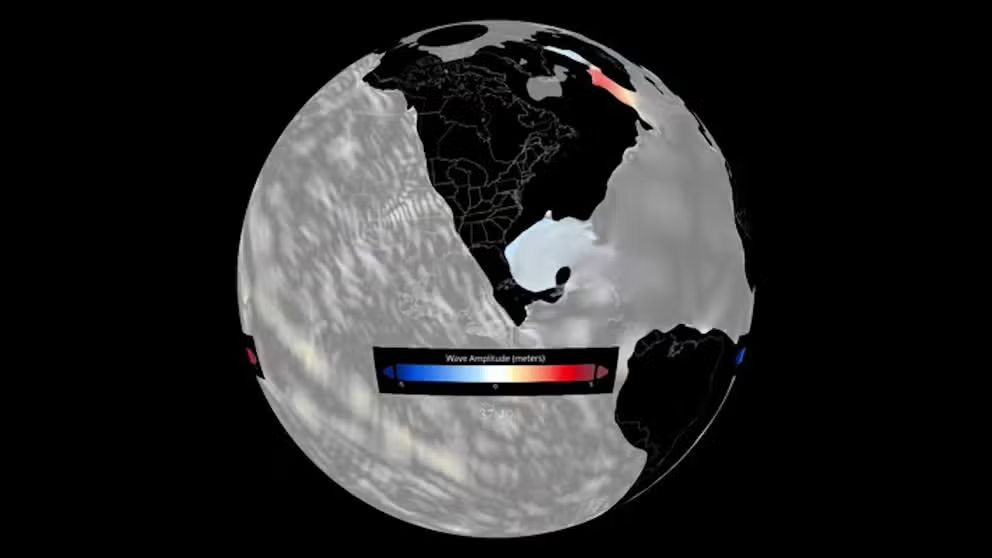
NOAA simulates tsunami from dinosaur-killing asteroid
A 6-mile-wide asteroid struck the Earth some 66 million years ago and generated a tsunami that created waves 2.5 miles high as it crashed ashore. NOAA has now created a simulation of the event. (NOAA Video)
Simulations by experts suggest the crater’s cavity was at least 30km (98,425 ft) deep, with the crater rim measuring twice the height of Mount Everest.
The crater was at least 115 miles wide, according to National Geographic.
This gigantic feature lasts for less than a minute before collapsing, then repeats the process two minutes later.
SEE IT: RARE GREEK COIN FROM 3RD CENTURY BC DISCOVERED BY 13-YEAR-OLD IN BERLIN
Five minutes following the impact, winds would have eased down to Category 5 hurricane strength, flattening everything that hasn’t already been burnt within 1,500 km of ground zero.
"This would feel like being inside an oven – causing burns, heatstroke and death," a statement from the study by both professors from theconversation.com said. "Wood and plant matter ignite, creating fires everywhere."
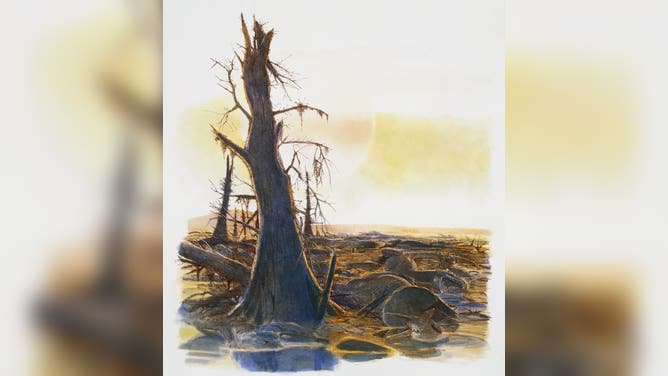
UNSPECIFIED - FEBRUARY 23: Scene of destruction with dead dinosaurs after a meteorite crash. Artwork by James Robins.
(Artwork by James Robins and photo by DeAgostini / Getty Images)
Since the asteroid landed in the sea, it triggered megatsunami waves that crashed into what is now the Gulf of America, slamming into any surviving animals and ensuring their demise.
If you were located around 2,000 to 3,000km (1,800 miles) away, you would have most likely died from the aftermath of the event, including overheating, earthquakes, hurricanes, fires and tsunami-driven floods.
REMARKABLE FOSSIL SHOWS DINOSAUR, MAMMAL FOREVER FROZEN IN EPIC BATTLE
Interestingly, dinosaurs in what is now China and New Zealand had very different fates.
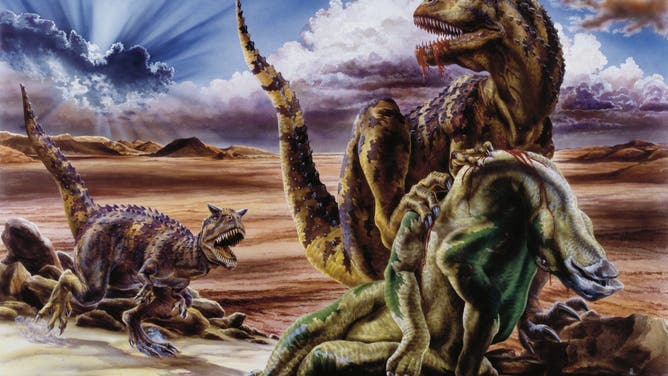
UNSPECIFIED - AUGUST 14: Illustration representing Carnotaurus fighting
( De Agostini / Getty Images)
An hour after impact, dust and soot engulf the entire planet as the sky darkens, unaware of the horrors on the other side of the globe.
Temperatures start to drop as dust blocks the sun. Trees and plants shut down as if winter is here, unable to sustain life, along with any animals that rely on warm conditions, and ultimately hunker down and die.
One week after impact
At this point, the sky has grown darker and darker to the point of no return, dropping temperatures to at least 41 degrees.
Most dinosaurs, including large flying and swimming reptiles, likely died within a week, with some smaller ones surviving longer.
FATHER-DAUGHTER 202 MILLION-YEAR-OLD FOSSIL FIND COULD BE LARGEST PREHISTORIC MARINE REPTILE
The continuous cooling temperatures and cloud cover resulted in wet weather, but not just any bad conditions; storms of acid rain fell across the planet.
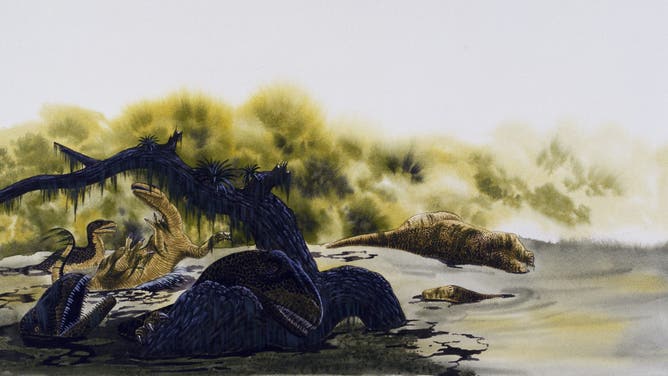
UNSPECIFIED - FEBRUARY 17: Specimens of Allosaurus dying (Photo by DeAgostini/Getty Images)
(DeAgostini / Getty Images)
"The dropping temperature ultimately allows water vapor to condense into drops, and the sulfur and nitrogen oxides dissolve to form sulfuric and nitric acids," a statement from the study reads. "This is sufficient to generate a rapid drop in pH. Early models suggest that the pH of the rain might be as low as 1 – the same acidity as battery acid."
At this point, the planet is a rotting wasteland, as the acid rain kills any remaining plant life and shallow marine wildlife that are unable to burrow or live underwater.
FOSSILIZED FECES, VOMIT REVEAL HOW DINOSAURS DOMINATED EARTH
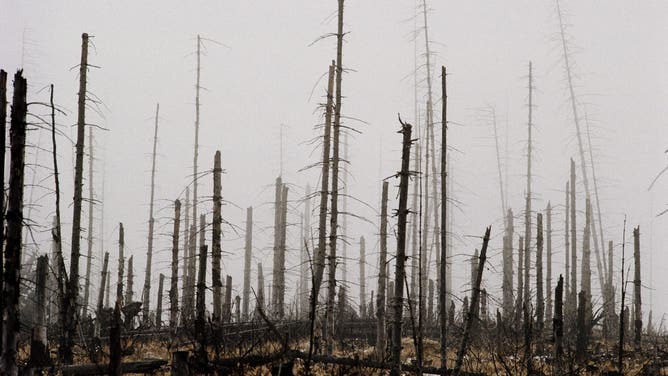
Poland, Karkonosze mountains, dead forest from Acid rain pollution.
(Christopher Pillitz / Getty Images)
One year after impact
After a year of chaos, the wildfires have been extinguished, and the oceans have calmed. However, the atmosphere is still full of dust, keeping the world in darkness, with temperatures as low as 60 (15 degrees Celsius) degrees below average compared to before the impact.
Any dinosaurs or reptiles that survived the initial impact would have died very soon after, experts said. Only the rotted skeletons of these once powerful creatures remain.
SEE IT: COMPLETE FOSSIL OF MASTODON JAW DISCOVERED IN BACKYARD OF NEW YORK HOME
The animals with the best chances of survival consist of mammals the size of rats or insects that would nestle in crevices for relief, and were barely able to survive on remaining scraps, as over 50% of the plants on the planet died out due to the cold and lack of sunlight.
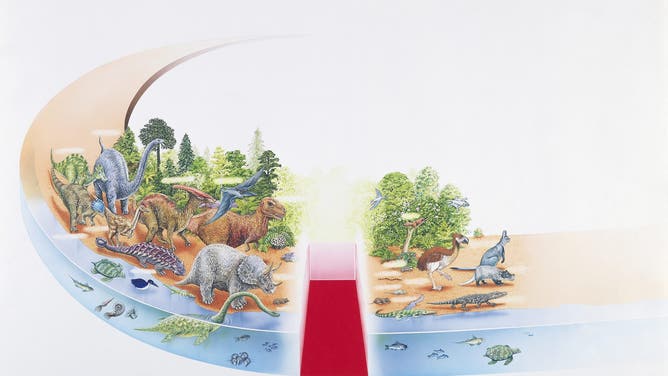
UNSPECIFIED - CIRCA 2003: The end of dinosaurs and animal species evolving on the Earth after their disappearance, illustration.
(DeAgostini / Getty Images)
Ten years after impact
After a decade of darkness and nonstop ferocious winter conditions, dust and soot particles remain in the atmosphere, leaving the average surface temperature about 41 degrees (5 degrees Celsius) below average.
Experts say the only species that could have survived this long are those that can burrow or live underwater.
WATCH: MASSIVE 60-TON ANIMATRONIC DINOSAUR CATCHES FIRE AT KANSAS PARK FOLLOWING LIGHTNING STRIKE
Surviving plants and animal groups that still roam amongst us today include turtles, smaller crocodiles, lizards, snakes, ground-dwelling birds and small animals that would go on to repopulate the planet.
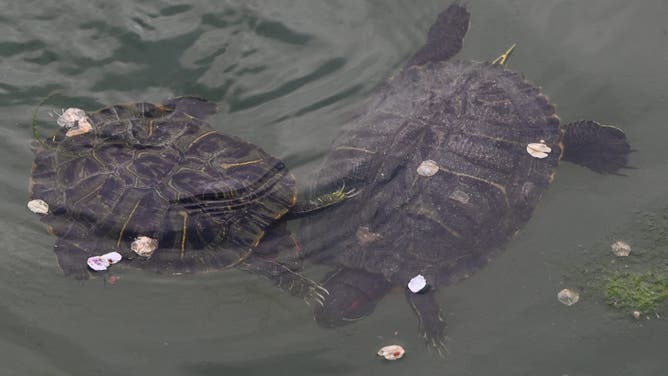
IWAKUNI, JAPAN - APRIL 12: A pair of Red-eared slider turtles interact in a pond at Kikko Park, engaging in a seasonal courtship display among floating cherry blossom petals in Iwakuni, Yamaguchi Prefecture, Japan, on April 12, 2026.
(Artur Widak/NurPhoto / Getty Images)
These animals reside in relatively safe areas where there is just enough light to support plant life.
Slowly but surely, life makes an astonishing comeback and begins to rebuild.
Eventually, a variety of species returned to devastated landscapes, forming completely new ecosystems, but without the large threat of the monstrous dinosaurs that once ruled the world.
FOSSIL OF ‘NIGHTMARISH’ SEA REPTILE FOUND IN MOROCCO
Over millions of years, enough species survived this cataclysmic event, either by luck of location when the asteroid made impact or by their ability to adapt to the vast changes of the new world.
Over time, as the world returned to normal, animals had the opportunity to expand on the old adaptive habits that predators often prevented them from developing.
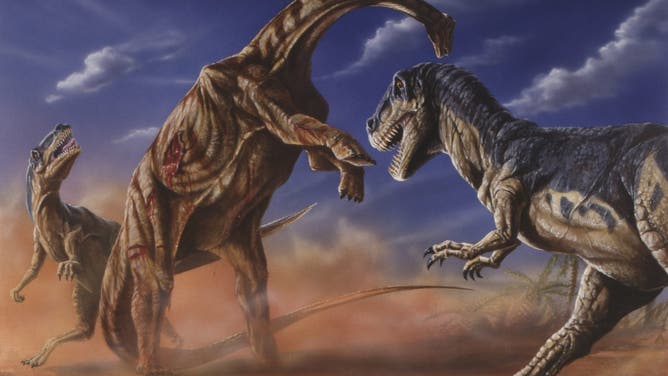
UNSPECIFIED - AUGUST 14: Illustration of Piatnitzkysaurus floresi
(De Agostini / Getty Images)
Despite this enormous event, it helped shape the beautiful planet we now inhabit, perfect for humans.
WHERE DINOSAUR BONES ARE REVEALED BY THE WEATHER
Professors Benton and Grady both suggest that, if it were not for this destructive asteroid, primates might never have reached the level we are at today.