

From secret science to public history: Manhattan Project Park marks 10 years
The Manhattan Project National Historical Park was created to preserve and help interpret the nationally significant historical sites, stories and legacies associated with the top-secret operation that helped America come out victorious in World War II.
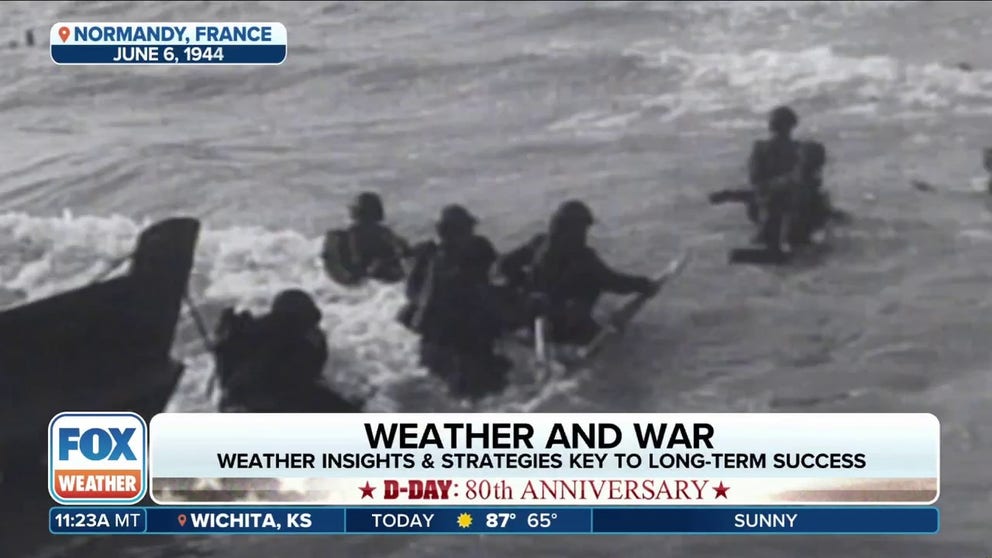
FILE: Weather and war: The pivotal role weather forecasting plays in military operations
Thursday marks the 80th anniversary of the D-Day invasion in France, and the weather forecast played a crucial role in planning and executing the operation. Paul Walsh, the Managing Director of G2 Weather Intelligence, joined FOX Weather to explain why.
OAK RIDGE, Tenn. – Officials are preparing to celebrate the 10th anniversary of the creation of the Manhattan Project National Historical Park in Tennessee, with special events for people of all ages.
The Manhattan Project revolutionized the world as we know it, with the creation of the atomic bomb, ushering in the nuclear age.
The Manhattan Project National Historical Park was created to preserve and help interpret the nationally significant historical sites, stories and legacies associated with the top-secret operation that helped America come out victorious in World War II.
THESE RARE TITANIC ARTIFACTS SOLD FOR OVER $1 MILLION AT AUCTION
To celebrate the creation of the park, special events will be held at Oak Ridge, Tennessee, with free admission to the museums throughout the day.
Event schedule
Park staff and volunteers will be at local museums from 10 a.m. to 4 p.m. to help with events such as:
- 6 a.m. – New Hope Center at Y-12 National Security Complex opens until 4:30 p.m.
- 9 a.m. — American Museum of Science and Energy & K-25 Atomic History Center open with free admission until 5 p.m.
- 10 a.m. — Children’s Museum of Oak Ridge & Oak Ridge History Museum open with free admission until 4 p.m. The Flat Top House will be open free of charge.
- 4 p.m. –Reception with remarks from NPS and City of Oak Ridge at Oak Ridge Conference Center.
- 5 p.m. – Free showing of Oppenheimer at Cinemark. Registration with the American Museum of Science and Energy is required.
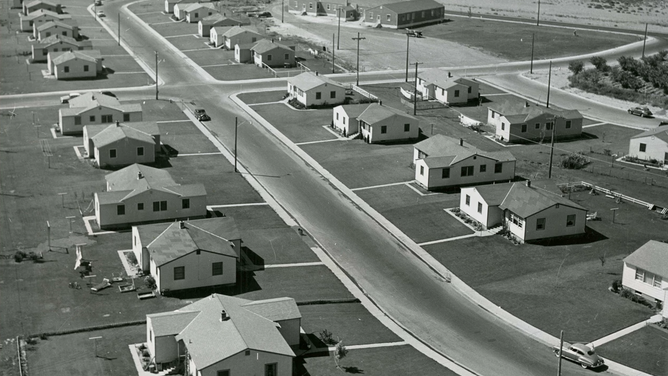
Communities for workers at Richland, Washington, amid the operations of the Manhattan Project.
(US DEPARTMENT OF ENERGY)
The most fascinating aspect of the project was the secret cities associated with it, located in Los Alamos, New Mexico; Oak Ridge, Tennessee; and Richland, Washington.
According to the National Park Service (NPS), these communities comprised a mix of military personnel and civilian employees, all from different backgrounds.
TAMPA BAY RAYS BACK AT TROPICANA FIELD FOR THE FIRST TIME IN OVER 500 DAYS SINCE HURRICANE MILTON
Thousands of people lived in these communities, all in a collective effort in the race against Nazi Germany to successfully create the world’s first atomic weapon.
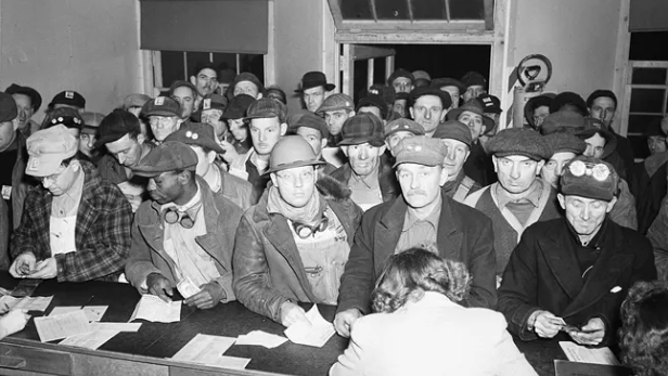
Workers form long lines on pay day at Hanford.
(US DEPARTMENT OF ENERGY)
"By 1945, Richland’s population climbed from 250 to 15,000; Oak Ridge’s soared to about 75,000; and Los Alamos grew to 6,000 people," a statement from the NPS said. "With limited connections to the outside world, residents of the secret cities built new communities and bonded over their collective sacrifices and shared patriotism."
The Manhattan Project remained a secret, even though it involved hundreds of thousands of people across the country; this was done to mask the behind-the-scenes operations and prevent enemy intelligence from discovering this main plan.

Women working at a grocery store in Oak Ridge, Tennessee, pose for a picture amid the Manhattan Project operations.
(US DEPARTMENT OF ENERGY/ED WESCOTT)
Jobs in these communities ranged from cooking meals to working in grocery stores to designing atomic weapons, according to the NPS.
Each community had normal amenities you would find in a heavily populated town, such as theaters, stores, schools, hospitals, and parks.
EVERYDAY INNOVATIONS BORN FROM SPACE TRAVEL
This was all done with the greater purpose of masking the production of the weapon of mass destruction from possible enemy intelligence.
Each location served a divine purpose in the construction of this weapon.
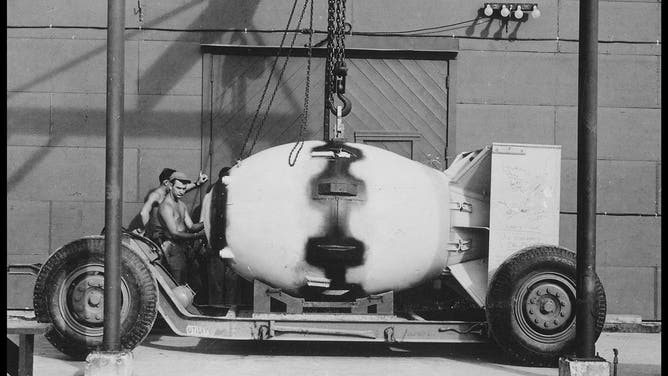
Fat Man on transport carriage, Tinian Island, 1945 'Fat Man' was the codename for the type of atomic bomb that was detonated over the Japanese city of Nagasaki by the United States on 9 August 1945.
(Photo 12/Universal Images Group / Getty Images)
Oak Ridge, Tennessee
This location was tasked with enriching uranium and would eventually serve as the headquarters for the massive project, as they built a huge industrial complex to produce enriched uranium.
The site also produced a limited amount of plutonium.
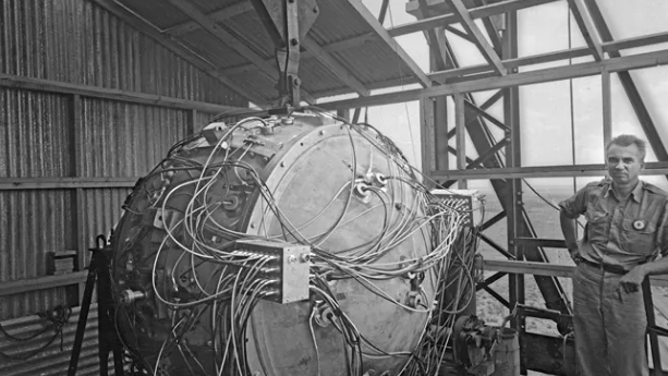
![Trinity test site for first successful atomic bomb.]() Image 1 of 3
Image 1 of 3Trinity test site for the first successful atomic bomb. (LOS ALAMOS NATIONAL LABORATORY)
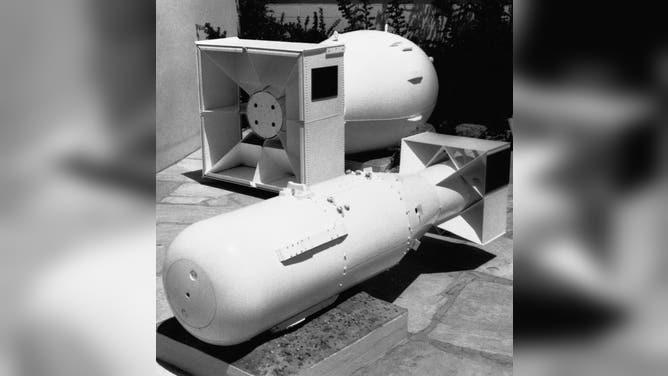
![Replicas of two atomic bombs, "Little Boy" and "Fat Man," on display at the Scientific Hall and Museum in Los Alamos, New Mexico. The original bombs were dropped on Hiroshima and Nagasaki, Japan, August 1945. Ca. 1947-1972.]() Image 2 of 3
Image 2 of 3Replicas of two atomic bombs, "Little Boy" and "Fat Man," are on display at the Scientific Hall and Museum in Los Alamos, New Mexico. The original bombs were dropped on Hiroshima and Nagasaki, Japan, August 1945. Ca. 1947-1972. (© CORBIS/Corbis)
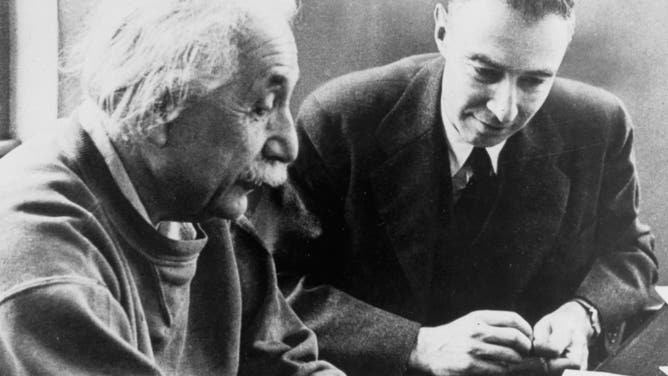
![Oppenheimer Learning from Einstein.]() Image 3 of 3
Image 3 of 3Oppenheimer Learning from Einstein. (© CORBIS/Corbis)
Hanford, Washington
This location housed huge production-scale reactions, chemical separation plants and fuel fabrication facilities.
Despite these marvelous inventions, production was still very slow, and it was not until mid-1945 that enough enriched uranium and plutonium were available to construct the first atomic bombs, according to the NPS.
TO STUDY CALIFORNIA’S LARGEST ACTIVE VOLCANO, SCIENTISTS FIRST HAVE TO CLIMB IT
The plutonium would then be sent to the main headquarters in New Mexico.
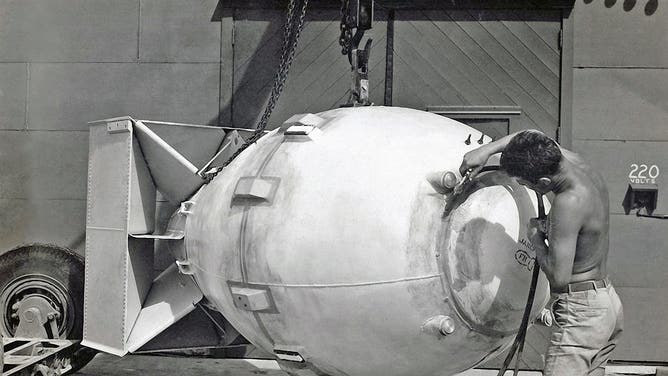
Atomic Bomb Fat Man later thrown over Nagasaki in 1945.
(Prisma Bildagentur/Universal Images Group / Getty Images)
Los Alamos, New Mexico
At this location, the bombs were designed and built after countless hours of experimentation to get the size and shape just right.
In 1943, General Groves established this location as a bomb design and development laboratory, with some of the world’s best scientists working under the leadership of J. Robert Oppenheimer.
On July 16, 1945, officials successfully tested the bomb at the Trinity test site in southern New Mexico as the world’s first human-caused nuclear explosion.
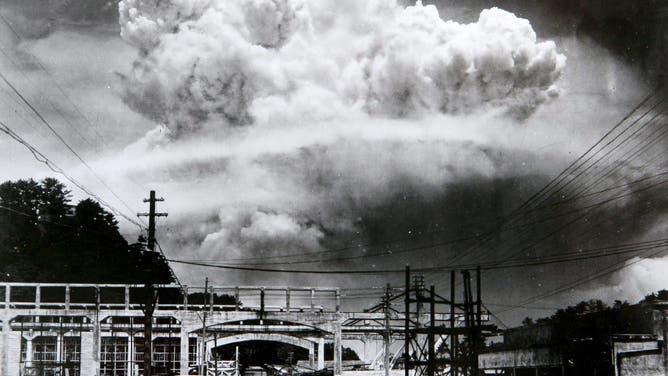
The nuclear bombing of Nagasaki, Japan, 9th August 1945 during world war two.
(Universal History Archive/Universal Images Group / Getty Images)
HURRICANE MELISSA TIES RECORD FOR STRONGEST HURRICANE IN ATLANTIC HISTORY
The creation of the famous Fat Man and Little Boy bombs marked the official introduction of nuclear weapons to modern combat in the world.
The U.S. would go on to drop the uranium-fueled Little Boy atomic bomb on Hiroshima, Japan, on Aug. 6, 1945, along with the plutonium-fueled Fat Man being dropped two days later.
More than 200,000 people died by the end of the year as a direct result of the bombings, and it opened humanity’s eyes to nuclear energy.
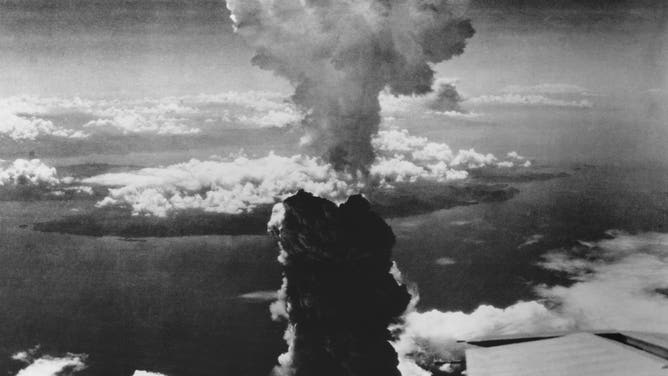
The mushroom cloud from the atomic explosion over Nagasaki, Japan, August 9, 1945.
(© CORBIS/Corbis / Getty Images)
These national historical sites allow the American people never to forget this significant chapter in our country’s history.
It is important to never forget and respect the sacrifices behind this project, as they were the reason the Allies were able to bring a swift end to the Second World War.