

Looking back at Japan’s historic tsunami disaster 15 years later
Fifteen years after the disaster, March 11 remains etched in history as the day of a triple tragedy that has shaped disaster response across the world.
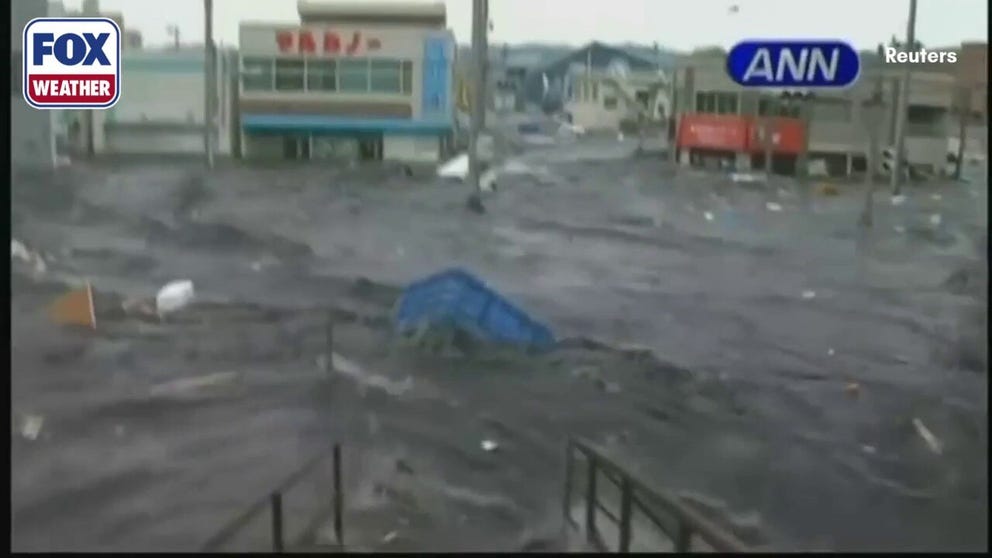
March 11, 2011: 15 Years since Japan’s historic tsunami disaster
Fifteen years ago, the world watched in horror as Japan was struck by the most powerful earthquake in its recorded history — a catastrophic event that unleashed a deadly tsunami, upended millions of lives and triggered a nuclear disaster.
Fifteen years ago, the world watched in horror as Japan was struck by the most powerful earthquake in its recorded history — a catastrophic event that unleashed a deadly tsunami, upended millions of lives and triggered a nuclear disaster.
March 11, 2011, remains etched in history as the day of a triple tragedy that has shaped disaster response across the world.
THESE ARE THE WORLD'S MOST POWERFUL EARTHQUAKES ON RECORD
The disaster, known as the Great East Japan Earthquake, claimed more than 20,000 lives, with approximately 2,500 people still listed as missing and presumed dead.
On Wednesday, a memorial ceremony was held in Fukushima, where attendees observed a moment of silence at 2:46 p.m. to honor and remember the victims of the historic disaster.
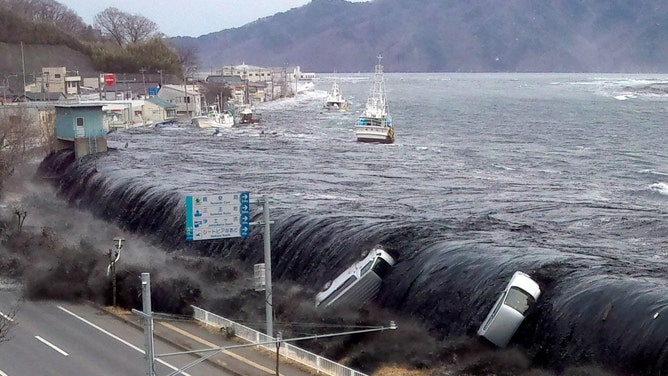
This picture taken by a Miyako City official on March 11, 2011, and released on March 18, 2011, shows a tsunami breeching an embankment and flowing into the city of Miyako in Iwate prefecture shortly after a magnitude 9.1 earthquake hit the region of northern Japan.
(JIJI PRESS/AFP via Getty Images / Getty Images)
Fifteen years earlier, at 2:46 p.m. JST on March 11, 2011, a massive magnitude 9.1 earthquake struck off the northeast coast of Honshu, generating a deadly tsunami that arrived at the coast in under 30 minutes.
20 YEARS LATER: A LOOK AT THE DEADLIEST DISASTER TO STRIKE EARTH IN MODERN HISTORY
According to the United States Geologic Survey (USGS), at the subduction zone between the Pacific Plate and the North American Plate, the Pacific Plate moves about 83 millimeters per year and dives into the deep waters of the Japan Trench.
Over time, stress builds where the two plates become locked together.
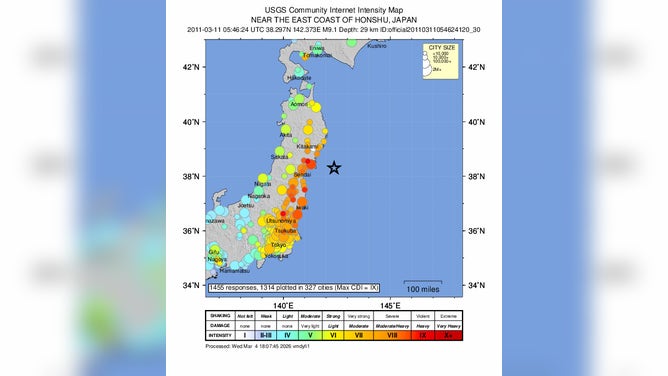
The 9.1 magnitude earthquake occurred approximately 45 to 80 miles off the coast of Japan. The epicenter, indicated by a star, was in the Pacific Ocean, east of the Oshika Peninsula of Tōhoku, at a depth of about 15 to 20 miles.
(USGS)
When that built-up stress was suddenly released, it triggered the most powerful earthquake in Japan’s recorded history, but that was just the start.
HERE'S HOW AI HELPED RESEARCHERS DISCOVER THOUSANDS OF MINI EARTHQUAKES BENEATH YELLOWSTONE
The region is a top hotspot for seismic activity in the world; the Japan Trench subduction zone has hosted nine events of 7+ magnitude since 1973.
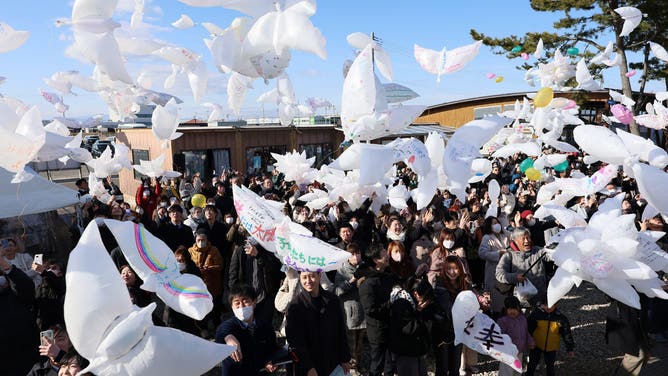
People release dove-shaped balloons in memory of the victims of the 2011 earthquake and tsunami disaster in Natori City, Miyagi Prefecture on March 11, 2026, on the 15th anniversary of the disaster.
(Photo by JIJI PRESS / AFP via Getty Images / Getty Images)
According to the National Oceanic and Atmospheric Administration (NOAA), the tsunami packed a maximum wave height of 30 to 40 meters (130 feet), and impacted a 1,242-mile stretch of Japan's Pacific Coast.
BUBBLING DISCOVERY ALONG CASCADIA FAULT GIVES INSIGHT INTO AREA PRONE TO 9.0 KILLER QUAKES IN WEST
Before people could begin to react to the violent shaking caused by the colossal earthquake, tsunami waters were racing towards the island's east coast with ferocious force.
Upon landfall, water washed over seawalls and eventually disabled the power supply and cooling of three Fukushima Daiichi reactors, leading to a significant nuclear accident that resulted in the evacuation of hundreds of thousands of Japanese citizens. Some areas of the Fukushima facility remain closed to this day.
![]() Image 1 of 6
Image 1 of 6HIGASHI MATSUSHIMA CITY, MIYAGI PREFECTURE, JAPAN - 2011/04/02: Fishing boats which were destroyed and pushed up on the land by the earthquake and tsunami that hit northeastern Japan on March 11, 2011. (Photo by Satoshi Takahashi/LightRocket via Getty Images)
![]() Image 2 of 6
Image 2 of 6TOKYO, JAPAN - MARCH 12: (JAPANESE NEWSPAPERS OUT) Smoke rise from the Kensennuma City center after an 8.9 magnitude strong earthquake struck on March 11 off the coast of north-eastern Japan, March 12, 2011 in Kesennuma, Miyagi, Japan. ( (Photo by Sankei via Getty Images))
![]() Image 3 of 6
Image 3 of 6A huge pile of rubble is seen in the devasted town of Otsuchi in Iwate prefecture appears behind tombstones on March 17, 2011, six days after a major earthquake and tsunami hit the northeastern coast of Japan. (NICHOLAS KAMM/AFP via Getty Images)
![]() Image 4 of 6
Image 4 of 6MINAMISANRIKU TOWN, MIYAGI PREFECTURE, JAPAN - 2011/06/07: Minamisanriku town that was devastated by the earthquake and tsunami that hit northeastern Japan on March 11, 2011. ((Photo by Satoshi Takahashi/LightRocket via Getty Images))
![]() Image 5 of 6
Image 5 of 6A picture shows wrecked cars littering a street in Natori, Miyagi prefecture on March 16, 2011 after the March 11 earthquake and tsunami. (MIKE CLARKE/AFP via Getty Images)
![]() Image 6 of 6
Image 6 of 6MINAMISANRIKU, JAPAN - MARCH 16: Destroyed vehicles lie near the rubble after the earthquake and tsunami devastated the area on March 16, 2011 in Minamisanriku, Japan. (Photo by Chris McGrath/Getty Images)
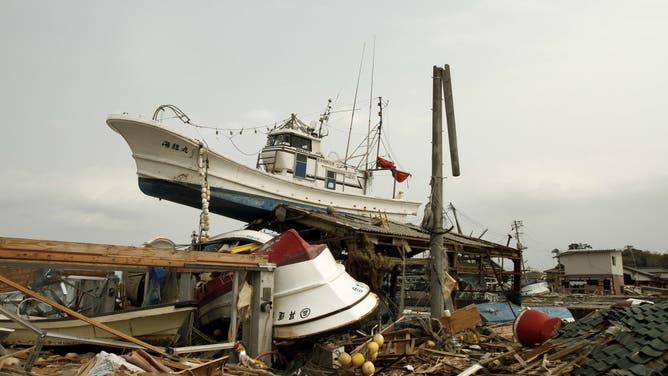
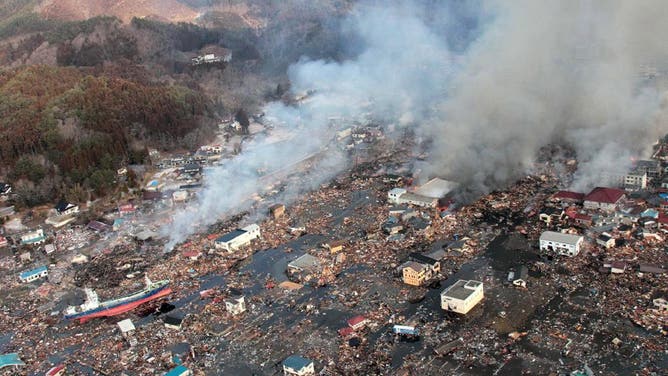
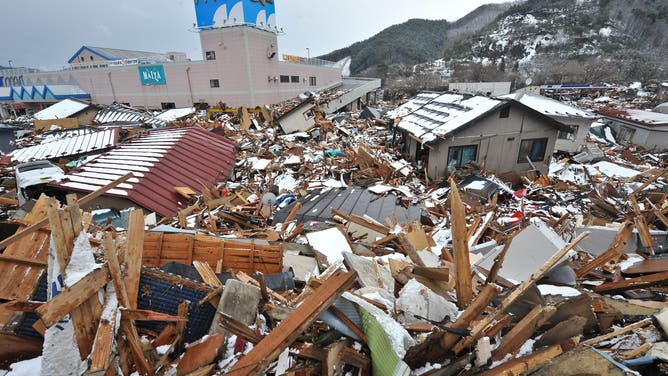
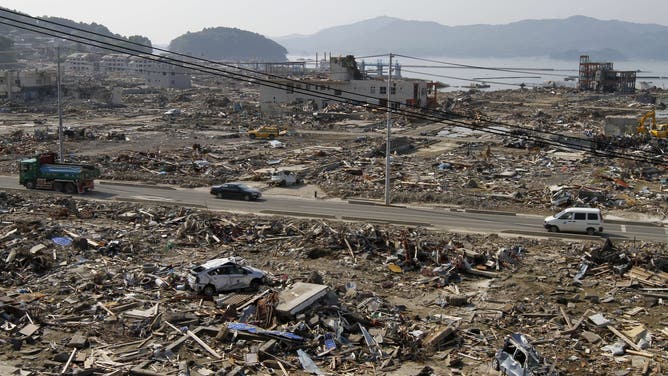
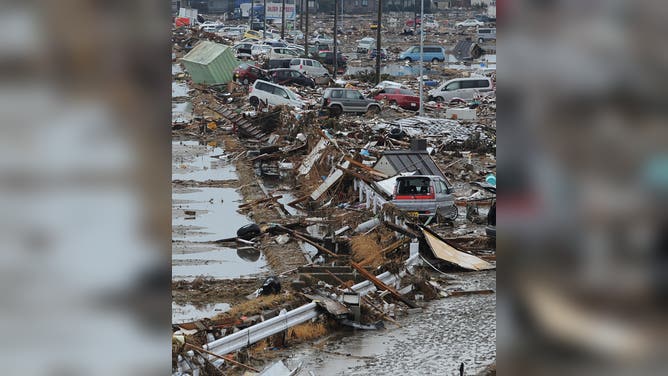
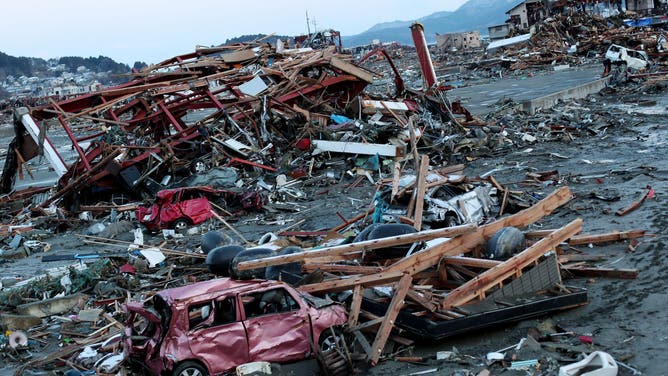
Coastal areas were completely inundated by rapidly advancing floodwaters, swallowing entire towns that morphed into dangerous debris flows, with reports of tsunami water reaching 6 miles inland, according to the USGS.
Although the majority of the tsunami’s impact was in Japan, the event was truly global. The tsunami was observed at coastal sea level gauges in over 25 Pacific Rim countries, in Antarctica, and on the west coast of the Atlantic Ocean in Brazil.
TSUNAMI WAVES HIT HAWAII, FORCING RESIDENTS TO EVACUATE FROM DIRE THREAT OF 'FORCEFUL WALL OF WATER'
Damage totals have been estimated at over $220 billion, ranking it as the costliest natural disaster in world history, according to the NOAA, with over 100,000 homes destroyed and millions more damaged.
The tsunami caused $31 million USD damage in Hawaii and $100 million USD in damages and recovery to marine facilities in California. Additionally, damage was reported in French Polynesia, Galápagos Islands, Peru and Chile.
How the disaster shaped modern tsunami forecast systems
As the 2011 Japan tsunami surged across the Pacific, a real-time flooding forecast model developed by NOAA’s Pacific Marine Environmental Laboratory (PMEL) faced its first operational test at the agency’s Tsunami Warning Centers.
"Tsunami detection and forecasting systems had been in development at PMEL even before the 2004 Indian Ocean tsunami," PMEL Director Michelle McClure said. "That tragedy underscored the urgency of rapidly identifying and predicting tsunami threats, both locally and globally."
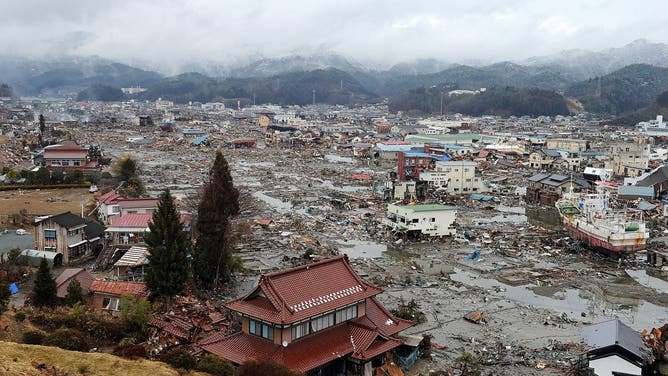
Damage caused by the March 11 tsunami is seen from a hill overlooking the city of Kesennuma on March 16, 2011.
(PHILIPPE LOPEZ/AFP via Getty Images)
The March 11, 2011, forecast marked the first time an inundation model was run in real time before waves reached projected locations in Hawaii and along the U.S. West Coast, according to Vasily Titov, senior tsunami modeler at NOAA’s Center for Tsunami Research.
"This event validated the system’s design capabilities while it was still in testing," Titov said. "The forecast accuracy — especially for inundation — was very good."
HURRICANE SEASON 2026: THESE ARE THE STORM NAMES YOU'LL SEE THIS SEASON
Proving its worth and capability by efficiently warning millions about the incoming tsunami impact, the same system in place in 2011 continues to protect people around the world in the event of a tsunami.
Today, PMEL’s tsunami inundation forecast system is fully operational at NOAA’s Tsunami Warning Centers, using more than 90 high-resolution models to predict wave heights, coastal flooding and dangerous currents for vulnerable U.S. coastal communities.
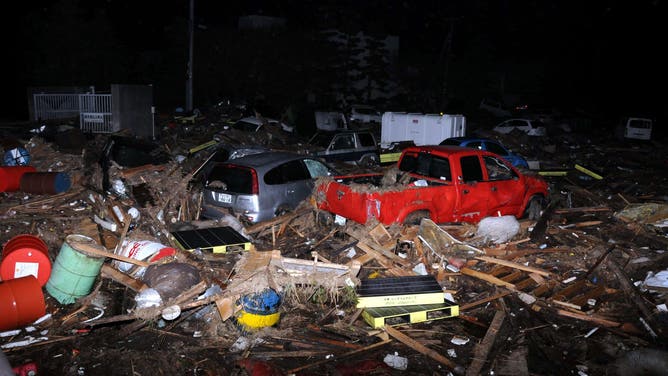
SENDAI, JAPAN: Debris after the tsunami following earthquake in Sendai, Miyagi, Honsu, Japan.
(Photo by Ali Ihsan Cam/Anadolu via Getty Images)
In 2011, 50 real-time DART tsunami buoys were deployed worldwide. Today, more than 70 are in operation, including fourth-generation systems that detect tsunamis sooner and feed higher-quality data into forecast models.
Additional undersea detection cables operated by the U.S., Japan and Canada further strengthen monitoring.
Together, these upgrades have made forecasts 10 times faster — with greater accuracy, according to the PMEL.
The system was most recently tested during the powerful 8.8 magnitude Kamchatka earthquake in 2025, the strongest global quake since 2011 and tied for the sixth-largest ever recorded.