

NASA's Artemis program: Paving the way for humankind's return to the moon and beyond
NASA's Artemis program is in motion. Here's how five missions will set the stage for a lunar landing and deep space exploration this decade.

Final preparations underway for NASA's Artemis II mission around the moon
The final stages of preparation are happening for Artemis II, the first crewed lunar mission in 50 years. FOX Weather Correspondent Brandy Campbell reports in front of the countdown clock on the latest weather conditions and preparations just one day ahead of the planned launch day.
Artemis II is capturing global attention—but it’s only the next stride in NASA’s accelerating campaign to return humans to the moon and beyond.
Artemis II will mark the first time humans set out to attempt a lunar flyby in over 50 years, another forward advancement in pursuing NASA's Artemis exploration program's ultimate goals: returning humankind to the moon, laying the foundation for the future and the exploration of Mars.
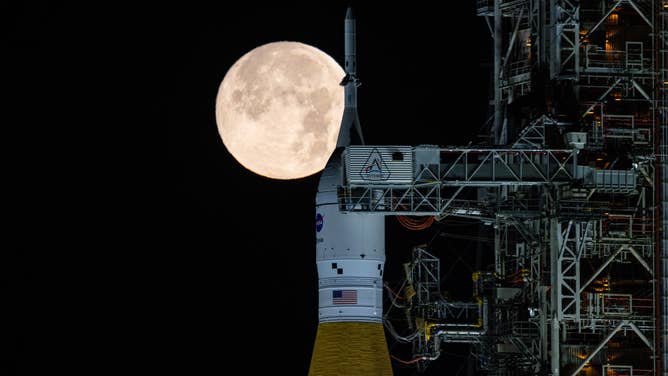
A full Moon is seen shining over NASA’s SLS (Space Launch System) and Orion spacecraft, atop the mobile launcher in the early hours of February 1, 2026.
(NASA/Sam Lott / NASA)
MEET THE ASTRONAUTS PREPARING FOR HUMANITY’S RETURN TO THE MOON ON THE ARTEMIS II MISSION
Founded on the idea of further pursuing human expansion across the solar system, NASA's Artemis program aims to achieve the goal of landing American astronauts on the surface of the moon this decade and maintaining U.S. superiority in exploration and discovery.
NASA’s "Moon to Mars" roadmap is already in motion. These five Artemis missions will build on the last, and lay the foundation that carries humanity deeper into space than ever before.
HOW IT STARTED: ARTEMIS I
The program's first mission, Artemis I, launched from NASA's Kennedy Space Center on Nov. 16, 2022, and successfully returned to Earth with a successful splashdown in the Pacific Ocean on Dec. 11, 2022.
Artemis I served as a test flight and laid the initial foundation for where we are today by sending a spaceship into deep space for a lunar flyby. Artemis I used a Space Launch System (SLS) rocket to launch an Orion spacecraft on a 25-day mission around the moon – without a single soul on board.
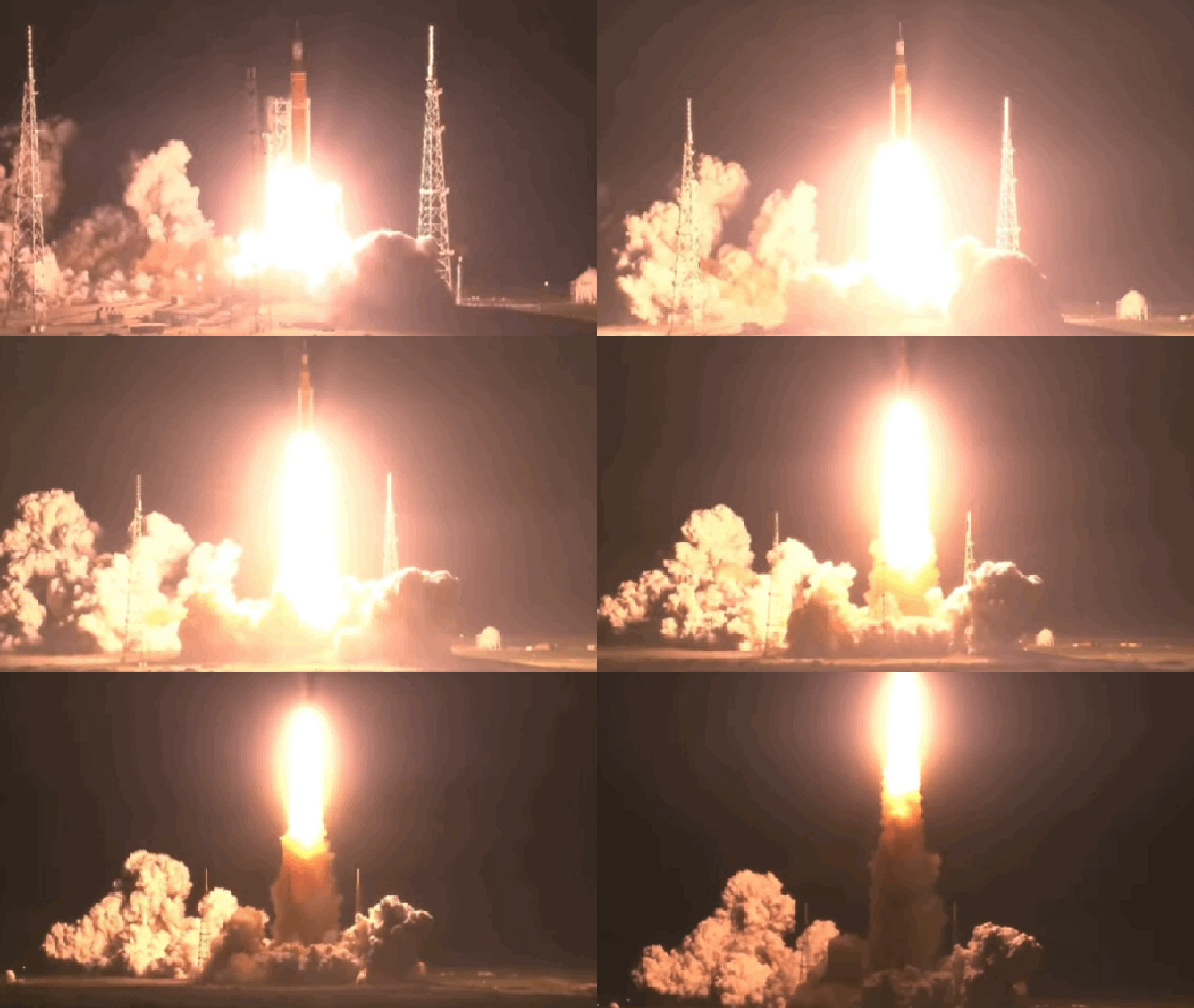
Artemis I launches from Kennedy Space Center on Nov. 16, 2022.
(NASA / FOX Weather)
Artemis I was the first integrated flight test of NASA’s newest Deep Space Exploration Systems.
After 1.4 million miles, the mission’s success propelled the program into its next phase—Artemis II—and brought humankind that much closer to its long-awaited return to the great unknown.
WHERE WE ARE NOW: ARTEMIS II
Picking up where Artemis I left off, Artemis II is using an SLS rocket to launch an Orion spacecraft for a flyover on the moon – but this time, they're bringing humanity with them.
Artemis II will attempt to bring humans back to deep space with a moon fly-by for the first time since 1972.
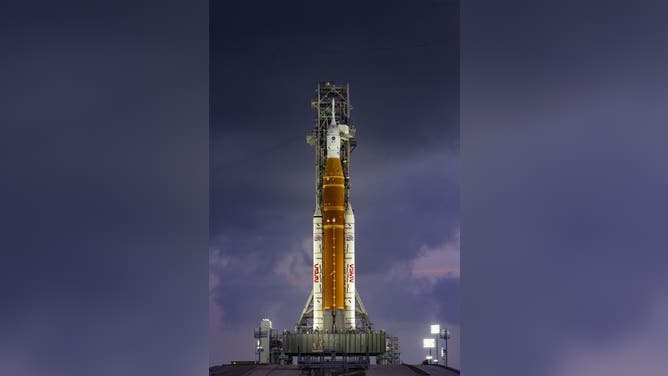
NASA's Artemis II Space Launch System rocket and Orion spacecraft rest on Launch Pad 39B at Kennedy Space Center in Cape Canaveral, Florida, on March 31, 2026, ahead of the crewed lunar mission.
(Jim WATSON / AFP via Getty Images / Getty Images)
The lunar fly-by will bring the spaceship roughly 4,000 to 6,000 miles away from the moon's surface – inviting the Artemis II crew to see the entire disk of the moon – which at closest approach, according to NASA, will appear to be about the size of a basketball held at arm’s length.
On its 10-day mission, Artemis II aims to demonstrate a broad range of capabilities needed on deep space missions, as the test flight will continue to raise the bar further for the next generation of astronauts.
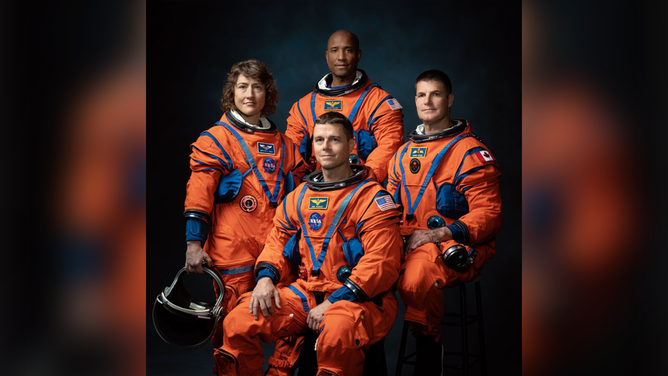
The crew of NASA’s Artemis II mission (left to right): NASA astronauts Christina Hammock Koch, Reid Wiseman (seated), Victor Glover, and Canadian Space Agency astronaut Jeremy Hansen.
(NASA)
The return to deep space, with three Americans and one Canadian onboard, marks a pivotal stepping stone in humanity's long-term return to the moon – further advancing the Artemis program's ultimate goals.
NEXT STEP: ARTEMIS III
Looking to the future, Artemis III will begin to lay the foundation for lunar landings by testing docking methods on the moon.
Currently scheduled for mid-2027, the demonstration mission in low Earth orbit will test commercial landers.

A surfer rides a wave as the full Pink Moon sets over the Huntington Beach Pier on Wednesday, April 24, 2024.
(Allen J. Schaben / Los Angeles Times / Getty Images)
According to NASA, the mission will launch crew in the Orion spacecraft on top of the SLS rocket to test rendezvous and docking capabilities between Orion and the private commercial spacecraft – developed by SpaceX, Blue Origin or both – needed to land astronauts on the moon.
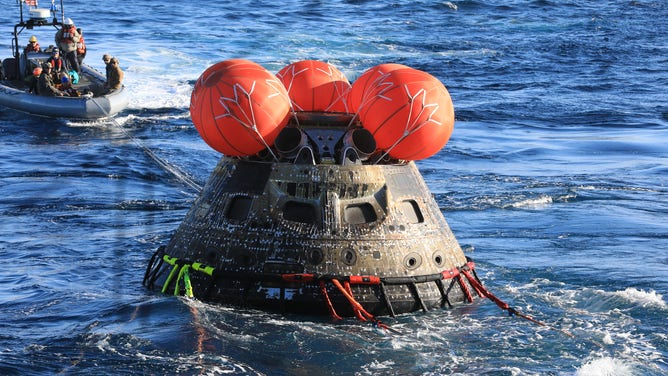
NASA's Orion spacecraft for the Artemis I mission was successfully recovered inside the well deck of the USS Portland on Dec. 11, 2022 off the coast of Baja California.
(NASA / NASA)
Artemis III will identify a moon lander vehicle that will be able to safely transfer future astronauts to the moon's surface and back to Orion in lunar orbit.
This will set the stage for humanity’s next giant leap: the Artemis IV lunar landing mission.
LUNAR LANDING: ARTEMIS IV
For the first Artemis lunar landing mission, Artemis IV, NASA is currently targeting a mission date for early 2028.
According to NASA, the mission "will be one of the most complex undertakings of engineering and human ingenuity in the history of deep space exploration" by exploring the moon's South Pole region.
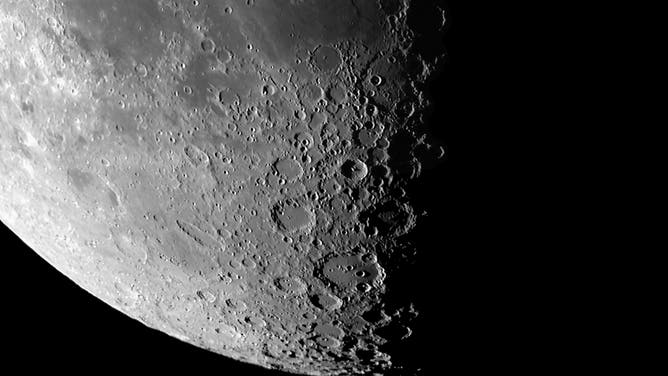
The lunar South Pole region of the Moon was captured on Oct. 18, 2003.
(Photo by Jamie Cooper/SSPL/Getty Images)
The mission will aim to use the astronauts’ observations, samples and data collected to expand our understanding of our solar system and Earth.
After launch, the Artemis IV crew will transfer from Orion to a commercial lunar lander—building off of Artemis III—for the journey to the lunar surface and back before returning to Earth for a Pacific Ocean splashdown.

Apollo 17 - NASA, 1972. The Last Man on the Moon: Eugene Cernan poses by the American flag in his A7L spacesuit, December 1972. Artist NASA.
((Photo by Heritage Space/Heritage Images via Getty Images) / Getty Images)
APOLLO 17 ASTRONAUTS GATHERED LUNAR ROCKS LEADING TO DISCOVERY OF MOON'S TRUE AGE
Artemis IV is aiming to bring humankind back to the moon's surface, and expand on lunar exploration, for the first time since the Apollo 17 mission in 1972.
MOON BASE: ARTEMIS V
Past the Artemis program's first lunar landing mission with Artemis IV, the next mission will continue to expand on NASA's presence on the moon.
NASA PAUSES GATEWAY LUNAR-ORBIT SPACE STATION TO BUILD LUNAR BASE ON THE MOON
With a launch anticipation by late 2028, Artemis V will return to the moon.
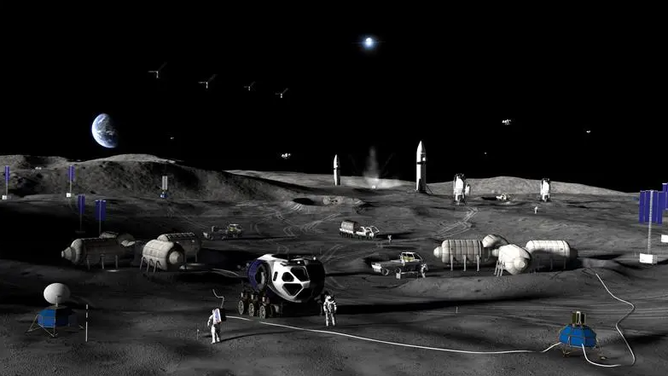
Artistic concept of Phase 3 of NASA’s Moon Base.
(NASA)
According to NASA, the Artemis program will expand to feature future missions about once per year after Artemis V.
Taking monumental steps towards the Artemis program's goal of building a foundation on the moon, construction on the NASA moon base will begin on the Artemis V mission.
10 IMPORTANT ROCKET LAUNCHES IN THE HISTORY OF THE US SPACEFLIGHT
‘GOLDEN AGE’ OF SPACE EXPLORATION
Looking towards the future of Artemis III and beyond, NASA continues to refine its plans for working towards the ultimate goals of the Artemis program.
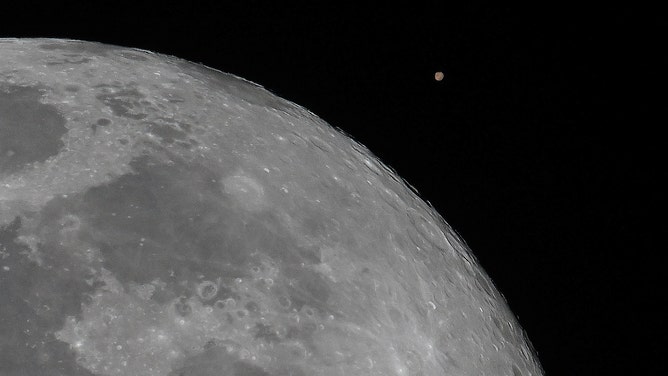
The first full moon of the 2025, called 'Wolf Moon', is seen next to Mars during a lunar occultation of Mars in Charlotte, United States on January 13, 2025.
(Photo by Peter Zay/Anadolu via Getty Images)
Ushering in a new "Golden Age" of space exploration, the Artemis program will drive increasingly complex missions to further human understanding of the moon and lay the foundation for humanity’s first crewed journey to Mars.