

NASA announces Artemis II mission phases, plans for future Artemis program launches
A news conference was held on Tuesday, where NASA said Artemis II is on track to launch with no issues reported.
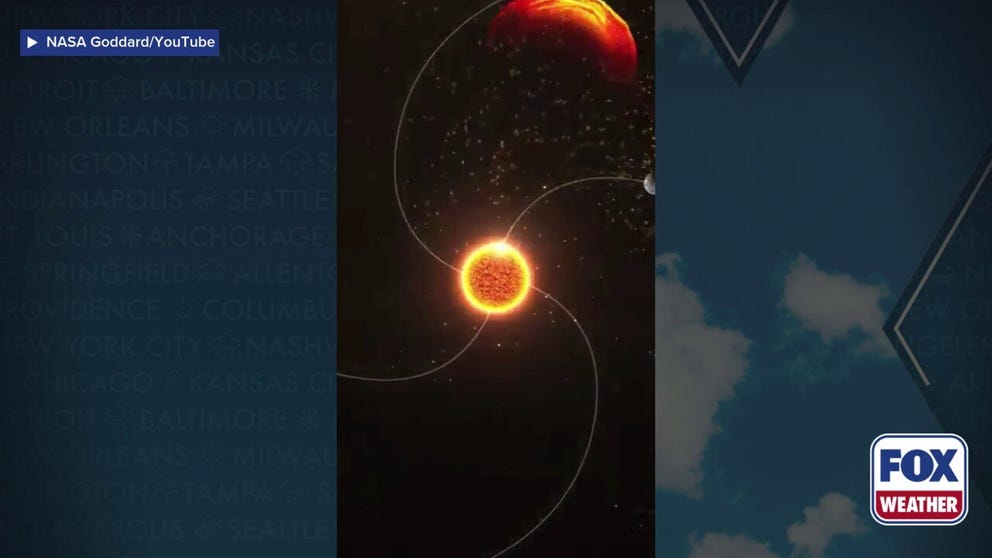
NASA to monitor Sun's activity during Artemis II mission around Moon
Solar activity can be dangerous to astronauts in space. As Artemis II prepares to launch on April 1, NASA will be monitoring the Sun's eruptions to help keep the Artemis crew safe from excess radiation.
NASA's next lunar mission, Artemis II, is on track to launch just a week away on April 1 and administrators revealed the mission's objectives, as well as plans for the future of the Artemis programs.
A news conference was held on Tuesday, where NASA said Artemis II is on track to launch with no issues reported.
The SLS rocket and Orion spacecraft that will carry three NASA astronauts and one Canadian Space Agency astronaut around the Moon have passed their flight readiness review, marking one of the last big things to happen prior to launch.
HOW OFTEN DO METEORITES CRASH IN THE US?
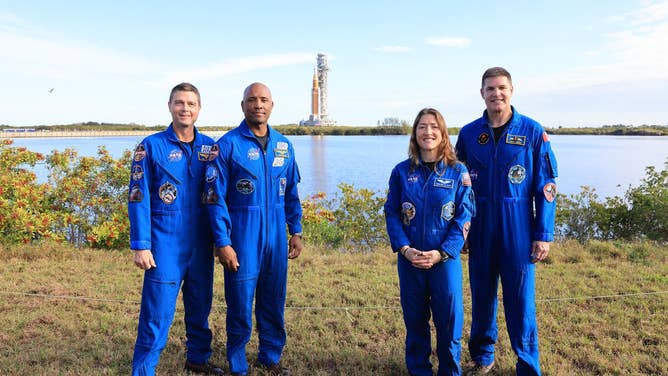
From left to right, Artemis II NASA astronauts Reid Wiseman, commander; Victor Glover, pilot, and Christina Koch, mission specialist, and CSA (Canadian Space Agency) Jeremy Hansen, mission specialist, pose for a photograph during rollout of NASA’s Artemis II SLS (Space Launch System) rocket and Orion spacecraft to Launch Complex 39B at NASA’s Kennedy Space Center in Florida on Saturday, Jan. 17, 2026
(NASA/Kim Shiflett / NASA)
All four astronauts are healthy and safe in Houston, and will journey to Florida in the coming days for launch.
The Artemis II mission will consist of four mission phases:
Phase I:
Artemis II's first phase will include the rocket launch as well as a 24-hour high-Earth orbit.
During this orbit, NASA will be monitoring environmental control and life-support systems, the newest and most critical piece to keeping the crew safe and healthy, NASA Acting Administrator of the Exploration Systems Development Mission Directorate, Dr. Lori Glaze, said.
WATCH: NASA'S HUBBLE SPACE TELESCOPE CAPTURES RARE PROOF OF COMET BREAKING APART
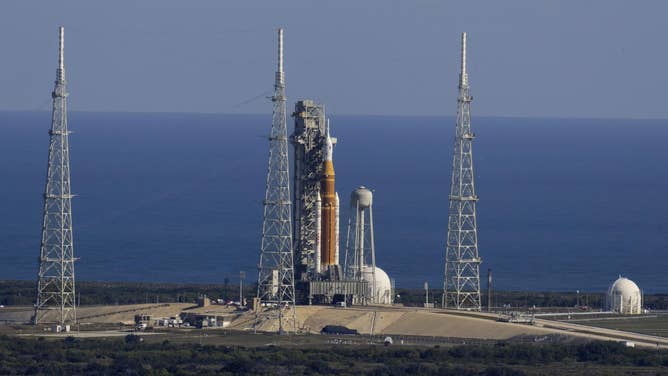
NASA’s Artemis II SLS (Space Launch System) rocket with the Orion spacecraft atop a mobile launcher is seen at Launch Complex 39B, Thursday, Jan. 29, 2026, at NASA’s Kennedy Space Center in Florida.
(NASA/Jim Ross / NASA)
Additionally, once the upper stage of the rocket has separated from Orion, NASA will conduct the proximity operations demonstration and test Orion's manual controls to ensure all systems are operating in the spacecraft.
The final stage of the first phase will be performing the trans-lunar injection, which Glaze said will set the astronauts on the path to the Moon and back.
Phase II:
Phase II will be the journey to the Moon.
Glaze said this process will take four days.
MARCH SKYWATCHING GUIDE: CATCH A BLOOD MOON, PLANET CONJUNCTION, AURORAS, AND MORE
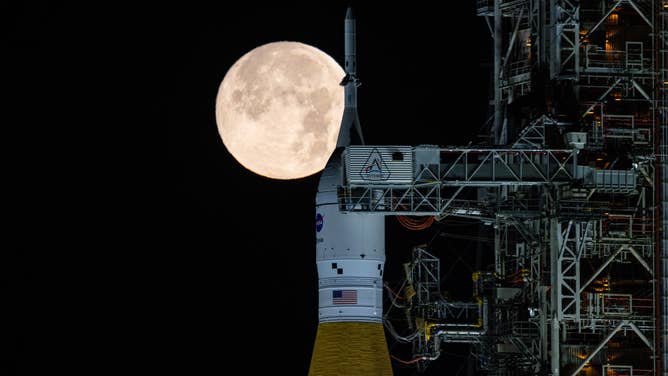
A full Moon is seen shining over NASA’s SLS (Space Launch System) and Orion spacecraft, atop the mobile launcher in the early hours of February 1, 2026.
(NASA/Sam Lott / NASA)
Phase III:
The third phase begins with the lunar fly-by.
This will be when astronauts on board get to observe the far side of the Moon, and hopefully break the Apollo record for the farthest any human has traveled from Earth in space, Glaze said.
Once the lunar fly-by is complete, the four-day journey back to Earth will begin.
HERE'S WHY NASA WILL MONITOR THE SUN FOR SOLAR ERUPTIONS DURING ARTEMIS II MISSION
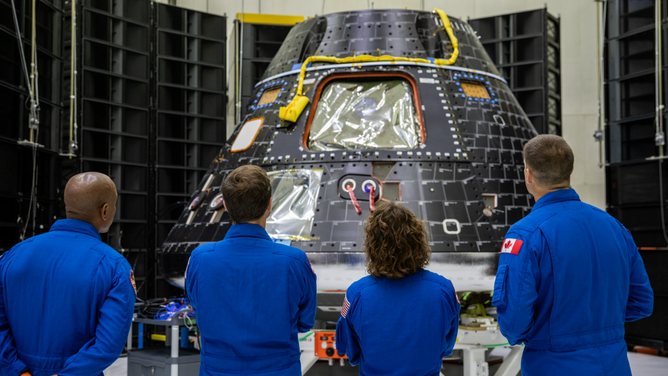
Artemis II crew members, shown inside the Neil Armstrong Operations and Checkout Building at NASA’s Kennedy Space Center in Florida, check out their Orion crew module on Aug. 8, 2023.
(NASA/Kim Shiflett / NASA)
Phase IV:
The fourth and final phase of Artemis II's mission will be the reentry to Earth's atmosphere and splashdown off the coast of San Diego in the Pacific Ocean.
Glaze said NASA will work closely with the Department of War to recover the crew and bring them safely to shore.
Once on land, the astronauts will be transported back to Johnson Space Center in Houston.
Future Artemis launches
In addition to breaking down the phases of Artemis II's mission, NASA further explained Artemis III, IV and even Artemis V's expected plans and timelines.
In late February, NASA administrators announced their plans to accelerate Artemis mission launches starting in 2027.
SCAN REVEALS NEW CLUES INTO ASTEROID BENNU'S SURFACE, FINDING 'MISSING PIECE' FOR SCIENTISTS
Artemis III will now be a low-Earth orbit mission with one or both of NASA's lunar Landers, planned to launch in mid-2027.
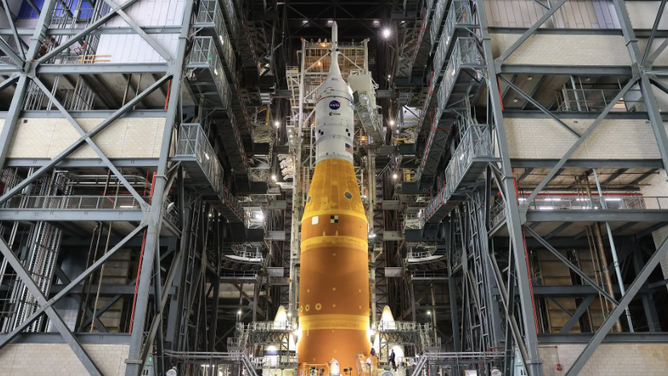
NASA’s Artemis II SLS (Space Launch System) rocket and Orion spacecraft, secured to the mobile launcher, stands vertical inside the Vehicle Assembly building on Tuesday, March 17, 2026, as preparations continue for rollout to Launch Complex 39B at NASA’s Kennedy Space Center in Florida.
(NASA/Kim Shifflett / NASA)
Glaze said as soon as Artemis II launches, assessment of the launchpad for Artemis III will begin.
"The hardware for Artemis III is very mature," Glaze said. "We're working to meet the 2027 launch readiness."
Glaze said a lot of the equipment for Artemis III is already ready.
Artemis IV and V:
Artemis IV is planned to launch in early 2028, with a mission of landing on the Moon.
Artemis V will follow in late 2028, Glaze said.
Equipment for Artemis IV is also in the process of being assembled and progress is being made, Glaze said.
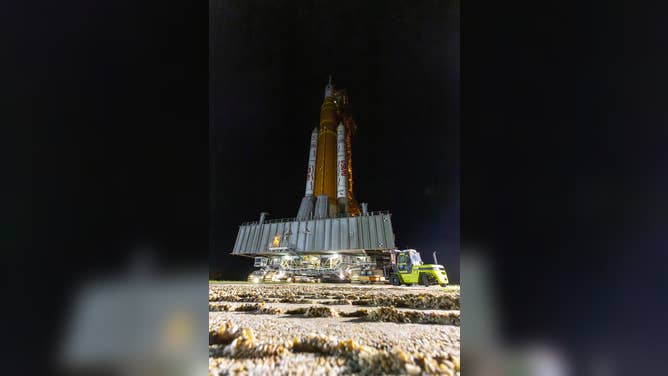
NASA’s Artemis II SLS (Space Launch System) rocket and Orion spacecraft, secured to the mobile launcher, is seen inside the Vehicle Assembly building as preparations continue for roll out to Launch Pad 39B, Thursday, March 19, 2026, at NASA’s Kennedy Space Center in Florida.
(NASA/Ben Smegelsky / NASA)
A new generation of spacesuits for Artemis IV is being created by Axiom.
Four astronauts will go on Artemis IV's mission, with NASA planning to set two astronauts of that crew onto the Moon's surface.
Pieces of Artemis V are in production as well.
Glaze said Artemis V will be the second landed mission on the Moon in 2028, with a goal of preparation for NASA's lunar base.