

Summer pest problems? Here's how to spot and get rid of common household bugs
From ants, to ticks and wasps, we're offering up some more information on these common household pests and how to treat the problem.
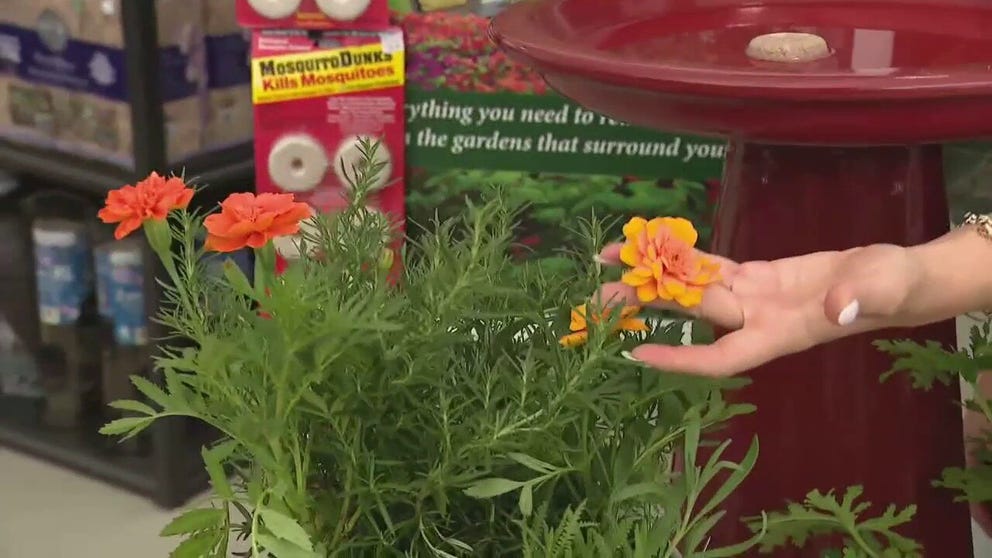
FILE: Plants that repel mosquitos
Keeping mosquitos away from your family this summer can start with your landscaping. FOX 26 Houston Reporter Ruben Dominguez discovers garden plants and pet and kid safe tips to keep the bloodsuckers at bay.
Summer is here and so are all the insects and bugs that plague us and our homes during the hottest times of the year.
It can be frustrating when you have an insect problem in your home, and getting rid of them is sometimes a challenge.
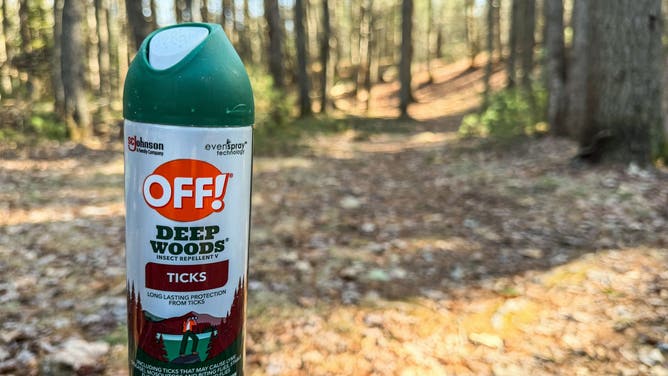
Can of OFF! Deep Woods Insect Repellent for Ticks ready to be applied at a hiking trail in Harpswell, Maine.
(Catherine Robotis/UCG/Universal Images Group / Getty Images)
From ants, to ticks and wasps, we're offering up some more information on these common household pests and how to treat the problem.
To keep unwanted bugs from entering your home, make sure to seal any cracks or crevices around the outside of your home with a silicone-based caulk or steel wool or both, according to Pestworld.org.
WHAT IS SEA LICE? HOW TO AVOID THE PARASITE AS SARGASSUM FLOODS SOUTH FLORIDA BEACHES
Ants
Ants are some of the most frustrating insects to invade your home. Primarily found in the kitchen or places where there is food, they can be difficult to get rid of.
Ants need food, water and shelter to survive.
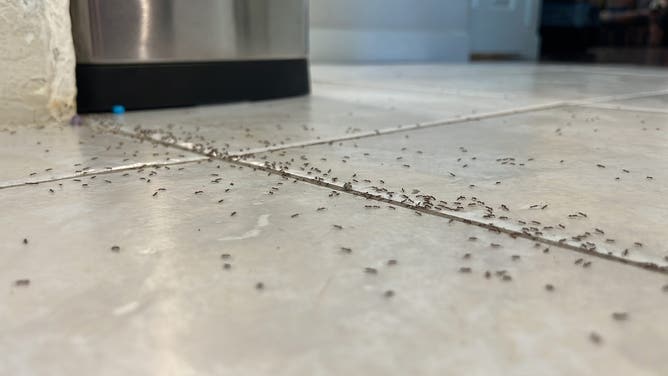
Trail of ants on a tiled kitchen floor during an ant infestation in a domestic home, Lafayette, California, July 10, 2024.
(Smith Collection/Gado / Getty Images)
ATLANTA FLOODING CONTRIBUTES TO 'UNPRECEDENTED' NUMBER OF DEAD FISH IN GEORGIA RIVER
In order to prevent ants from becoming a problem:
- Wipe up all crumbs and spills on floors, cabinets, stovetops, counters and in the refrigerator quickly.
- Keep the area around the sink free of moisture.
- Make sure to put trash in a sealed receptacle and use airtight containers to store food.
By doing all of this, you're eliminating the ants' ability to find food. If the problem continues, use an ant bait trap in areas where you're finding the ants.
These traps work because the ants will carry bait back to the colony, killing them all.
Flies
Flies are equally irritating to find in your home. There are two different types of flies, and they find their way in through open or damaged doors and windows.
INVASIVE ANT SPECIES THAT CAN CAUSE ANAPHYLAXIS REPORTED IN NEARLY 20 STATES
Fruit flies are attracted to food smells. Houseflies are attracted to air currents and food, too.
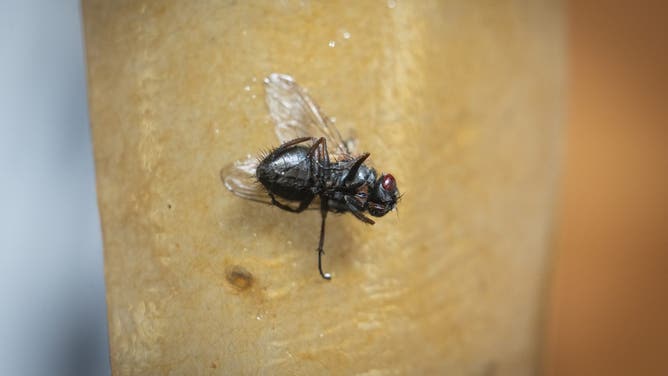
A common housefly is seen stuck to a sticky fly trap in a kitchen in Warsaw, Poland on 19 July, 2023.
(Jaap Arriens/NurPhoto / Getty Images)
To prevent flies from becoming a problem:
- Wipe up crumbs and spills quickly.
- Regularly remove trash or smelly food products.
- Keep surfaces dry.
- Set up fly traps to catch any already in the home.
Gnats
There are also two types of gnats that find their way into homes and are a nuisance to humans and pets: fungus gnats and biting gnats.
Gnats are teeny tiny insects of the same family as flies and mosquitoes.
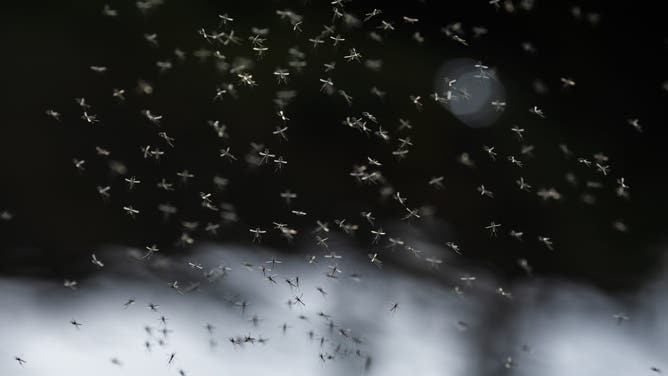
MORDEN, ENGLAND - MARCH 20: Gnats fly above a stream at Morden Hall Park on March 20, 2020 in Morden, Greater London.
(Dan Kitwood / Getty Images)
Fungus gnats feed on houseplants and can weaken and harm them. They don't bite humans.
Biting gnats do bite humans and animals, as their name suggests. Their bite isn't harmful, but can cause itching and welts at the bite site.
WILDLIFE OFFICIALS URGE RESIDENTS TO KILL INVASIVE ARGENTINE TEGUS SPREADING DISEASE
How to get rid of them?
- Let plants dry out, fix any leaks and clear up any standing water in order to keep gnats away from your property.
- Insect repellents can keep them off pets and humans when outside.
- Concoct a homemade solution found online, such as dish soap and apple cider vinegar, to attract the gnats already in your home and kill them.
- For houseplants, online sources say mix one part 3% hydrogen peroxide to three parts water in a spray bottle and drench plants to kill gnat larvae.
Mosquitoes
Mosquitoes are some of the most common outdoor pests in the summertime. Some people are more unlucky than others when it comes to being bitten by mosquitoes, but the unmistakable itch caused by a mosquito bite is a quick way to ruin your summer evening.
SLITHERING TOWARD EXTINCTION: DEADLY DISEASES COULD WIPE OUT RATTLESNAKE POPULATION
Mosquitoes are usually found in warm and wet environments. Mosquitoes survive by feeding on hosts, like humans and animals.
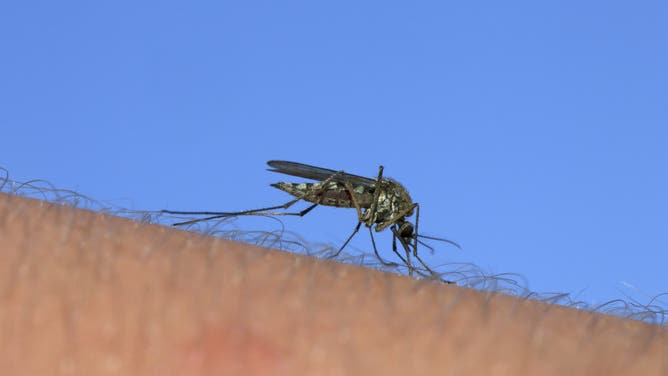
mosquito (Culex pipiens) stinging human arm to feed on blood. (Photo by: via Getty Images)
(Arterra/Universal Images Group / Getty Images)
Only female mosquitoes suck human blood; male mosquitoes eat plant nectar.
Combat mosquitoes by:
- Wearing long sleeves and pants when outside around dawn or dusk.
- Wear a mosquito repellent.
- Remove any standing water, as that's where females lay eggs and what attracts them.
- Place a fan around outdoor gatherings, as mosquitoes aren't strong flyers and it can help deter them.
LARGE INCREASE IN TICK BITES REPORTED AT HOSPITALS ACROSS THE US AS SPRING WARMTH KICKS IN
Ticks
Another pest that feeds on human and animals' blood is the tick.
Ticks are frustrating and love to hide in places you wouldn't expect. A hike through the woods on a trail or doing yard work can often lead to finding ticks on your body.
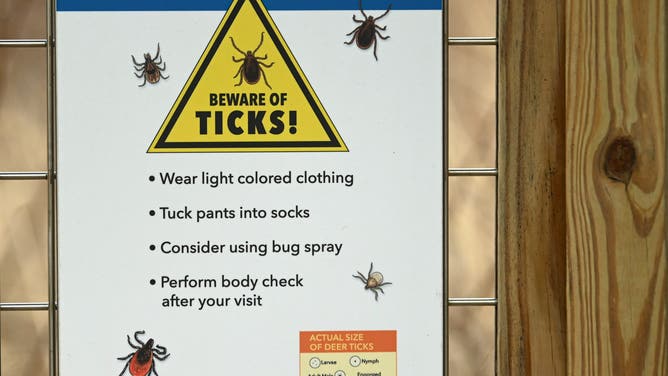
ALBANY, NY - MARCH 12: A sign warns hikers to be aware of ticks at the Rapp Barrens trailhead kiosk in the Pine Bush Preserve on Thursday, March 12, 2026 in Albany, N.Y.
(Lori Van Buren/Albany Times Union / Getty Images)
It's extremely important to find ticks on your body quickly and remove them properly.
Improper removal of ticks can lead to a host of problems, as they have the ability to pass on a number of medical conditions and diseases such a Lyme disease, Rocky Mountain Spotted Fever and Alpha-gal Syndrome, to name a few.
FEDERAL OFFICIALS UNVEIL NEW PLAN IN THE FIGHT AGAINST LYME DISEASE AND TICK-BORNE ILLNESS
To safely remove a tick, the Centers for Disease Control and Prevention (CDC) said:
- Grasp the tick as close to the skin's surface as possible using clean, fine-tipped tweezers. If fine-tipped tweezers are not available, use regular tweezers or your fingers to grasp the tick and be careful not to squeeze the tick's body.
- Pull the tick away from the skin with steady, even pressure. Don't twist or jerk the tick. This can cause the tick's mouthparts to break off and remain in the skin. If this happens, your body will naturally push the mouthparts out over time as your skin heals.
- Dispose of the live tick by taking one of these steps: place it in a sealed container, wrap it tightly in tape, flush it down the toilet or put it in alcohol. Do not crush the tick with your fingers.
- Once the tick is removed, thoroughly clean the bite area and your hands with soap and water, rubbing alcohol or hand sanitizer.
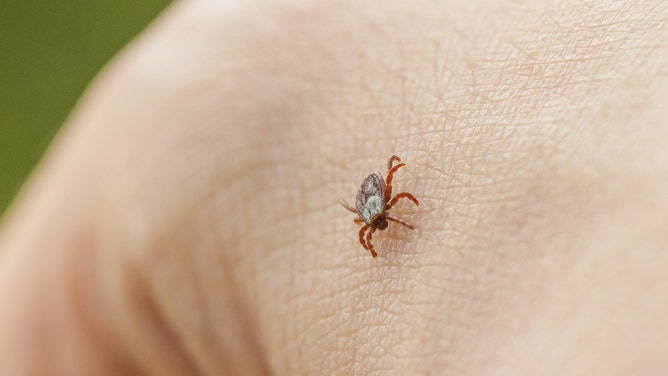
Tick on the skin
(iiievgeniy / Getty Images)
If you find one tick on your body, make sure to do a very thorough check, as there could be others.
Wasps
Wasps aren't always aggressive, typically only stinging people or pets if threatened or disturbed.
Paper wasps, the most popular type of wasp, build a large nest where they lay their eggs.
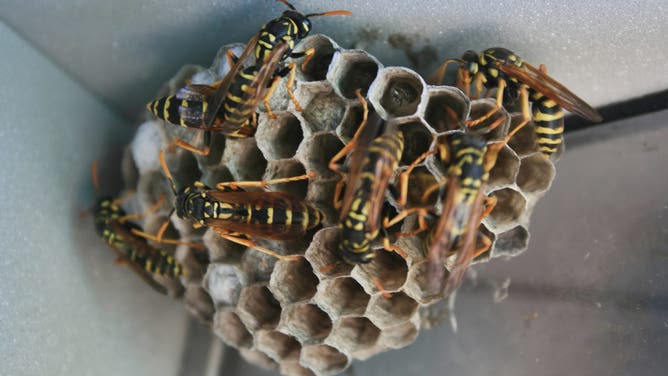
European paper wasps (Polistes dominula) on a small nest in Ontario, Canada.
(Creative Touch Imaging Ltd./NurPhoto / Getty Images)
Wasps' nests need to be removed professionally to avoid being stung in large numbers. Contact a licensed professional if you think there's a wasp nest on your property.
If you're stung by a wasp, wash the sting site with soap and water and apply an ice pack to the area to help with swelling.
Wasps typically don't leave a stinger behind when stinging, but if a stinger is left behind, gently scrape it from the skin with a fingernail.