

Experts say millions of spotted lanternflies could plague New York City this year
This past winter wasn’t cold enough to reduce the insect’s population. As a result, officials expect the species to surge again this season.
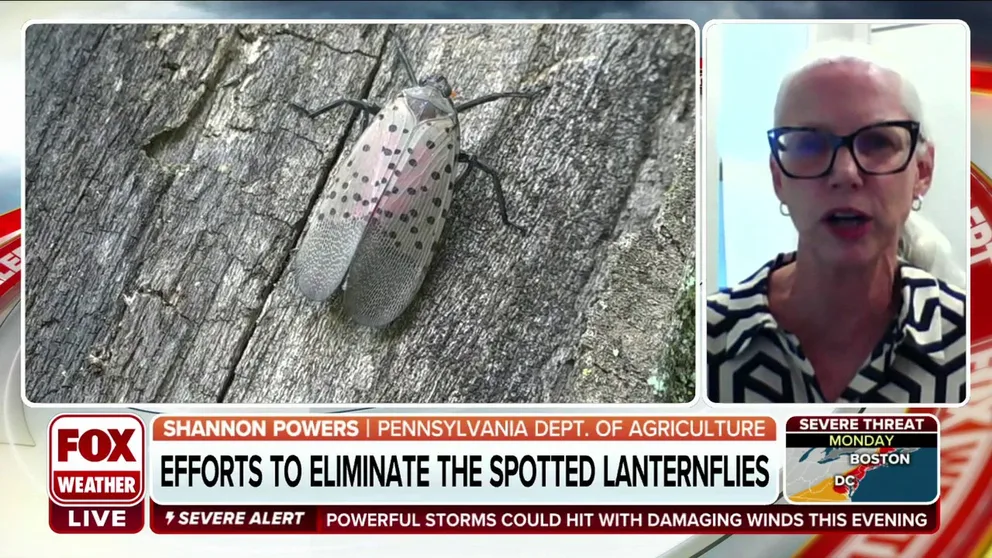
FILE: Spotted lanternflies threaten local economies
Pennsylvania Department of Agriculture spokesperson Shannon Powers on combating the invasive bug that is swarming across the U.S.
The annoying, now-annual hatching of spotted lanternflies is less than a month away, and experts warn there could be millions across New York City this year.
According to New York’s Department of Agriculture, this past winter wasn’t cold enough to reduce the insect’s population. As a result, officials expect the species to surge again this season.
SALAMANDERS IN MANHATTAN: HERE'S HOW YOU CAN HELP PRESERVE THEIR HABITAT
"Predicting the spotted lanternfly population for the coming season is extremely difficult, as the research community continues to work on pinpointing what factors influence the population from year to year," Jola Szubielzki, director of public information at the Department of Agriculture, said. "We do know that winter temperatures downstate were not cold enough for long enough to kill off eggs that overwintered."
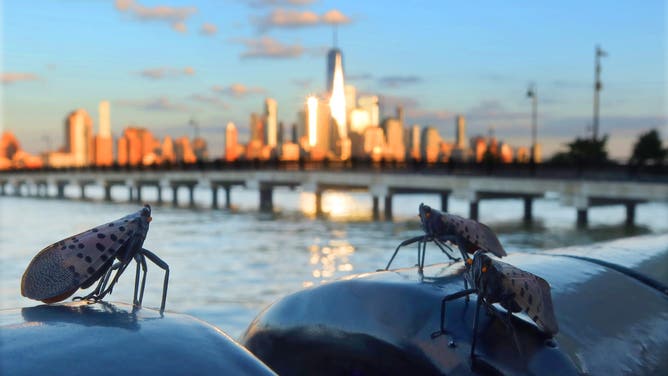
Three spotted lanternflies stand on a railing next to the Hudson River as the sun sets on the skyline of Lower Manhattan in New York City.
(Gary Hershorn/Getty Images / Getty Images)
The insect, that looks like a cross between a moth and a ladybug, is native to Asia and was first discovered in the U.S. in Pennsylvania in 2014.
Now, the lanternfly has been spotted in more than 21 states, including New York, New Jersey, Connecticut, Virginia and Ohio, and has become a persistent nuisance in New York City each summer since 2020.
SPIDERS THE SIZE OF A HUMAN HAND ARE SPREADING THROUGHOUT THE US
"Cities tend to have milder winters, creating favorable conditions for species that otherwise would only be able to live in warmer climates," Kristen Winchell, an assistant professor of biology at New York University, said in a press release.
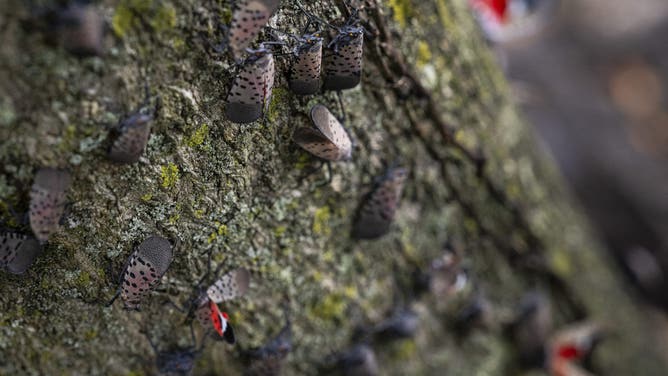
An infestation of spotted lanternflies in an adjacent wooded area at an offsite vineyard operated by Fabbioli Cellars.
(Graeme Sloan/For The Washington Post via Getty Image / Getty Images)
Officials say these bugs will continue to spread, especially as they continue to hitchhike by laying egg masses on vehicles, trains, shipping materials and outdoor surfaces, according to the Virginia Department of Agriculture.
WATCH: COUPLE SAVES SEA TURTLE ENTANGLED IN FISHING NET IN MALDIVES
"Cities are also highly connected places where trade happens, and organisms may end up on shipments in planes or boats traveling between cities," Winchell said. "Finally, urban environments aren’t very friendly to a lot of native species, so you have a degraded ecological community that creates opportunities for new species to come in."
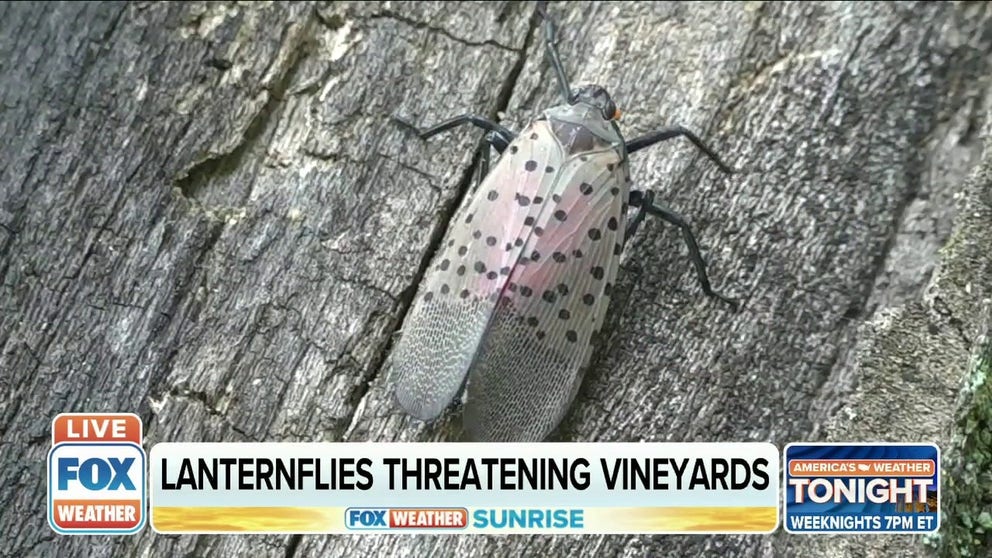
FILE: People being told to squash lanternflies as they threaten vineyards
An invasive bug is spreading in states up and down the northeast, and causing problems for vineyards. Now people are being told to squash these ‘spotted lanternflies' as soon as they see them.
Each year, female lanternflies typically lay one or two egg masses, each containing about 30 to 60 eggs. They cover them with a creamy, mud-like substance that acts as camouflage to protect the egg sacs, according to Cornell University.
The eggs are laid in the fall and hatch in the spring, with young nymphs emerging as early as May and maturing into adults later in the summer.

FILE: 9-year-old scientist honored by Yale for spotted lanternfly work
Bobbi Wilson, a 9-year-old scientist, gains recognition for her work on the eradication of the spotted lanternfly months after being the subject of a police complaint. Wilson, joined by her mother Monique Joseph, spoke on the spotted lanternfly collection and receiving the donor scientist award from Yale University.
In a 2024 study from New York University, researchers found that the bugs are living up to five months longer than they did when they first arrived, due to the climate of urban environments.
"This is important because a lengthening of the active period each year means they have more time to reproduce and spread," Winchell said.
SPRING STING: PORTUGUESE MAN O' WAR RETURNS TO GULF COAST BEACHES
While lanternflies don’t bite or sting and aren’t directly harmful to humans or pets, they do pose a serious threat to agriculture.
The insects feed by sucking sap from plants, weakening trees and crops like grapes, apples and hops. They also leave behind a sticky substance known as honeydew, which promotes the growth of mold.
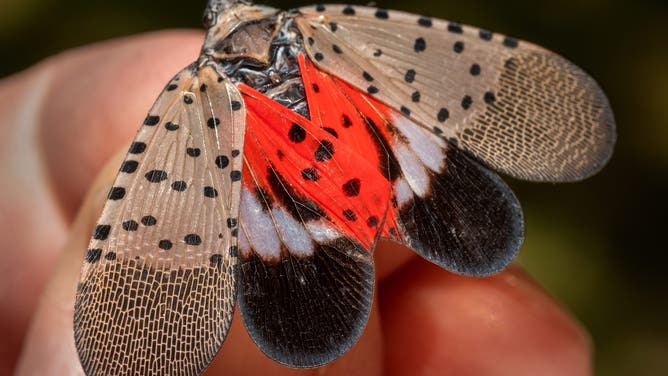
Vince Burkle, of the Indiana Department of Natural Resources, holds an adult spotted lanternfly found in Huntington, Indiana.
(Andy Lavalley/Post-Tribune/Tribune News Service via Getty Images / Getty Images)
Officials warn that the economic impact of these invasive species could be significant.
Residents are encouraged to take immediate steps to help contain the spread, including using pesticides, removing egg masses and participating in the stomp-it campaigns.
"Vigilance and proactive control methods, such as egg mass scraping, are still needed, even during the early spring months," Szubielzki said.