

Lala roars back to hurricane strength, putting marine wildlife and historic monument in its path
The hurricane poses no threat to land, as it will occur over open water. Still, it poses a notable risk to the marine wildlife inhabiting the sanctuary, one of the world's largest marine conservation areas, along with housing the Battle of Midway National Monument.
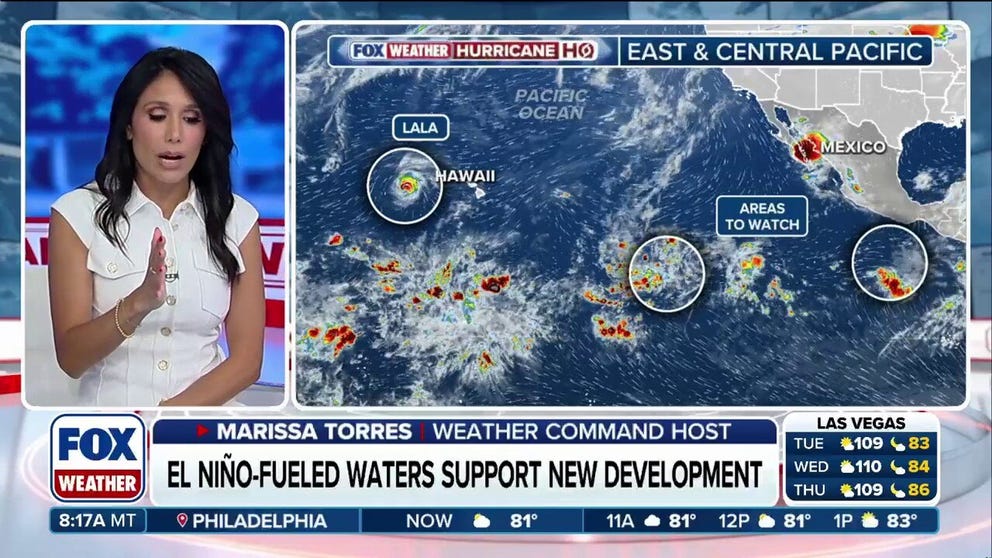
Lala restrengthens to hurricane status as two other areas to watch churn in the Pacific
The FOX Forecast Center continues monitoring the Pacific as Lala has restrengthened back to a hurricane while moving away from the Hawaiian Islands. Meanwhile, two other areas are being watched off the coast of Mexico, with one distant disturbance potentially putting Hawaii back on watch. Full outlook:
THE TAKEAWAY
- Lala strengthens into a Category 3 hurricane, but there is no threat to land.
- Hurricane Lala is threatening a marine wildlife sanctuary and the historic monument of the Battle of Midway.
- The sanctuary encompasses over 582,000 square miles of Pacific Ocean waters in Hawaii.
HAWAII – Just days after Hurricane Lala slammed the Hawaiian Islands, the storm is making a comeback as the National Hurricane Center (NHC) has issued additional storm alerts on Tuesday, with a national monument at risk.
The storm is moving west of the Hawaiian Islands, where atmospheric conditions are helping the storm move over warmer waters.
BREWING SUPER EL NIÑO EXPECTED TO BE STRONGEST ANYONE ALIVE ON THE PLANET HAS EVER EXPERIENCED
As a result, the NHC has announced that Lala has strengthened into a hurricane as it moves westward, targeting the iconic Papahanaumokuakea Marine National Monument.
The NHC has issued a Hurricane Watch stretching from Lisianski Island to Maro Reef.
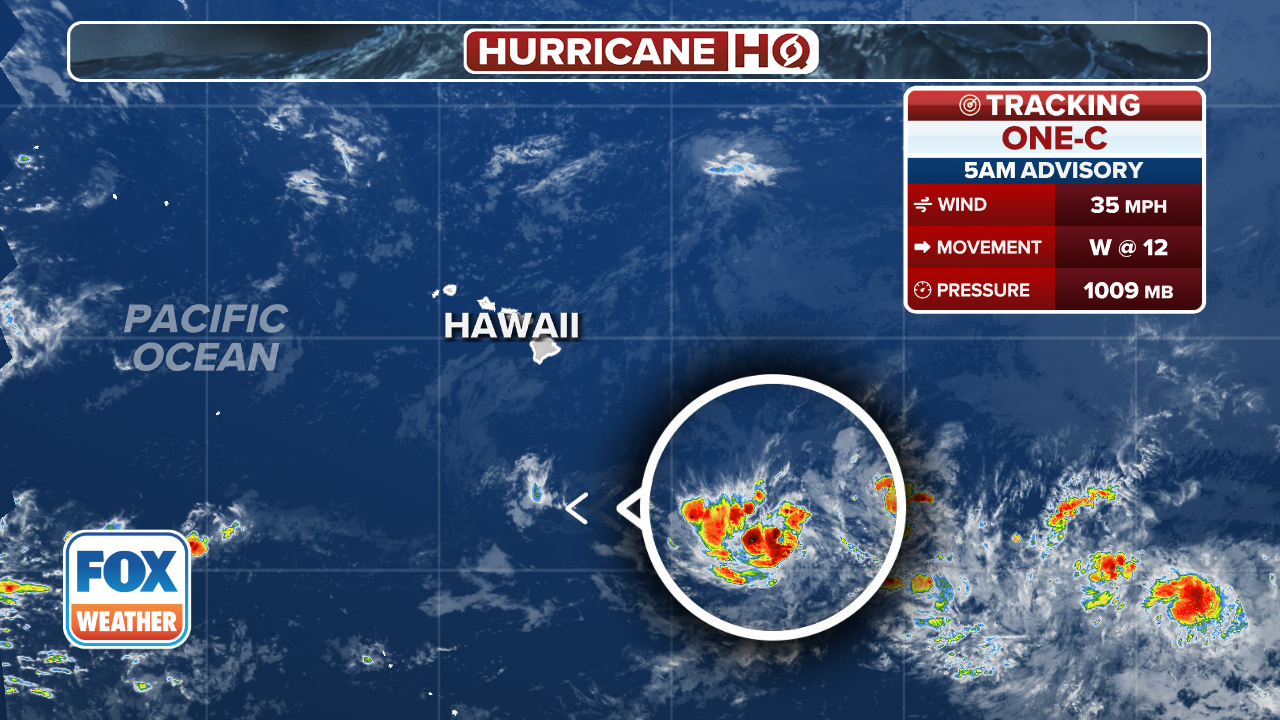
(FOX Weather)
Currently, Category 3 Hurricane Lala has winds of up to 125 mph, with possible further strengthening as the storm is expected to remain a hurricane for the next several days.
The hurricane poses no threat to land, as it will occur over open water. Still, it poses a notable risk to the marine wildlife inhabiting the sanctuary, one of the world's largest marine conservation areas, along with housing the Battle of Midway National Monument.
TROPICAL THREATS BREW IN ACTIVE PACIFIC FOLLOWING LALA’S SEVERE IMPACTS TO HAWAII
The sanctuary encompasses over 582,000 square miles of Pacific Ocean waters in Hawaii, protecting nationally significant natural, cultural and historical resources and providing opportunities to conduct research in various fields.
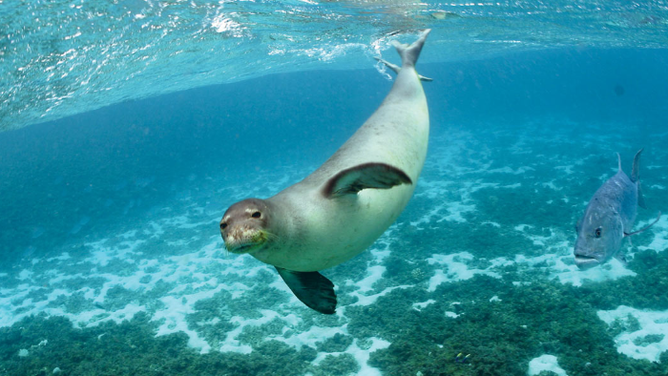
Hawaiian monk seal swimming amidst the Papahanaumokuakea Marine National Monument.
(James Watt/NOAA)
Within the vast protected waters of the Pacific is also the historic Battle of Midway Monument, a time in history that all Americans and perhaps the entire world should learn to appreciate, as it served as a major turning point in World War II.
MAGNITUDE 4.1 EARTHQUAKE RATTLES HAWAIIAN ISLAND SLAMMED BY FORMER HURRICANE LALA
Battle of Midway
The Battle of Midway took place six months following the bombing of Pearl Harbor, where the U.S. Navy achieved victory in a wild air and sea battle on June 3 to 6, 1942, as allies successfully defended the major base located on Midway Island.
Midway Island is a key location for controlling the Pacific, as it sits almost directly between the U.S. and Japan.
The battle began with the Japanese launching a diversionary attack on the Aleutian Islands.
THE BIGGEST HURRICANES AND TROPICAL STORMS TO THREATEN HAWAII IN THE LAST 10 YEARS
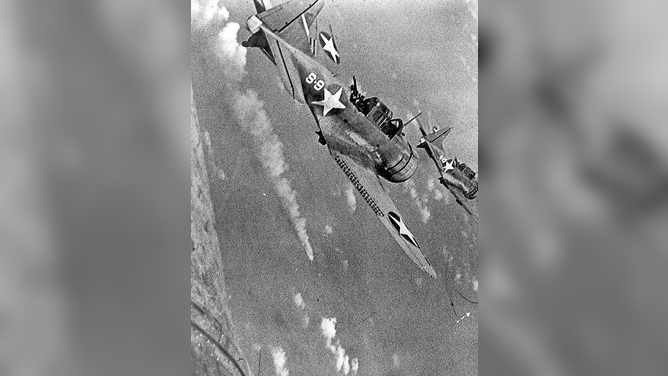
American dive-bombers attacking a Japanese ship during the Battle of Midway.
(National Archives and Records Administration)
In response, a group of B-17 Flying Fortress Bombers flew from Midway to attack what they thought was the main fleet of the Empire of Japan, which was actually strategically stationed 600 miles to the west.
This unsuccessful attack marked the first military engagement in the Battle of Midway, according to History.com.
HOW DID WEATHER PLAY A ROLE DURING WORLD WAR I FOR THE ALLIES?
Japan's plan to seize control of Midway involved a three-part approach: an air attack launched from four aircraft carriers, followed by an invasion force of ships and soldiers on the island, and finally an all-out joint strike with additional reinforcements from the main fleet.
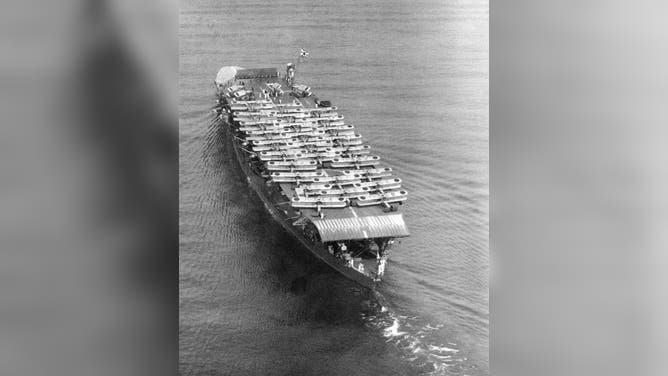
Japan: Imperial Japanese Navy aircraft carrier Akagi off Osaka, 15 October 1934. On deck are Mitsubishi B1M and B2M bombers.
(History/Universal Images Group / Getty Images)
Following another unsuccessful attack, Japanese forces launched phase one of their planned attack the next day, sending 108 warplanes from four aircraft carriers to the U.S. base on Midway, leaving it heavily damaged but still functional.
FROM SECRET SCIENCE TO PUBLIC HISTORY: MANHATTAN PROJECT PARK MARKS 10 YEARS
This became a chess match between military strategists on both sides: U.S. Admiral Chester W. Nimitz and Imperial Japanese Admiral Isoroku Yamamoto.
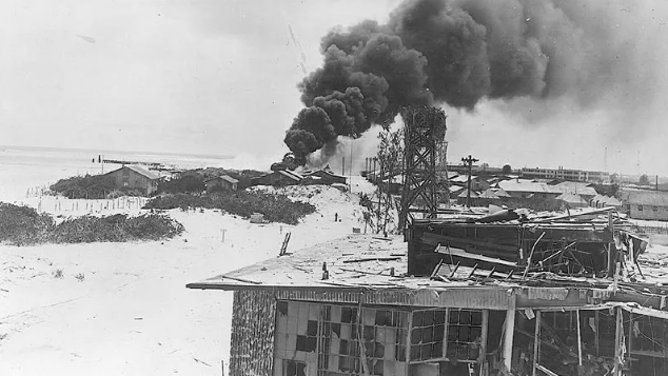
![Midway island after the first wave of Japanese attacks.]() Image 1 of 4
Image 1 of 4Midway island after the first wave of Japanese attacks. (National Archives and Records Administration)
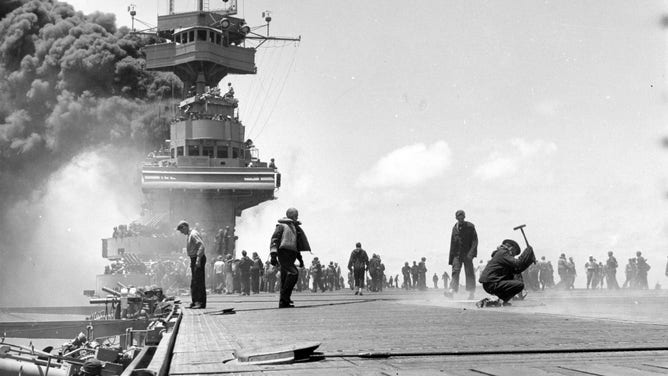
![Scene on board USS Yorktown (CV-5), shortly after she was hit by three Japanese bombs on 4 June 1942.]() Image 2 of 4
Image 2 of 4Scene on board USS Yorktown (CV-5), shortly after she was hit by three Japanese bombs on 4 June 1942. (Naval History and Heritage Command)
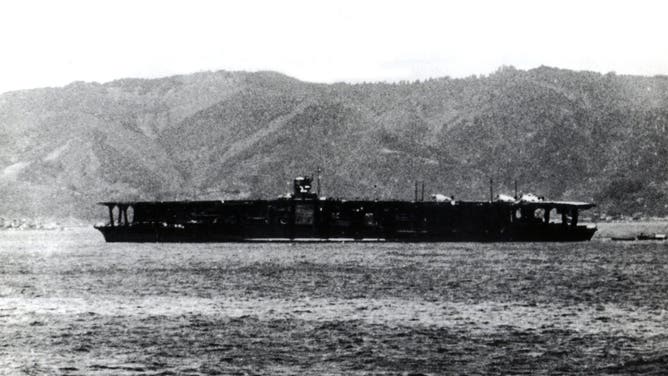
![Japanese aircraft carrier "Akagi", in the Sukumo Bay (Japan), April 27, 1939. Begun as a battle cruiser of the Amagi class, its keel was built in the Kure shipyard where it was finished on March 25, 1927 as a carrier. Modernized and overhauled in 1938, the "Akagi" participated in the attacks on Pearl Harbor and Ceylan (against the British fleet). Bearing the insignia of Admiral Nagumo, it was sunk during the Battle of Midway, June 5, 1942, along with the Japanese carriers "Kaga", "Soryu" and "Hiryu".]() Image 3 of 4
Image 3 of 4Japanese aircraft carrier "Akagi", in the Sukumo Bay (Japan), April 27, 1939. Begun as a battle cruiser of the Amagi class, its keel was built in the Kure shipyard where it was finished on March 25, 1927 as a carrier. Modernized and overhauled in 1938, the "Akagi" participated in the attacks on Pearl Harbor and Ceylan (against the British fleet). Bearing the insignia of Admiral Nagumo, it was sunk during the Battle of Midway, June 5, 1942, along with the Japanese carriers "Kaga", "Soryu" and "Hiryu". (Photo12/Universal Images Group)
![Japanese aircraft carrier Hiryu burning.]() Image 4 of 4
Image 4 of 4Japanese aircraft carrier Hiryu burning. (Naval History and Heritage Command)
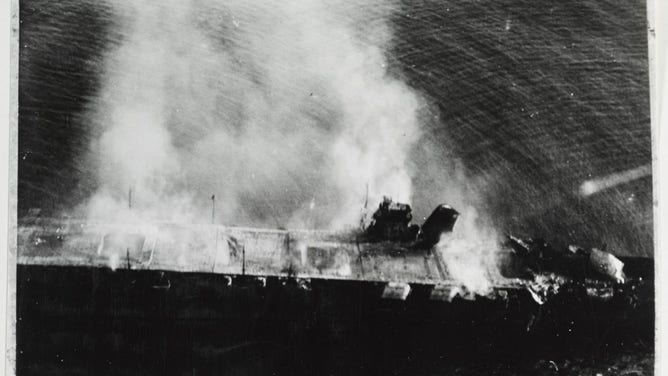
After unsuccessful attacks, a surprise wave of U.S. carrier-launched aircraft bombers struck and hit three Japanese carriers, setting them ablaze.
In response, the Japanese tried to use their last aircraft carrier, Hiryu, to launch two waves of attacks against the USS Yorktown, located east of Midway.
THE WEATHER BEHIND D-DAY: HOW METEOROLOGISTS INFLUENCED OPERATION OVERLORD
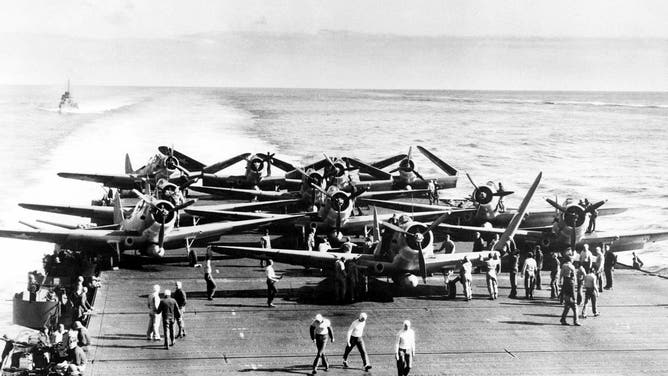
USA/Japan: TBD-1 torpedo bombers on the deck of USS Enterprise before launching an attack against four Japanese carriers in the Battle of Midway, 4 June, 1942. The squadron lost ten of fourteen aircraft during the attack.
(History/Universal Images Group / Getty Images)
This proved unsuccessful as U.S. dive bomber aircraft arrived from all three stationed carriers, destroying the last vessel of the Japanese fleet.
Despite the major combat of Midway ending by the evening of June 4, U.S. troops on land and sea continued their attacks over the next two days.
SEE IT: RARE 4TH-CENTURY ROMAN VILLA AND MOSAIC FOUND BENEATH FARM IN ENGLAND
On June 6, Japanese forces retreated, ending the Battle of Midway.
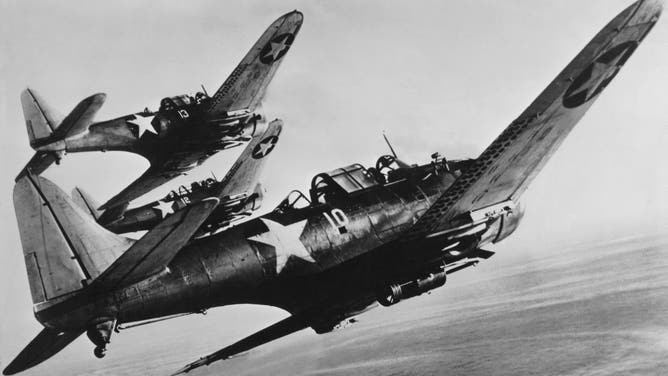
United States Navy carrier based Douglas SBD-3 Dauntless single engine scout plane dive bombers flying in formation over the Pacific during the Battle of Midway campaign circa June 1942 in the Hawaiian Islands archipelago of the North Pacific Ocean.
(Keystone/Hulton Archive / Getty Images)
In the end, Japan lost as many as 3,000 men, 300 aircraft, one heavy cruiser and four aircraft carriers, while the U.S. lost two aircraft carriers (Yorktown and Hammann), 145 aircraft and around 360 servicemen.
WOOL UNIFORMS AND EXTREME HEAT: A FIRSTHAND ACCOUNT OF WEATHER DURING THE BATTLE OF GETTYSBURG
As a result, Japan ended its dream of securing strategic control of the Pacific and remained on the defensive for the rest of the war. At the same time, the U.S. reestablished itself as the world's dominant naval power.