

See it: Rare 4th-century Roman villa and mosaic found beneath farm in England
Archaeologists from the University of Exeter and Cotswold Archaeology have recently uncovered a stunningly rare polychrome mosaic within the remains of a Roman villa beneath farmland in Devon County, England.
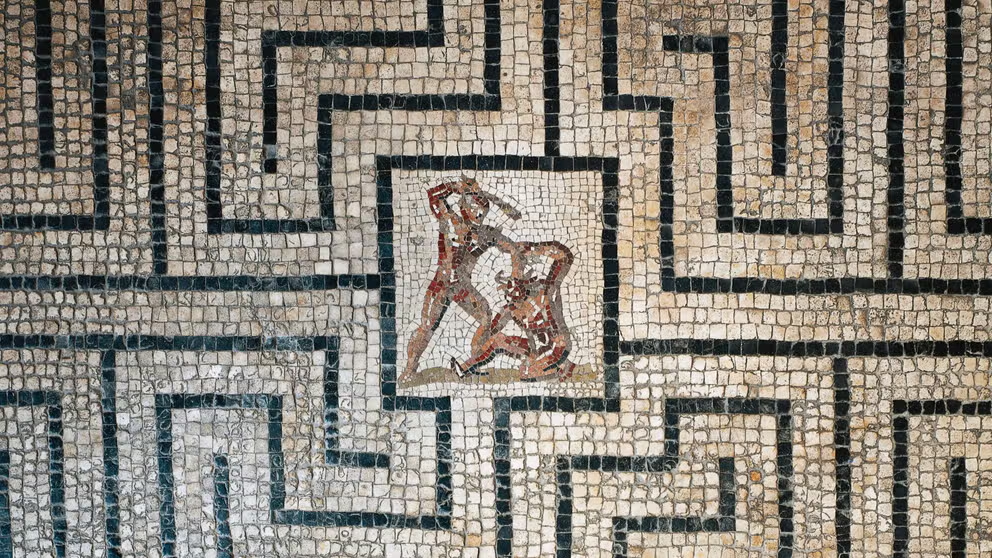
A Brief History of Mazes
Mazes and labyrinths have been found around the ancient world. One of which was made famous by ancient Greek legends, and it served as the setting for a hero's quest.
DEVON COUNTY, England – History lovers have had an exciting summer of discoveries thus far, as archaeologists have unearthed the remains of a Roman-era villa.
Archaeologists from the University of Exeter and Cotswold Archaeology have recently uncovered a stunningly rare polychrome mosaic within the remains of a Roman villa beneath farmland in Devon County, England.
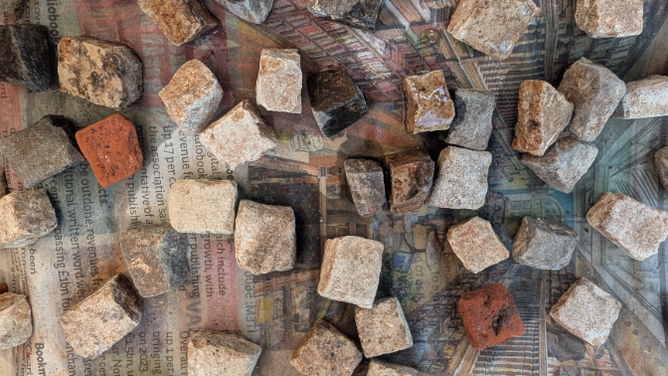
Within, the mosaic contains thousands of red, white, and dark blue/grey cubes, which surely was a sight to bear witness to when it was first constructed in the fourth century.
The mosaic has covered the floor of a room within the villa, potentially a dining or reception room, consisting of these small cubes, creating a beautiful art style.
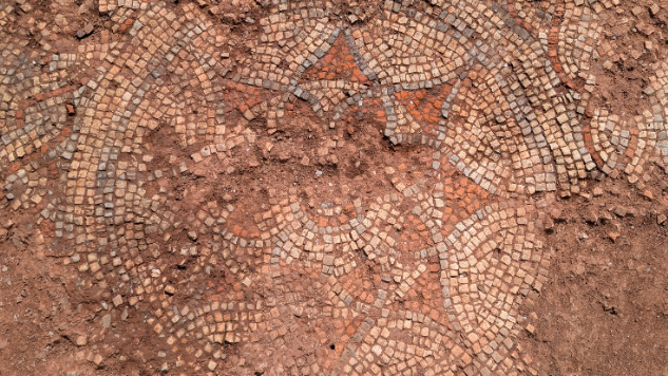
Mosaic from the Roman Empire, found in a 4th-century villa.
(University of Exeter’s Department of Archaeology and History)
According to researchers at the University of Exeter, this kind of discovery is rare in the region, with only a few villas found.
Further from the main villa where the mosaic was found, archeologists discovered a bathhouse with at least two pools and painted plaster walls, along with art depicting the Roman Goddess Victoria (victory).
These findings indicate that the residents during this time were certainly wealthy.
PHOTOS: 1,300-YEAR-OLD VIKING ERA SWORD DISCOVERED BY FIRST GRADE STUDENT ON SCHOOL FIELD TRIP
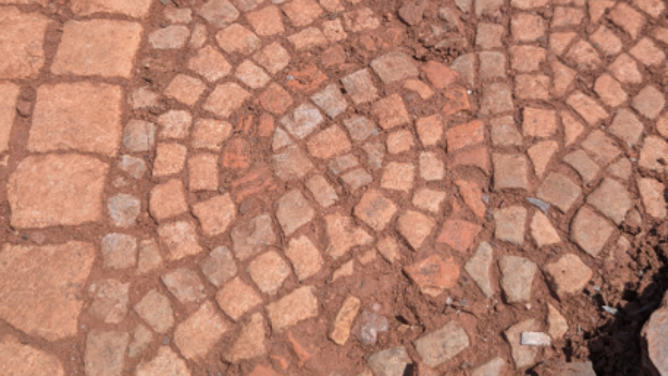
Detailed view of the mosaic found in England.
(University of Exeter’s Department of Archaeology and History)
"We did not expect to find such an elaborate bathhouse, for example," said project lead Dr. Susan Greaney from the University of Exeter’s Department of Archaeology and History. "This villa was undoubtedly home to people of wealth and high standing."
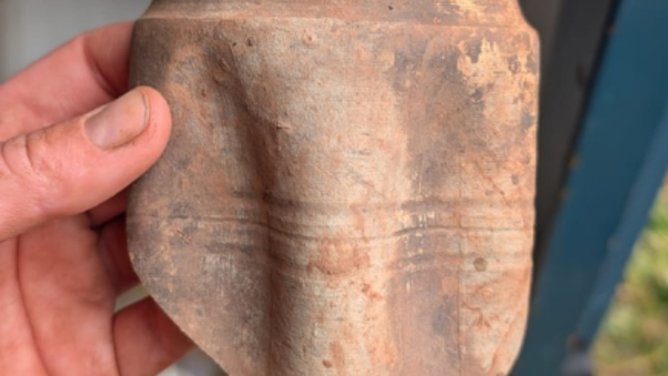
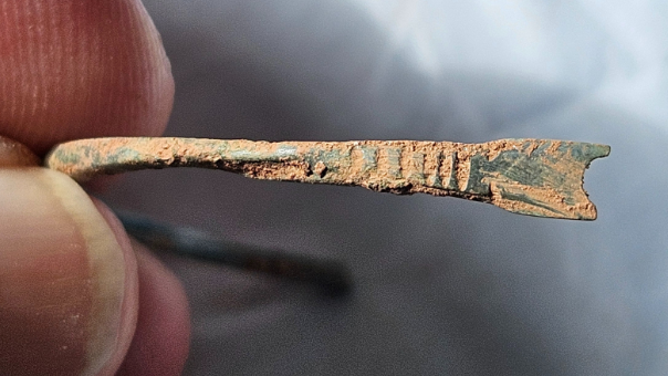
Amongst other items found in the villa were a silver spoon, a copper bracelet, various pottery, including a beaker used for serving drinks and a large storage jar.
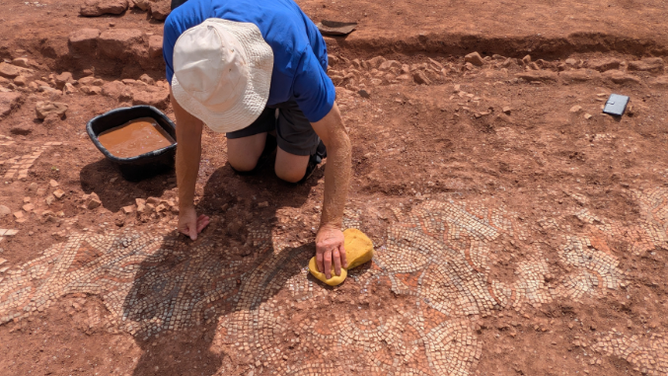
![Archeologists and students clean off the mosaic.]() Image 1 of 4
Image 1 of 4Archeologists and students clean off the mosaic. (University of Exeter’s Department of Archaeology and History)
![A well-kept beaker used for serving drinks was found in the Roman villa.]() Image 2 of 4
Image 2 of 4A well-kept beaker used for serving drinks was found in the Roman villa. (University of Exeter’s Department of Archaeology and History)
![A copper bracelet found among other items in a villa from the Roman Empire in England.]() Image 3 of 4
Image 3 of 4A copper bracelet found among other items in a villa from the Roman Empire in England. (University of Exeter’s Department of Archaeology and History)
![Small cubes used to create the mosaic found from the Roman Empire.]() Image 4 of 4
Image 4 of 4Small cubes used to create the mosaic found from the Roman Empire. (University of Exeter’s Department of Archaeology and History)
Two additional buildings were excavated, both built of stone, with one containing at least two large water tanks, likely used as a plunge bath. In contrast, the other was likely used as a barn or for agriculture, given the evidence of animal bones in the area.
These discoveries are incredibly rare for the region, as the Roman Empire's influence in modern-day Britain was brief. Yet, they shed light on the country's extensive history even before it was formed.
SEE IT: VILLA CONTAINING RUINS FROM ROMAN EMPIRE UNCOVERED IN EGYPT
Roman influence in Britain
Archeologists are astonished by the rare discovery of these Roman artifacts in Britain, which held influence in the land for just over 360 years and dispersed just before the fall of the Western Roman Empire.
Rome's influence in Britain began under the reign of Emperor Claudius, who took power in 41 A.D. following the assassination of his nephew and Co-Consul, Emperor Caligula.
Caligula was assassinated by his own group of elite soldiers that protected generals of the Roman Republic and eventually found then newly-appointed Claudius, deceivingly hiding behind a curtain during the event.
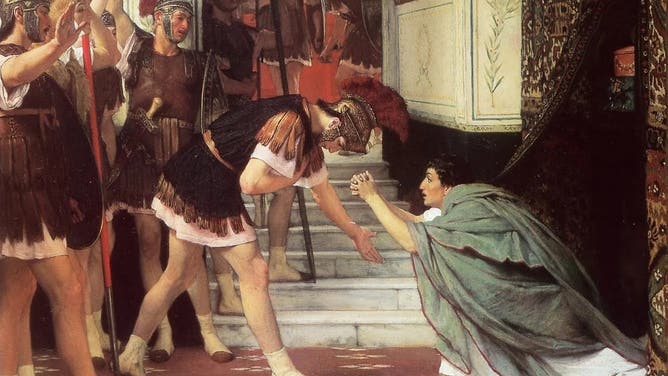
41 CE, the Roman Emperor Gaius Julius Caesar Augustus Germanicus (Caligula) was assassinated. Claudius, the emperor's uncle was found hidden behind a curtain by a Praetorian Guardsmen named Gratus who said "This is a Germanicus; come on, let us choose him for our emperor."
(Universal History Archive/Universal Images Group / Getty Images)
To his surprise, the same royal guard that killed Caligula saluted him as the new emperor.
Claudius did not have the best reputation amongst his peers, facing opposition from Rome’s senators who viewed him as weak, as he had physical disabilities and was passed off as dull or feeble.
This only fueled him and also initially helped him to deceive those who may have wanted to kill him along with Caligula, thinking he could be used as a pawn in the form of an emperor, which would be quite the opposite.
SEE IT: ARCHEOLOGISTS UNCOVER RESIDENTIAL CITY FROM BYZANTINE EMPIRE IN EGYPT
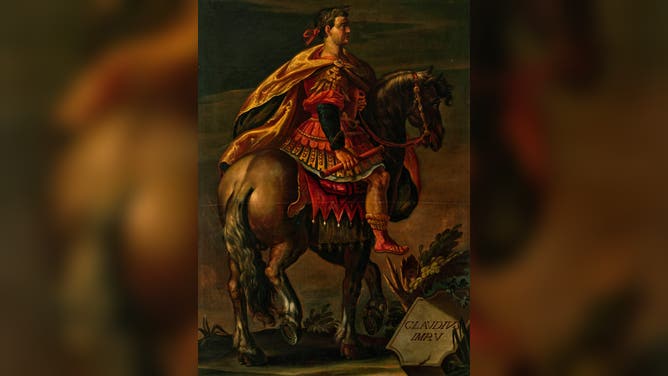
Emperor Claudius on horseback. Private Collection. Creator: Stradanus (Straet, van der), Johannes, (Follower) . (Photo by Fine Art Images/Heritage Images via Getty Images)
(Fine Art Images/Heritage Images / Getty Images)
In 43 A.D., he proved himself a worthy leader by launching a military campaign of 40,000 troops and several war elephants across the English Channel, according to History.com.
The goal was simple: to take the land that is modern-day Colchester and capture the leader of the Catuvellauni, a Celtic tribe that had fought against Roman expansion for almost 9 years.
Through further skirmishes against various tribes, the Romans were able to weaken their opponents logistically and take sections of land. In the first summer of the assault, the empire secured a massive chunk of land in Southeast Britain.
ARCHEOLOGISTS RESTORE LARGE FRESCO ON THE CEILING OF A HOME IN POMPEII FROM 2,000 YEARS AGO
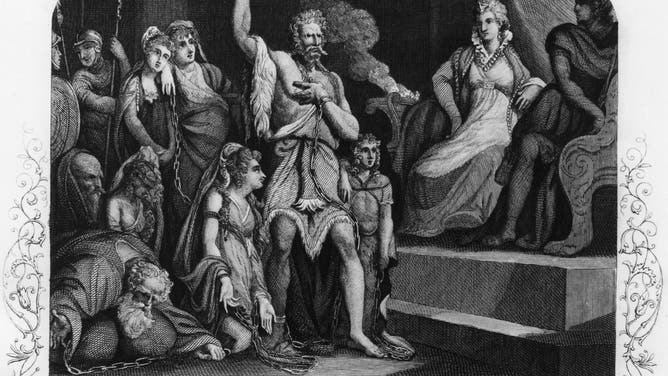
Caractacus, King of the Britons, with members of his family in chains addressing Roman Emperor Claudius, circa 50 AD.
(Hulton Archive / Getty Images)
Following years of resistance, the land was finally conquered, and the Roman Empire donned the name of Britannia for its new island territory.
2,000-YEAR-OLD GOLD RINGS ENGRAVED WITH ANCIENT SCRIPTURE DISCOVERED IN THAILAND
Colchester would become the capital of Britannia, the newly formed Roman province, and the establishment of further influence and justified colonization of the time for the empire that many cultures trace back to in history.