

Cemetery from the Roman Empire uncovered in Egypt reveals new details about monumental era in history
Officials recently uncovered a cemetery that revealed a variety of burial patterns, shedding light on the citizens of a legendary empire.
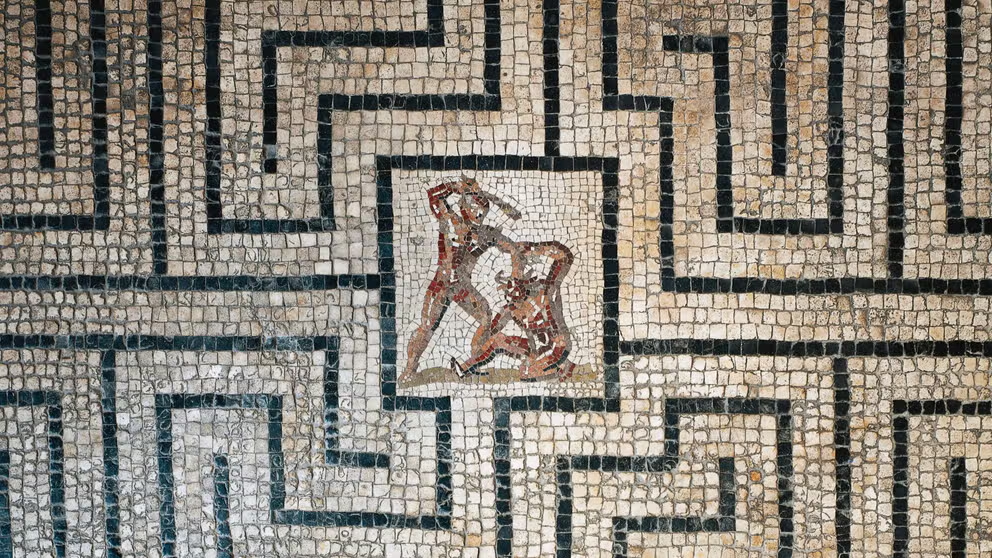
FILE: A Brief History of Mazes
Mazes and labyrinths have been found around the ancient world. One of which was made famous by ancient Greek legends, and it served as the setting for a hero's quest.
EGYPT – Lovers of the Roman Empire can rejoice about new discoveries recently made in Egypt after officials uncovered a cemetery revealing a plethora of information.
During an Egyptian archaeological mission as part of the Supreme Council of Antiquities, officials uncovered a cemetery from the Greco-Roman era.
Officials recently uncovered a cemetery that revealed a variety of burial patterns, shedding light on the citizens of a legendary empire.
PHOTOS: BOY DISCOVERS RARE, PREHISTORIC FOSSIL DURING FIELD TRIP IN KANSAS
According to the Ministry of Tourism and Antiquities in Egypt, several graves featured different styles and patterns, such as color-plaster coffins and barrel-shaped pottery coffins, which were very common during the Ptolemaic Period, the era just before Rome dominated this land.
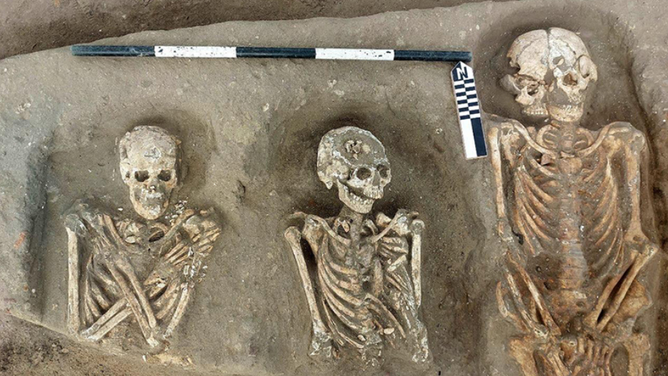
Officials uncover a roman cemetery in Egypt.
(Arab Republic of Egypt Ministry of Tourism and Antiquities )
Along with these findings, officials uncovered storage containers and ovens containing large quantities of fish, bird and other animals' bones, which shed light on the daily activities and diets of the Romans in Egypt.
According to the National Library of Medicine, the typical life expectancy during this time period was 30 to 35 years old.
PHOTOS: 1,300-YEAR-OLD VIKING ERA SWORD DISCOVERED BY FIRST GRADE STUDENT ON SCHOOL FIELD TRIP
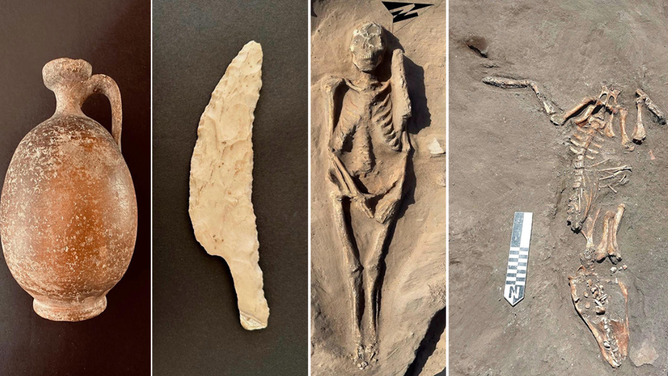
Other items found at a cemetery from the Greco-Roman era in Egypt.
(Arab Republic of Egypt Ministry of Tourism and Antiquities )
According to the Museum of Natural History, most people during this time ate vegetables and starchy roots, cereals, fish and seafood, eggs and spices.
SUNKEN WWI SHIP 'TAMPA' FOUND OFF ENGLISH COAST, SOLVING CENTURY-OLD MYSTERY
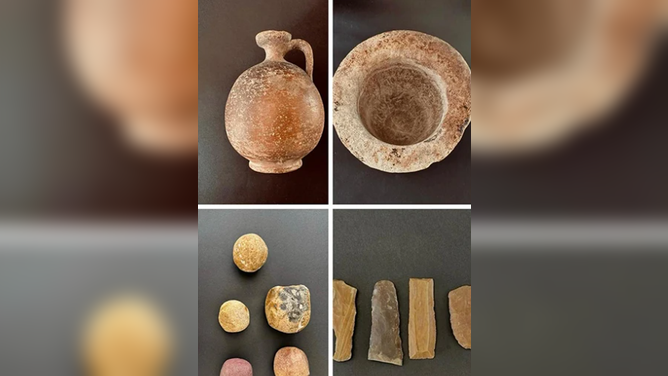
Items found at a cemetery from the Greco-Roman era.
Roman influence in Egypt
During this time, in the Greco-Roman era, the Roman Empire was further expanding in the Middle East, officially beginning with the arrival of Emperor Augustus in 30 B.C., following the easy defeat of Mark Antony and Cleopatra.
Once the empire arrived, they quickly dismantled the once-great monarchy, which had only existed as a dutiful ally after Julius Caesar aided Cleopatra in the Battle of the Nile in 47 B.C., allowing her to remain on the throne as co-regent with her half-brother, Ptolemy XIV, according to History.com.
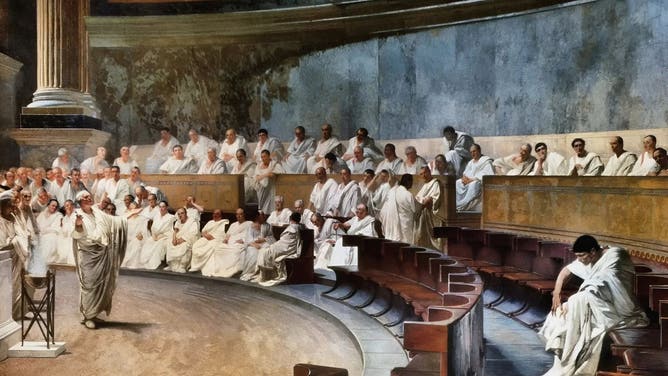
A fresco by Cesare Maccari (1840 1919) depicting Roman senator Cicero (106 43 BCE E) denouncing Catiline's conspiracy to overthrow the Republic in the Roman senate. (Palazzo Madama, Rome). Note: illustrations commonly show the senators arranged in a semicircle around an open space where orators were deemed to stand; in reality the structure of the existing Curia Julia building, which dates in its current form from the Emperor Diocletian, shows that the senators sat in straight and parallel lines on either side of the interior of the building. The Senate was also larger and more dull.
(Universal History Archive/Universal Images Group / Getty Images)
Tensions had been building since the first triumvirate, the era of the Roman civil war, when a Roman Consul, Pompey the Great, sided with Julius Caesar.
The civil war following this, initiated in 49 B.C., when Julius Caesar was pitted against his former ally, Pompey the Great, who was jealous and had his own supporters, demanding Caesar return to Rome as a civilian.
A year later, Pompey would be defeated by Caesar and flee to Egypt in an attempt to seek aid from former allies Ptolemy and Cleopatra, but on Sept. 28, before he stepped on shore, he was struck down and assassinated.
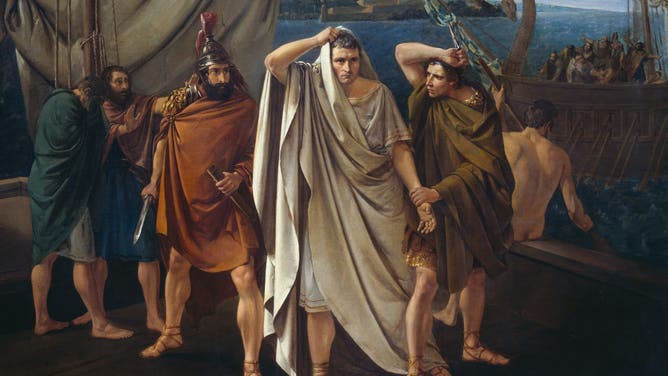
The murder of Pompey the Great, 1836, painting by Enrico Bandini (1807-1888).
(Getty Images)
Ptolemy was intimidated by Caesar and didn’t want to get on his bad side, while also trying to get an edge on his sister.
ANCIENT DISCOVERY: LOST PAGES OF THE NEW TESTAMENT REVEAL LETTERS OF THE APOSTLE ST. PAUL
This was a huge mistake; not only did Ptolemy misread the situation, but he also disrespected the consul of Rome in Pompey with the brutal murder and severed head upon presentation to Caesar.
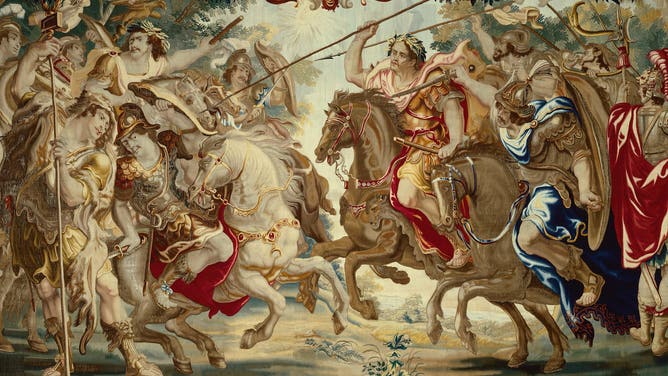
Caesar Defeats the Troops of Pompey, from 'The Story Caesar and Cleopatra', Flanders, circa 1680circa 1680. Woven at the workshop of Gerard Peemans, after a design by Justus van Egmont. Detail from a larger artwork. Artist Gerard Peemans.
(Heritage Art/Heritage Images / Getty Images)
As a result, Caesar executed Pompey’s assassins. He transported Cleopatra to safety amidst Egypt’s now-newly emerged civil war, in which he will side with her and become lovers over the next six months in Alexandria, Egypt.
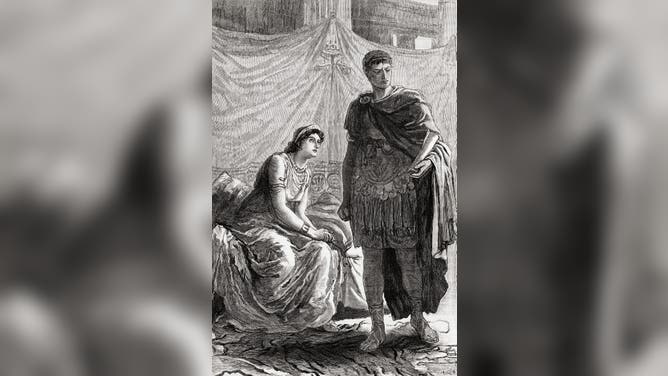
The interview between Cleopatra and Octavian, after his victory over Mark Anthony at the battle of Actium in 31 BC, where she pleads her innocence. Cleopatra VII Philopator, 69 BC – 30 BC. Queen of the Ptolemaic Kingdom of Egypt. Caesar Augustus, 63 BC – AD 14, aka Octavian. First Roman emperor. From Cassell's Illustrated Universal History, published 1883.
(Ken Welsh/Design Pics/Universal Images Group / Getty Images)
This would lead to the eventual permanent control of Egypt years down the road, following the death of Caesar and other political factors for both once-powerful empires.
THE WEATHER BEHIND D-DAY: HOW METEOROLOGISTS INFLUENCED OPERATION OVERLORD
Further discoveries throughout Egypt offer additional insight into the daily lives and history of the former empire.