

Hear it: Scientists recreate the sounds of a Jurassic forest from millions of years ago
By studying living relatives and measuring wing vibrations, experts built a 2-D digital model of each fossil wing and ran physical simulations to determine its natural frequency.
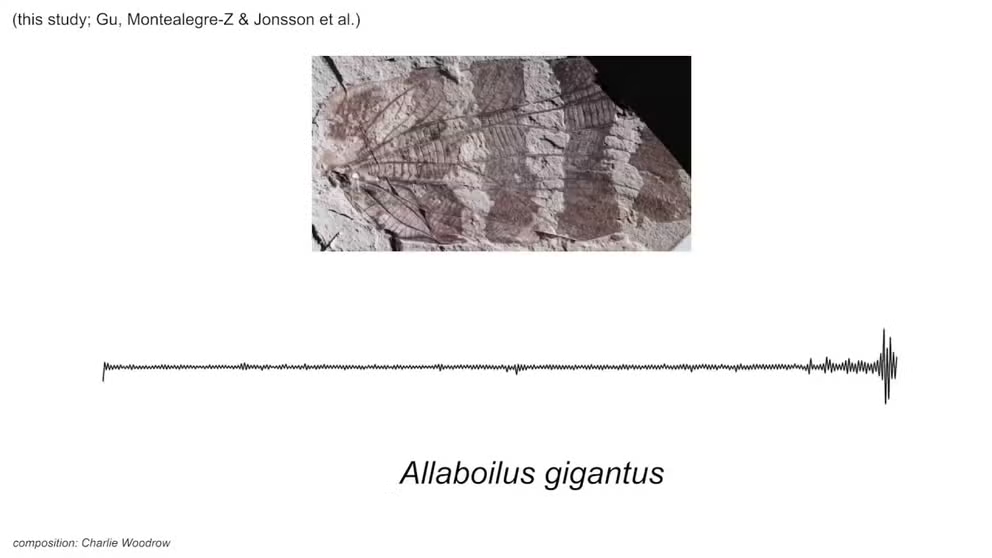
What a Jurassic forest may have sounded like millions of years ago
PREHISTORIC SOUNDS: Check out this simulation of what a prehistoric forest and its ecosystem from the Jurassic period may have sounded like millions of years ago.
THE TAKEAWAY
- Listen to what a prehistoric forest from the Jurassic Period may have sounded like.
- Experts built a 2-D digital model of each fossil wing and ran physical simulations to determine these sounds.
- Experts were able to analyze 20 fossils from Mongolia, China.
Little is known about the sounds of the natural environment that dinosaurs inhabited millions of years ago in Jurassic forests, or the exact noises some of these creatures made, but scientists just got a step closer after analyzing fossils.
Although it is nearly impossible to replicate the sounds dinosaurs made because vocal organs and other soft tissues rarely fossilize and survive the test of time, scientists can still salvage the sound-producing structures of certain species.
Researchers in the Proceedings of the National Academy of Sciences (PNAS) explore the background of efforts to revive these extinct sounds.
ANCIENT SHARK GRAVEYARD DISCOVERED IN EGYPT REVEALS 5 EXTINCT SPECIES FROM DINOSAUR ERA
By analyzing the sound-producing structures in the sclerotized cuticle of fossilized arthropods, along with the stridulatory files and plectra preserved in fossilized wings, they found distinct features that reveal aspects of their calls.
Stridulatory files perform the process of Stridulation, which is the act of producing sound by rubbing two body parts together, like a cricket.
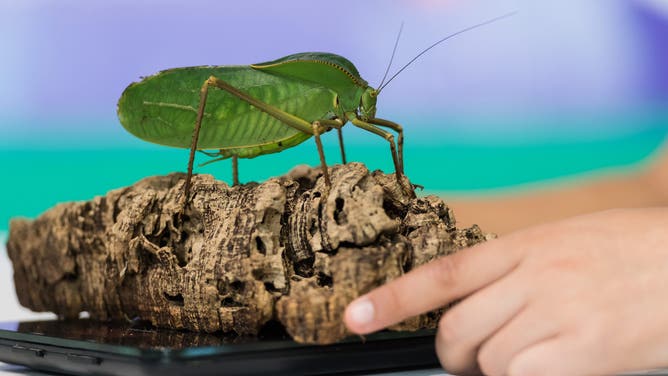
LONDON, UNITED KINGDOM - AUGUST 24, 2026: A zookeeper weighs a katydids during the photocall for the annual weigh-in at ZSL London Zoo in London, United Kingdom on August 24, 2026. Every year keepers at the London Zoo record animals' vital statistics to monitor their health and general well-being.
(Wiktor Szymanowicz/Future Publishing / Getty Images)
Insects such as crickets and katydids are major contributors to our planet's soundscapes and have changed significantly since their emergence during the Late Carboniferous period, around 359 to 299 million years ago.
Using a phylogenetic approach with laser Doppler vibrometry and numerical simulations, experts analyzed 20 fossils from Mongolia and China and reconstructed their acoustic features.
SEE IT: RARE 4TH-CENTURY ROMAN VILLA AND MOSAIC FOUND BENEATH FARM IN ENGLAND
Through this process, they reconstructed the acoustic landscape and showed diverse tones of ultrasonic calls, with implications for early insect-mammal co-evolution.
These prehistoric insects produced pure-tone calls, with frequencies and repertoires associated with different morphologies and wing sizes.
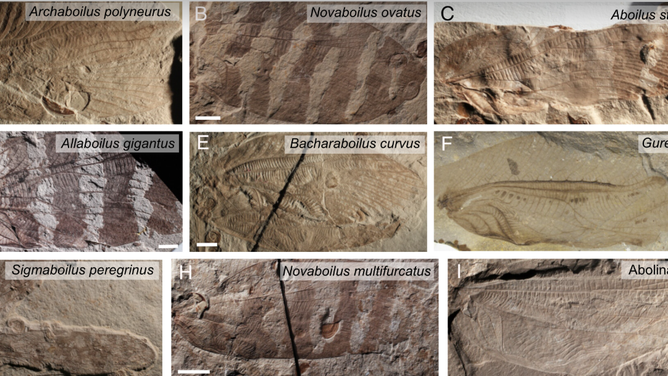
Fossilized insects from the late Jurassic Period.
Much like today, only certain insects roam certain landscapes, but a noticeable feature of these biodiverse habitats is the acoustic landscape in which the inhabitants created.
"Undoubtedly, the forests, grasslands and steppes of the Cenozoic and Mesozoic were filled with acoustic signals emitted by a rich diversity of both invertebrates and vertebrates," the PNAS said.
40,000-YEAR-OLD FROG FOSSILS UNEARTHED IN SOUTHERN CALIFORNIA REVEAL A SPECIES LOST TO TIME
While sound itself does not fossilize, experts can infer and hypothesize these ancestral sound-producing and hearing traits through ancestral state reconstruction based on the traits of a modern-day relative of these extinct bugs.
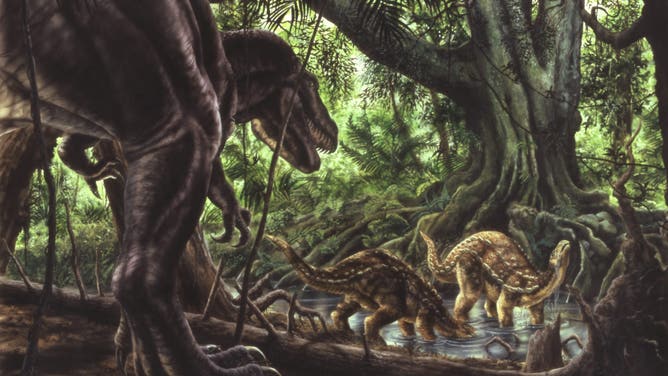
UNSPECIFIED - AUGUST 14: Illustration of Dracopelta
(De Agostini via Getty Images/De Agostini / Getty Images)
Modern-day relatives, such as hump-winged crickets (Prophalangopsidae), are living fossils that have wing morphologies and stridulatory behaviors that have been deeply preserved for ages.
Only nine species of hump-winged crickets are known to exist today; roughly 100 others are known only from fossils.
SEE IT: ANCIENT TOMB AND ARTIFACTS UNCOVERED DURING EXPANSION OF ITALIAN PASTA FACTORY
This provides a rare functionally informed window into how some of these early insects and their Jurassic ancestors may have generated sound.
By studying the living relatives and measuring wing vibrations, experts built a 2-D digital model of each fossil wing and ran physical simulations to determine its natural frequency.
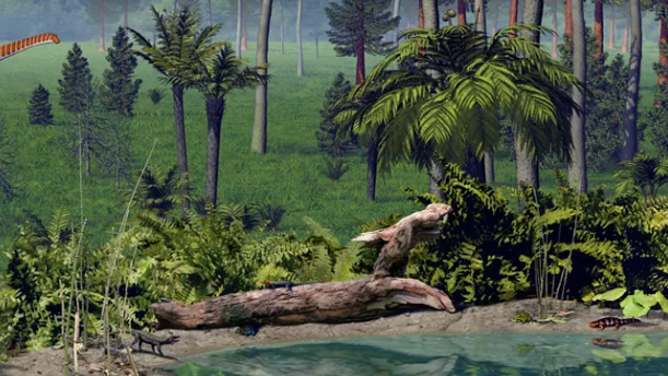
Environment during the late Jurassic Period.
(NPS / Bob Walters and Tess Kissinger)
Experts simulated the insect's sound by striking its own fossilized wing, creating a vibration from the fossil itself.
The result is an odd, but somewhat similar-sounding scenery to modern day, as you can imagine various bugs making different noises as you walk through the dense prehistoric forest.
ANCIENT SHARK GRAVEYARD DISCOVERED IN EGYPT REVEALS 5 EXTINCT SPECIES FROM DINOSAUR ERA
The noises these extinct insects made are unlike anything we’ve heard in modern day, letting you imagine what it would sound like to be in a prehistoric environment.
Hopefully, with further advances in technology, we can discover other sounds that extinct animals made millions of years ago.