

Ancient shark graveyard discovered in Egypt reveals 5 extinct species from dinosaur era
During the Late Cretaceous, sea levels stood roughly 320 to 850 feet higher than they do today.

FILE: Fossil diver discovers extremely rare megalodon tooth in Florida
Kristina Scott went diving in Venice, Florida, on May 14 for fossils. Little did she know she'd find a massive six-inch megalodon tooth.
THE TAKEAWAY
- Five extinct shark species from the Cretaceous period were found in Egypt.
- Researchers found 14 fossilized teeth.
- The Cretaceous period had sea levels ranging from 320 to 850 feet higher than today.
EGYPT – Scientists have made a rare discovery in Egypt's desert, uncovering a shark graveyard of now-extinct species left frozen in time, waiting to be found.
Archaeologists in Egypt's southwestern desert dug phosphate beds from the Duwi Formation, a Late Cretaceous deposit, and found a former tropical marine environment that preserved these fossils.
This geological dig site preserves marine vertebrates and fossils, allowing experts to connect certain physical attributes correctly.
ANCIENT 'LOST WORLD' COULD REWRITE HISTORY FOR HOW FIRST AMERICANS ARRIVED 13,000 YEARS AGO
The result is a new assemblage of extinct lamniform sharks, some of which represent the first fossil record for Egypt and Africa, according to Cretaceous Research.
Within these phosphate beds, archaeologists uncovered five extinct shark species named Cretalamna cf. C. maroccana, Scapanorhynchus cf. S. raphiodon, Serratolamna cf. S. serrata, Squalicorax bassanii, and Squalicorax pristodontus.
Officials also found 14 fossilized teeth belonging to the sharks.
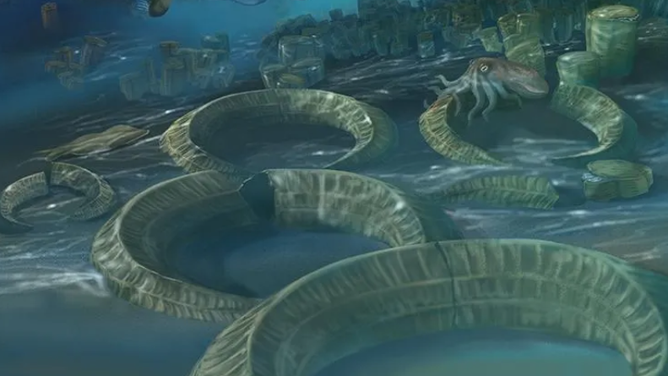
This illustration shows the edge of a warm inland sea during the Cretaceous Period.
(Smithsonian Institution)
This was the Late Cretaceous period, when sea levels were much higher than today, ranging from around 320 to 850 feet higher than now.
Evidence suggests life probably began in the ocean at least 3.5 billion years ago, with the first organisms being single-celled microbes, and for 2.3 billion years, life consisted of only this.
WATCH: SANDBAR SHARK SWIMS OFF RHODE ISLAND COAST AS NUMBERS ACROSS NEW ENGLAND SURGE
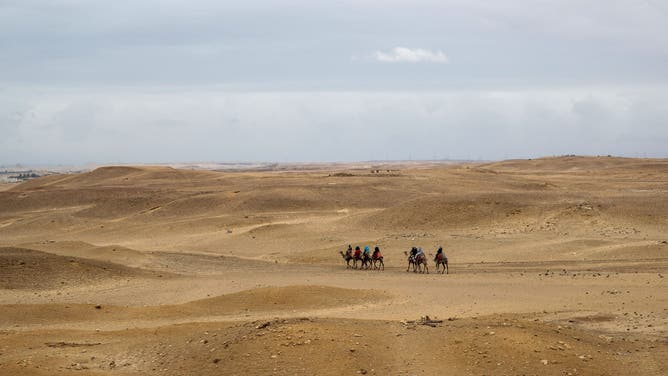
Tourists ride camels in the desert outside the Giza pyramids necropolis on the southwestern outskirts of the Egyptian capital on March 13, 2020.
(Mohamed el-Shahed / AFP / Getty Images)
Until around 1.2 billion years ago, when more complex multicellular organisms evolved, and since then, more life forms have appeared and evolved, but not continuously, as some don't survive the changes of this world.
SEE IT: ANCIENT TOMB AND ARTIFACTS UNCOVERED DURING EXPANSION OF ITALIAN PASTA FACTORY
Through further study and more discoveries in this region, officials hope to shed new light on the paleodiversity and secrets these fossils hide about various periods in time and the environment they inhabited.