

Ancient 'lost world' could rewrite history for how first Americans arrived 13,000 years ago
The Kelp Highway Theory proposes that the first Americans arrived by sea by following the Pacific Rim to avoid glaciers, completely overturning the previous decades-long belief that the people came over on the Bering Land Bridge.

FILE: Chillin' with Van Dillen and 'Park'd' host Abby Hornacek
FOX Weather Meteorologist Bob Van Dillen sits down with FOX Nation's Abby Hornacek, host of Park'd. Listen in as they chat about how she became the host of Park’d, her family’s competitive streak and her intense adventures.
New evidence suggests that Americans may not have arrived in the Americas by the previously thought Bering Land Bridge, but actually by boat.
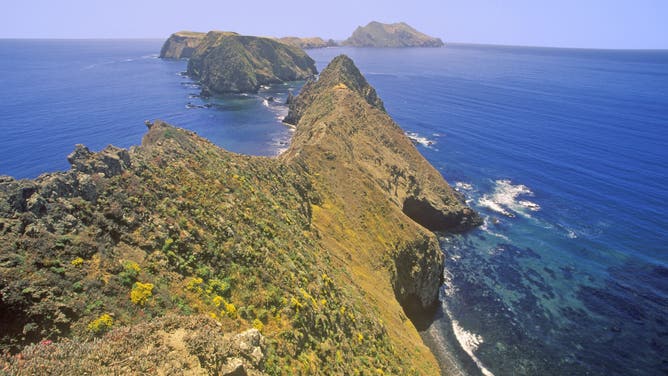
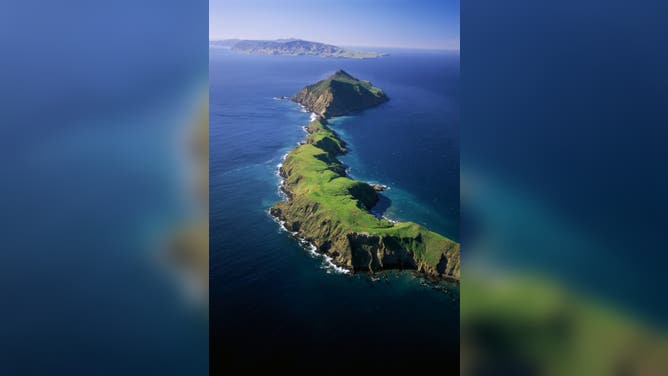
Off the coast of California sits eight islands known as the Channel Islands. Popular for their sea caves, kelp forests, kayaking and whale watching, these islands act as a beautiful and serene spot for travelers from all over the world.
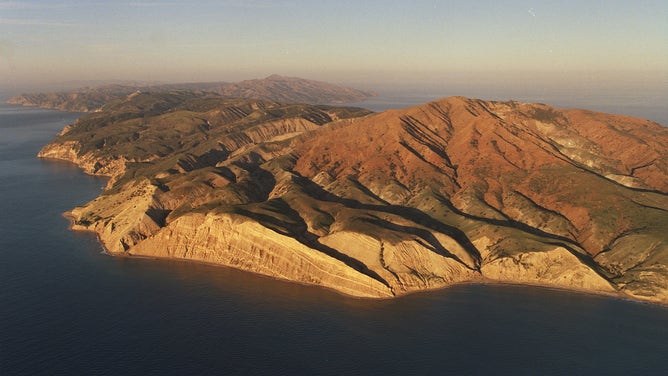
CHANNEL IS.1/C/22DEC97/MN/MACOR Southern California just off the coast from Ventura, The Channel Islands. National Parks Sevice maintains the Islands, Santa Cruz Island shown here is the newest addition to the chain as a National Park. South-Western side at sunrise.
(Photo By MICHAEL MACOR/The San Francisco Chronicle via Getty Images / Getty Images)
Due to the lack of burrowing animals in the area, like rodents and earthworms, the Channel Islands are known for their historically accurate and intact sedimentary layers, making them a popular spot for archaeologists.
Over 18 million years ago, these islands were right off the coast of San Diego but shifted over time due to continental drift. Their first discovery was in 1542 by Portuguese explorer Juan Rodríguez Cabrillo.
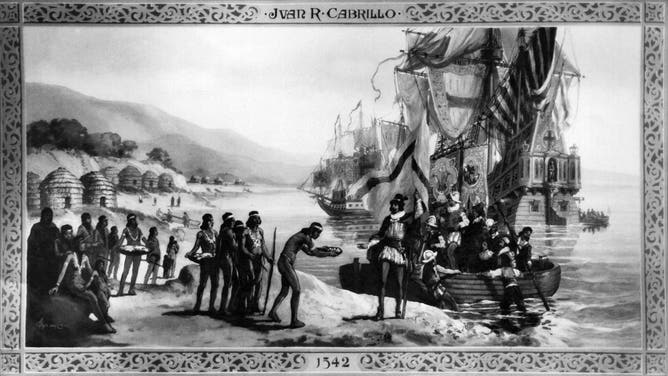
A painting depicting Juan Rodriguez Cabrillo meeting natives on the California coast during his expedition, California, 1542.
(Photo by Underwood Archives/Getty Images / Getty Images)
In the late 1940s, archaeologist Phil Orr set up camp on Santa Rosa Island, the second largest of the Channel Islands, 26 miles off the coast of Southern California, to discover if pygmy mammoths and humans lived simultaneously on the islands.
This project led him to dig deep into Earth’s layers, which is where, in 1959, he discovered the oldest human remains ever found in North America, dating back 13,000 years ago. The remains were later named the Arlington Man.
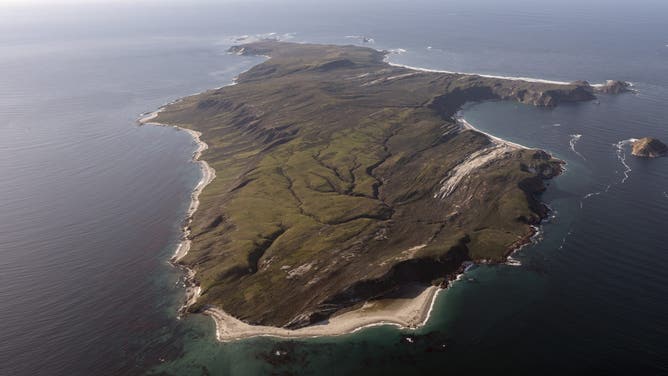
UNITED STATES - JANUARY 27: Aerial view of Santa Rosa Island, one of eight islands in the Channel Islands archipelago located in Santa Barbara Channel of the Pacific Ocean off the coast of Southern California
(Photo by Carol M. Highsmith/Buyenlarge/Getty Images / Getty Images)
This is where, while unknown at the time, the theory that the journey to America could have been by sea travel sprouted.
But if the bones were found in 1959, why are we just now talking about this theory?
It is due to a combination of factors.
First, at the time when Orr found the Arlington Man, due to the lack of proper equipment, he was unable to date the bones without destroying them. He was only able to obtain a charcoal sample nearby and date it back to 10,000 years before his time.
Second, due to the lack of evidence, Orr was unable to draw any strong conclusions about the remains and how they could tie back to the first Americans.
These factors, in combination with the widely accepted Clovis theory that dominated the ideas at the time, led to a standstill on the discovery.
That’s where geologist Thomas Stafford came into play.
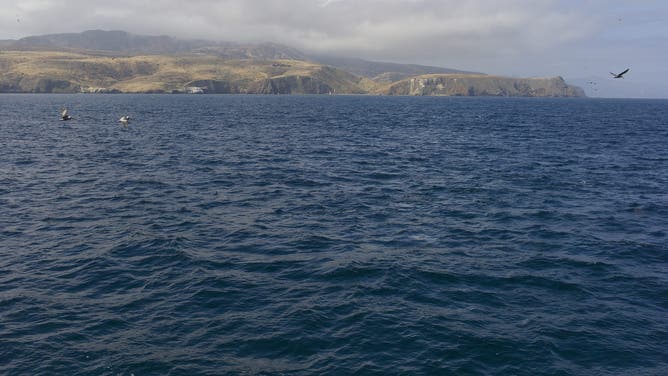
The California coastline off of Santa Barbara is shared by oil platforms and an extremely rich ocean ecosystem around the Channel Islands, which are migrational feeding zones for several whale species and include a national park.
(Photo by Andrew Lichtenstein/Corbis via Getty Images / Getty Images)
Nearly 40 years after their original discovery, Stafford used improved radiocarbon dating to determine the remains to be approximately 13,000 years old.
With the discovery of the remains’ true age and the evidence and findings over the decades since their discovery, the idea that the Paleo-Indians could have voyaged by the sea was finally coming together. And so, the Kelp Highway Theory was born.
The Kelp Highway Theory proposes that the first Americans arrived by sea by following the Pacific Rim to avoid glaciers, completely overturning the previous decades-long belief that the people came over on the Bering Land Bridge.
This theory is not only supported by the remains of the Arlington Man, but also by the ecosystem.
The kelp highway has the same animals and plants all the way from Japan to California.
![]() Image 1 of 2
Image 1 of 2Inspiration Point on Anacapa Island, Channel Islands National Park, California (Photo by: Joe Sohm/Visions of America/Universal Images Group via Getty Images)
![]() Image 2 of 2
Image 2 of 2Aerial view of Anacapa Island in Channel Islands National Park, California. (Photo by Nik Wheeler/Corbis via Getty Images)
This is important because it means that the travelers didn’t have to acclimate to a new environment and could continue using the same hunting and gathering skills they were used to, aiding their survival.
With the recent discovery of pre-Clovis sites like southern Chile’s Monte Verde, where remains were found that date back to 14,500 years ago, the Kelp Highway Theory is proving to become more probable and more widely accepted every day.
Today, the main population of the Channel Islands is made up of park employees and visitors.
According to the National Park Service, the goal of the staff is to "preserve the historic resources associated with the various historic inhabitants of the islands to help tell their stories to the public."