

What if Yellowstone ‘blows’? A look at the worst-case scenario
The following timeline explores a hypothetical worst-case scenario, based on volcanic research from UK scientists.
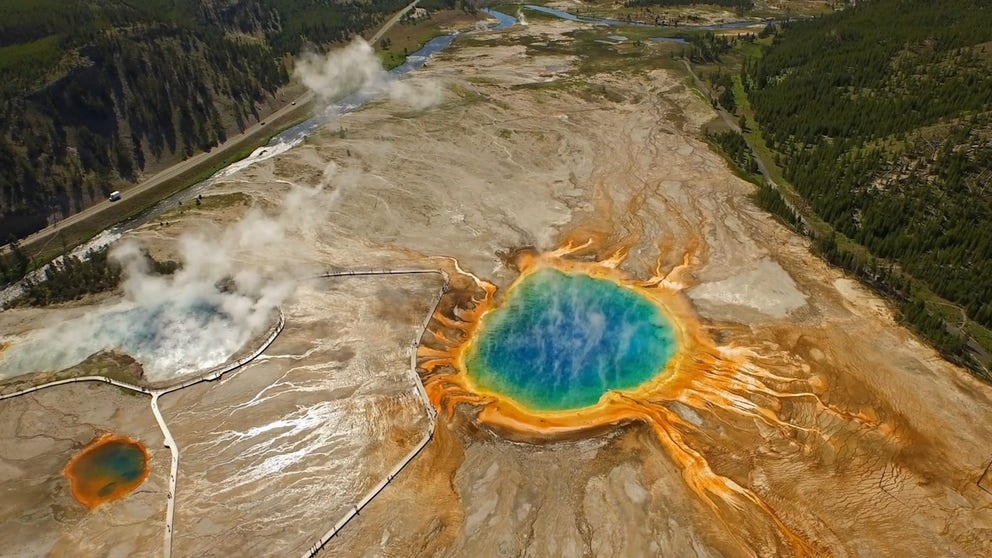
FILE: Yellowstone National Park
A look at the United States' first National Park: Yellowstone.
THE TAKEAWAY
- A massive volcanic eruption rocked what is now northwestern Wyoming, sending ash across much of North America and altering the global climate.
- If a similar eruption happened today, the effects would be impossible to ignore.
- The following timeline explores a hypothetical worst-case scenario, based on volcanic research from UK scientists.
YELLOWSTONE NATIONAL PARK, Wyoming - Around 631,000 years ago, a massive volcanic eruption rocked what is now northwestern Wyoming, sending ash across much of North America and altering the global climate.
YELLOWSTONE EXPLOSION CAUSED BY ‘CLOGGED UP’ HYDROTHERMAL SYSTEM, SCIENTISTS SAY
No known humans witnessed the catastrophe. But if a similar eruption happened today, the effects would be impossible to ignore.
A Yellowstone super-eruption would have the potential to disrupt life across the U.S. and the world.
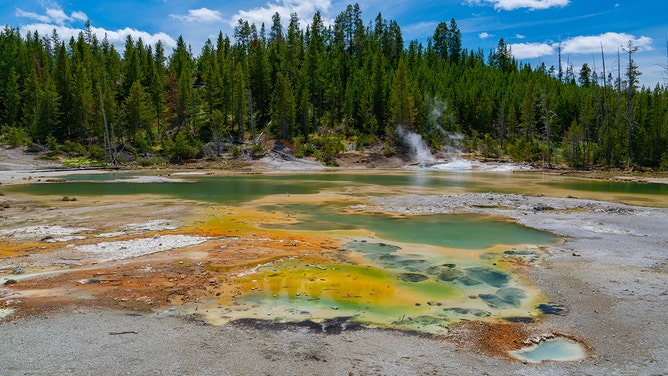
General views of Crackling Lake in the Norris Geyser Basin at Yellowstone National Park on May 27, 2021 in Yellowstone National Park, Wyoming.
(AaronP/Bauer-Griffin/GC Images / Getty Images)
So, what would happen if Yellowstone erupted?
The following timeline explores a hypothetical worst-case scenario, based on volcanic research from United Kingdom scientists.
WATCH: ERUPTION AT YELLOWSTONE NATIONAL PARK POOL CAUGHT ON CAMERA
T-2 months
Shortly after 6 a.m., an analyst monitoring Yellowstone's seismic activity notices an unusual cluster of earthquakes beneath the massive caldera.
Yellowstone experiences thousands of earthquakes every year, and earthquake swarms are not unusual. However, scientists pay particular attention when swarms become concentrated, migrate upward or occur alongside other changes.
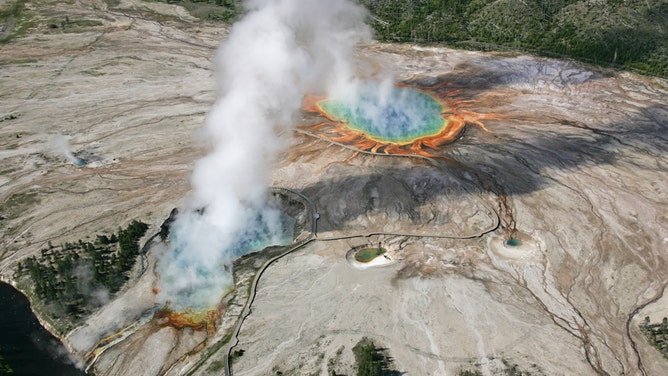
An aerial photograph of Excelsior Geyser and Grand Prismatic Spring in the Midway Geyser Basin, Yellowstone National Park, Wyoming.
(Photo via Smith Collection/Gado/Getty Image / Getty Images)
Additional monitoring reveals that the earthquakes are clustering beneath Yellowstone's caldera, which stretches roughly 34 to 43 miles across.
NEW BLUE POOL AT YELLOWSTONE NATIONAL PARK DISCOVERED AFTER 'MILDLY EXPLOSIVE' ACTIVITY
According to the study, scientists do not consider the activity proof that an eruption is coming. They begin watching the volcano more closely.
T-1 month
Four weeks later, the earthquake swarm continues and becomes shallower.
GPS stations show that the ground above the activity is moving apart, while instruments measuring deformation detect increasing strain.
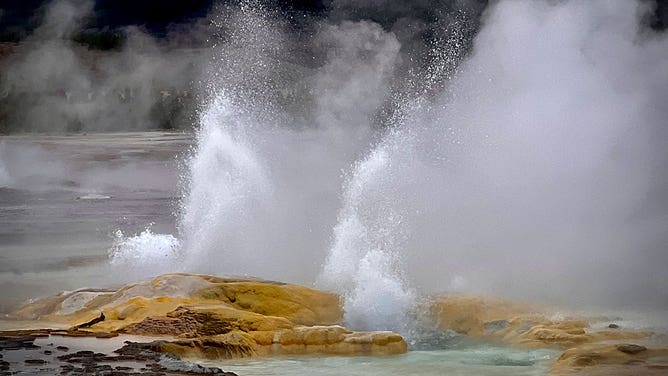
A geyser explodes at Yellowstone National Park in October 2021.
(Robert Ray/FOX Weather)
Satellite observations reveal accelerating uplift across a broad area.
The combination of earthquakes, ground deformation and changes in the hydrothermal system raises concern that magma could be moving through the Earth's crust.
Yellowstone's volcanic alert level is raised from "normal" to "advisory," signaling that unrest is above the volcano's typical background level.
Officials begin reviewing evacuation and public communication plans while emphasizing the uncertainty surrounding the activity.
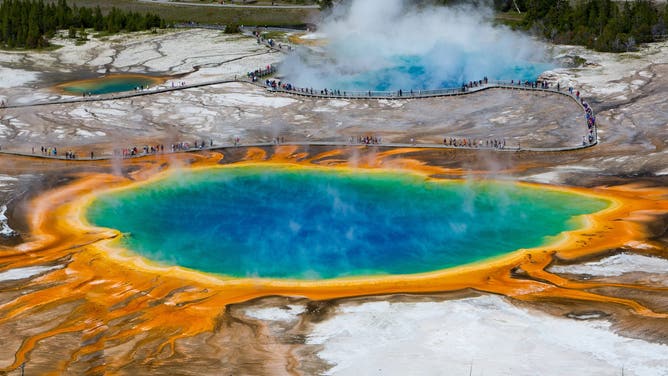
The largest hot spring in Yellowstone National Park is Grand Prismatic Spring.
(Inger Vandyke / VW PICS / Universal Images Group / Getty Images)
T-2 weeks
The situation rapidly escalates.
Earthquakes become more frequent and shallower, while volcanic tremors suggest increasing movement of magma and pressurized fluids beneath the surface.
Ground uplift accelerates, with some GPS stations moving centimeters in just days.
Yellowstone's famous geysers also become increasingly erratic, while changes in gas emissions and spring-water chemistry suggest increased volcanic activity.
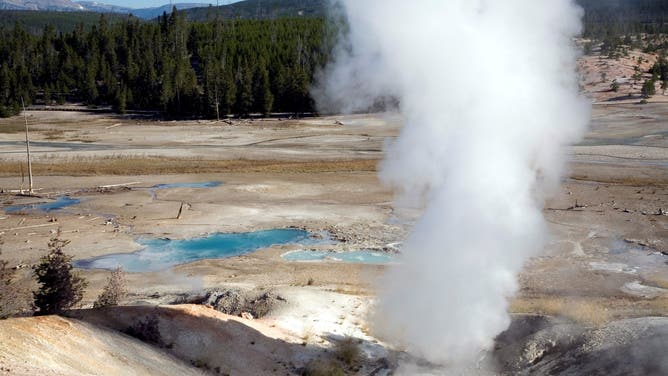
Norris Geyser Basin. Yellowstone National Park. Wyoming. United States of America
(Claudio Beduschi/REDA/Universal Images Group / Getty Images)
In this hypothetical scenario, scientists announce an 85% to 92% probability of a catastrophic eruption within three weeks.
The Yellowstone alert level is raised to watch, while the USGS raises the aviation color code to orange. Aircraft are rerouted around the region.
7 THINGS TO KNOW ABOUT YELLOWSTONE NATIONAL PARK
An evacuation zone extending roughly 62 miles beyond Yellowstone National Park is created, which impacted about 200,000 residents along with thousands of visitors.
T=0
Seismic instruments are overwhelmed by a burst of shallow earthquakes as cracks begin opening across the Yellowstone region.
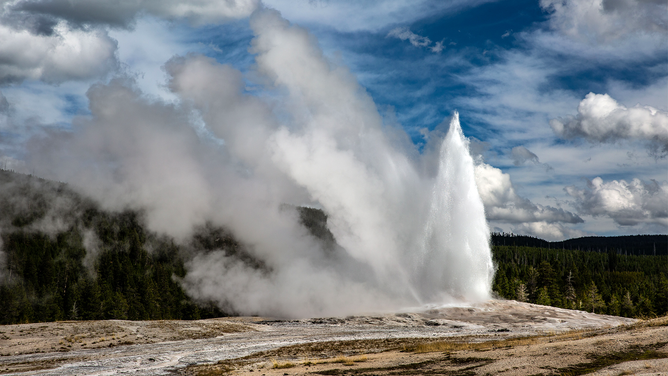
The iconic Old Faithful Geyser springs to life (every 90 minutes) in Yellowstone National Park's Upper Geyser Basin on September 18, 2022, in Yellowstone National Park, Wyoming.
(George Rose / Getty Images)
The alert level is raised to red, signaling that a dangerous eruption is imminent.
Rising magma enters the underground hydrothermal system, rapidly heating and vaporizing enormous amounts of water.
THE HIGHEST-ELEVATION TORNADOES IN US HISTORY PROVE TWISTERS CAN STRIKE ALMOST ANYWHERE
The sudden expansion can trigger violent explosions that send steam, mud, ash and shattered rock high into the atmosphere.
Hours later, gas-rich magma reaches the surface. Temperatures could reach roughly 650 to 800 degrees Celsius as the magma violently fragments into pumice and ash.
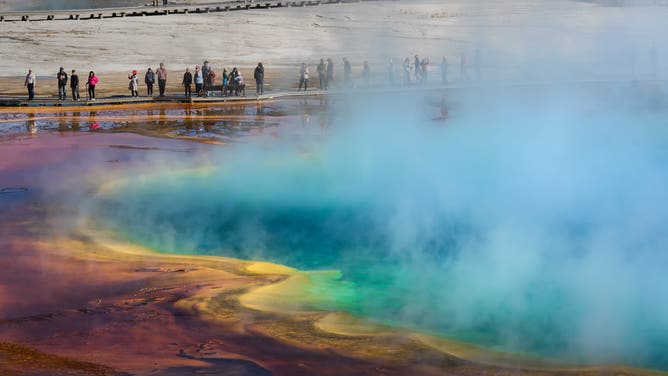
Tourists visit the Grand Prismatic Spring in Yellowstone National Park, Wyoming.
(Qian Weizhong/VCG via Getty Images / Getty Images)
Ash begins spreading hundreds of miles from the eruption site before high-altitude winds carry fine particles thousands of miles away.
WATER AVAILABILITY BECOMING A CHALLENGE FOR GREATER YELLOWSTONE AREA
T+1 day
As the eruption continues, portions of the eruption column collapse. Areas closest to the eruption are devastated.
Farther away, ash begins falling across a portion of the U.S. and southern Canada. Roads become difficult to travel, visibility deteriorates and power and communication systems begin to fail.
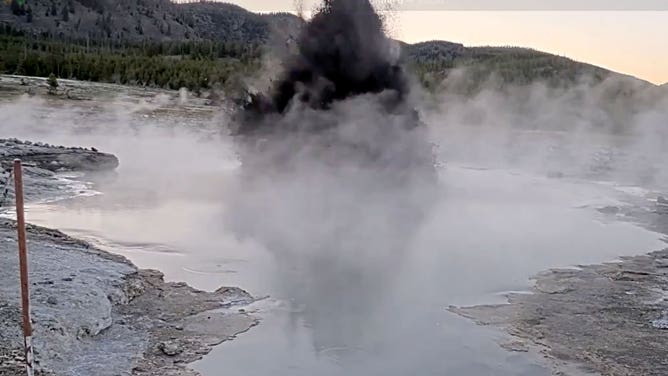
Water and debri shoot into the air during an eruption at Black Diamond Pool in Yellowstone National Park in Wyoming on May 31, 2025.
(USGS / FOX Weather)
Ash could also bury farmland across multiple states, threatening crops and livestock.
Major cities far from Yellowstone could experience darkened skies, hazardous air and widespread disruptions.
MAN TAUNTS, MOVES DANGEROUSLY CLOSE TO BISON IN YELLOWSTONE NATIONAL PARK
T+3 days
Three days into the eruption, much of North America is dealing with the consequences of widespread ashfall.
Billings, Montana, could eventually receive feet of ash, while Salt Lake City and Boise could receive inches.
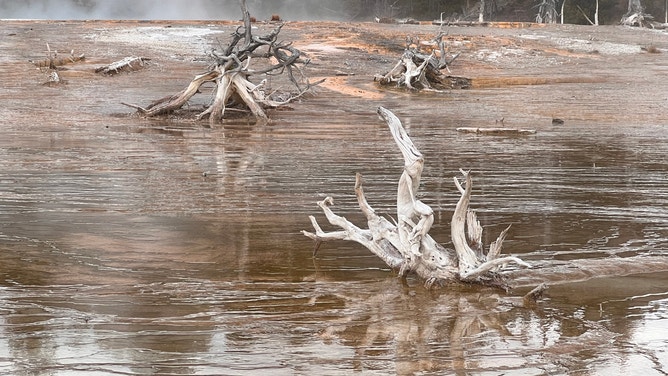
Images from Yellowstone and Grand Tetons National Parks.
(FOX Weather)
It is also possible that daylight could be reduced to twilight as ash fills the atmosphere.
The ash also begins damaging critical infrastructure. The volcanic ash can conduct electricity, potentially causing short circuits and failures at power lines and substations. Ash can clog machinery and generators while its weight places additional stress on buildings and infrastructure.
As electricity fails, water pumps, sewage treatment systems, heating systems, fuel stations and communications networks can also go offline.
Food supplies become increasingly difficult to move as transportation networks break down and supermarket shelves empty.
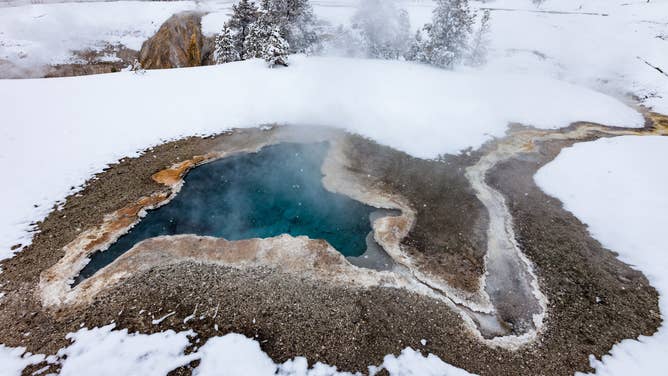
Blue Star Spring steams on a cold winter day in Yellowstone National Park, Wyoming. The spring's piping hot heat comes from molten rock churning within the floors of Yellowstone.
(Jon G. Fuller / VW PICS / Universal Images Group / Getty Images)
T+2 weeks
Weeks after the eruption, repeated ashfall continues to disrupt daily life.
Roads are blocked, drainage systems become overwhelmed and roofs can collapse beneath the weight of accumulated ash. Rain can turn dry ash into a dense, heavy slurry that makes cleanup even more difficult.
Airports across North America remain closed or severely disrupted because volcanic ash can damage aircraft engines.
SCIENTISTS UNCOVER FIRST KNOWN ADULT T. REX TRACKWAY DATING BACK 66.5 MILLION YEARS
Railways, freight networks and farms struggle to operate.
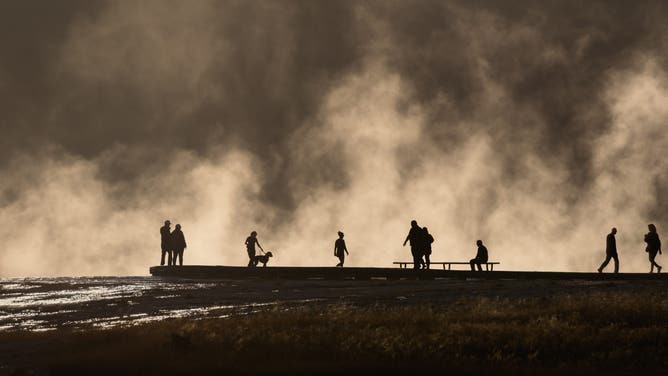
Tourists visit the Grand Prismatic Spring on October 8, 2024 in Yellowstone National Park, Wyoming.
(Qian Weizhong/VCG via Getty Images / Getty Images)
Livestock and crops die in heavily affected areas where pasture and water supplies are buried or contaminated.
Shelter, fuel, food and clean water become increasingly scarce.
T+4 months
Several months later, the eruption has weakened to intermittent explosions, but the crisis is far from over.
Wind repeatedly lifts settled ash back into the atmosphere, while rain and snow redistribute deposits across roads, drains and communities.
SCIENTISTS UNCOVER POTENTIALLY SIGNIFICANT MOVEMENT AT ONE OF AMERICA'S MOST DANGEROUS FAULT LINES
Health systems face enormous pressure as people experience eye and throat irritation and worsening respiratory problems.
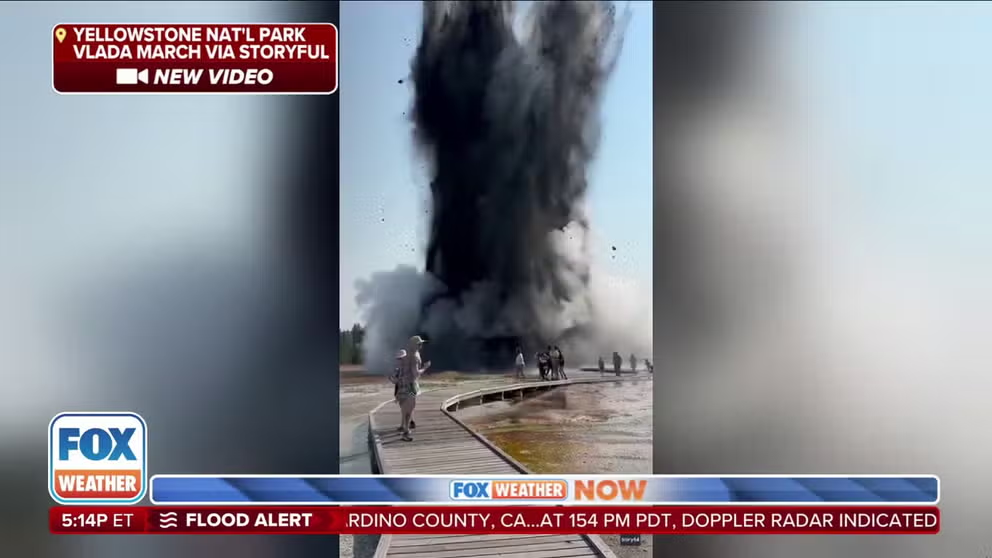
Geyser explodes in Yellowstone National Park
A hydrothermal explosion happened at a geyser in Biscuit Basin in Yellowstone National Park, destroying a boardwalk.
Water treatment facilities and power plants struggle with contamination, equipment failures and shortages.
Agricultural losses across North America begin affecting global food supplies, driving food prices higher.
Meanwhile, sulfur dioxide released high into the atmosphere forms sulfate aerosols that reflect some of the Sun's energy back into space.
STUNNING SKIES: HERE ARE THE TOP 10 NATIONAL PARKS FOR STARGAZING
Modeling suggests global average temperatures could temporarily fall by around 32 degrees or less, but some regions could experience larger changes.
T+10 years
A decade later, the effects of the eruption would still be felt around the world.
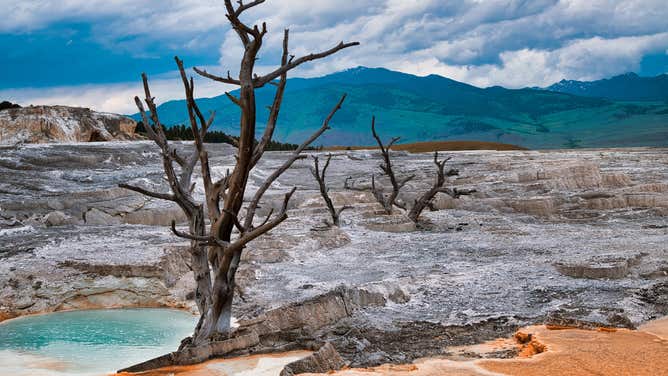
The temperature and chemistry of some hot springs make them inhospitable for most organisms.
(Gagliardi Giovanni / REDA&CO / Universal Images Group / Getty Images)
Communities would be rebuilding transportation networks, farms and water systems.
Agriculture could look dramatically different as societies adapt to damaged farmland, changing weather patterns and disrupted food supplies.
NIAGARA FALLS UNVEILS NEW ATTRACTION BRINGING VISITORS CLOSER THAN EVER TO ICONIC NATURAL WONDER
Small-scale greenhouses and other controlled growing systems could become increasingly important, while livestock production could decline because of shortages of land and animal feed.
Water availability would also vary dramatically by region.
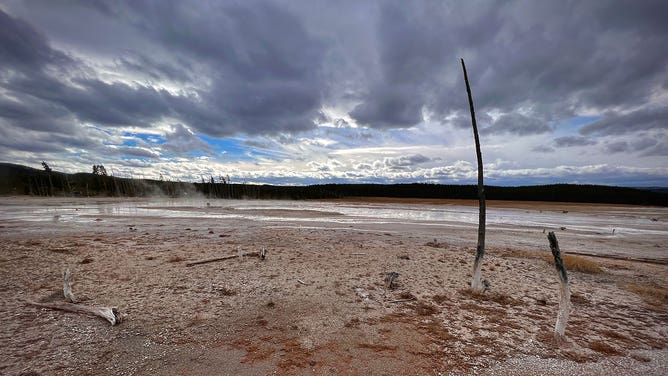
Dried portions of a lake bed are seen at Yellowstone National Park in October 2021.
(Robert Ray/FOX Weather)
Some areas could receive more rainfall while others become drier.
The health consequences could persist for years. Long-term exposure to fine volcanic ash can damage the lungs, and researchers would likely study potential increases in diseases associated with prolonged exposure.
HOW THE BIGGEST WAVES IN THE WORLD BREAK OFF THE COAST OF PORTUGAL
T+1 million years
A million years later, the eruption would be little more than a geological scar.
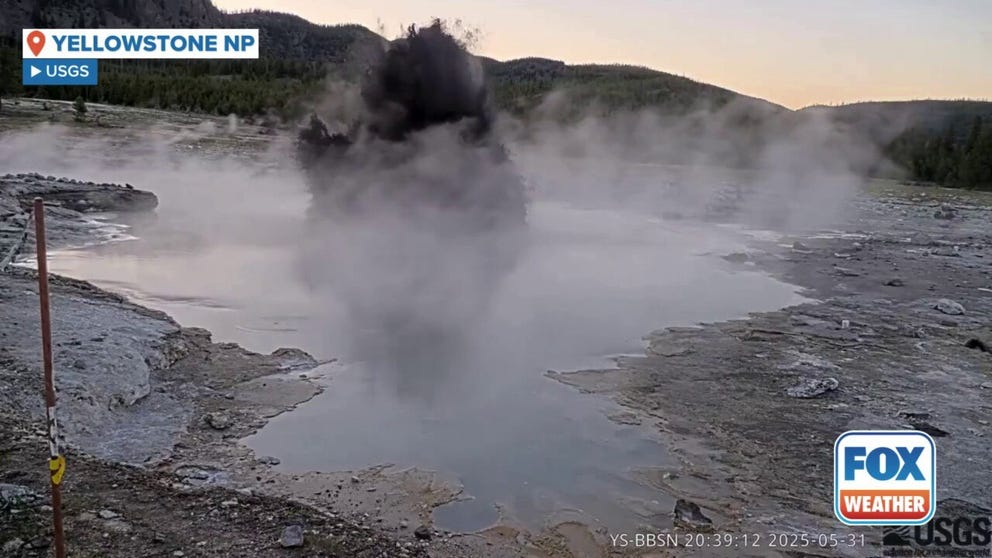
Eruption at Yellowstone National Park caught on camera
The USGS released this video of an eruption at Black Diamond Pool in Yellowstone National Park that happened May 31, 2025.
Vegetation and ecosystems would have long since returned, and the landscape around Yellowstone would look dramatically different.
A future civilization examining Earth could find evidence of the enormous caldera beneath the surface and determine that a massive eruption once occurred there.
SOMETHING IS LURKING BENEATH THE EVERGLADES — AND FLORIDA’S FROGS AND SALAMANDERS ARE AT RISK
The eruption would have transformed the planet, disrupted global climate and caused enormous loss of life.
But remember - this is all hypothetical.