

What is an exoplanet and what makes one habitable?
Exoplanets are extraordinary discoveries first found by NASA 30 years ago and could be the next step toward finding habitable life.
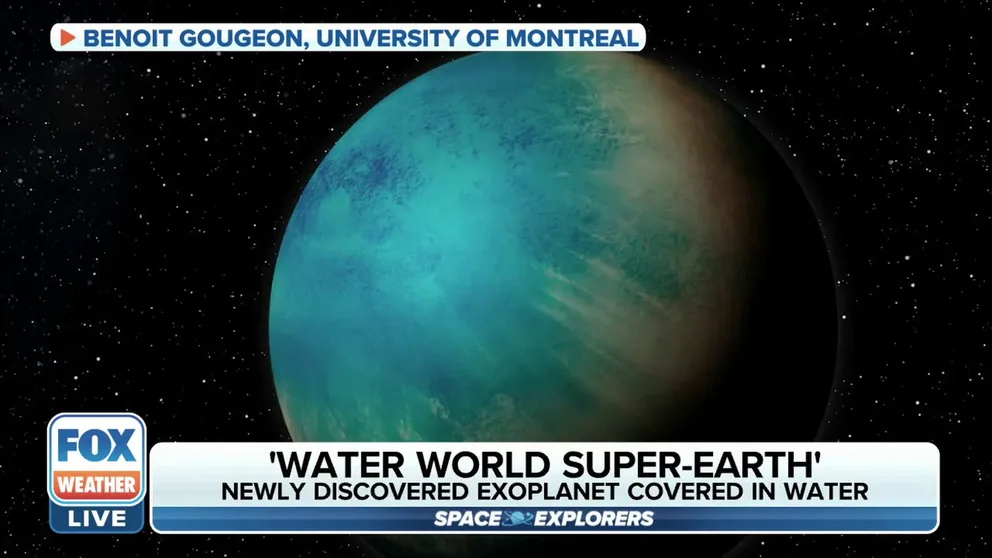
FILE: Newly discovered 'super-Earth' exoplanet could be 'water world'
Astronomers have discovered a new exoplanet orbiting a distant star that might constitute a "super-Earth" completely covered in water.
The universe contains many surprises and opportunities, including the phenomena of exoplanets.
Our universe is full of endless discoveries and possibilities that scientists continue to pursue in search of habitable life.
Exoplanets are extraordinary discoveries first found by NASA 30 years ago and could be the next step toward finding habitable life.
According to NASA, an exoplanet is a planet beyond our solar system, with most of them orbiting other stars. Some are free-floating exoplanets, called rogue planets, which are untethered to any star.
The official number of exoplanets is 6,150, with more being discovered; more than 8,000 additional candidate planets await confirmation to join the club.
NASA PAUSES GATEWAY LUNAR-ORBIT SPACE STATION TO BUILD LUNAR BASE ON THE MOON
As the quest for habitable planets is still in the early phase, it is worth noting that the rate of exoplanet discoveries has accelerated recently, with the database reaching 5,000 confirmed three years ago.
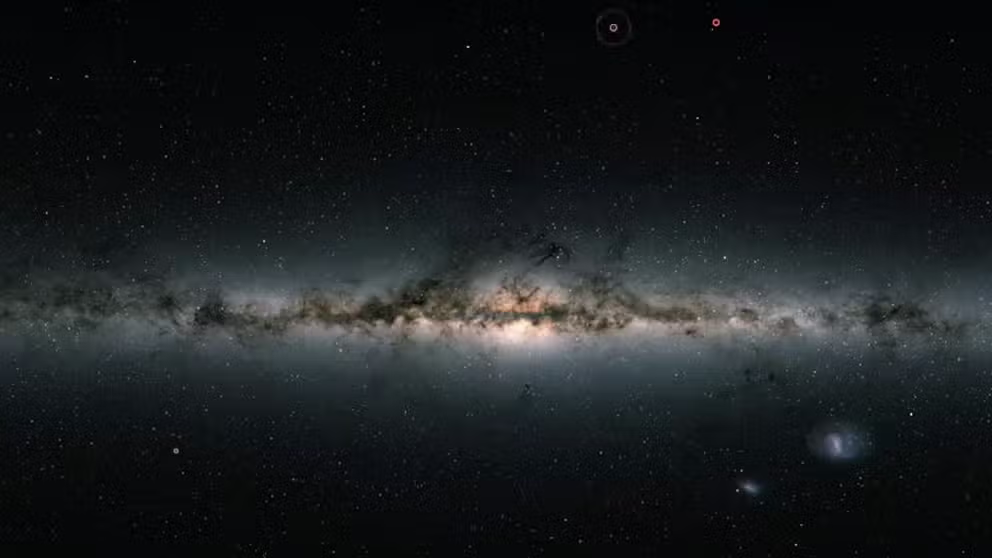
Listen to the sounds of 5,000 exoplanets
In this animation, exoplanets are represented by musical notes played across decades of discovery. The lower the note, the longer the orbit, NASA says. (NASA/JPL-Caltech/M. Russo, A. Santaguida)
What makes a new planet habitable?
When searching for planets that can sustain habitable life, it helps by searching for worlds most similar to ours.
Many exoplanets that have been discovered are rocky-type worlds in the same size range as Earth, which is a favorable factor for possible life.
Most of these Earth-sized worlds have been detected orbiting red dwarf stars. Despite this pleasant news, red-dwarf stars have a potentially deadly habit, especially in their younger years, according to NASA.
NASA ANNOUNCES ARTEMIS II MISSION PHASES, PLANS FOR FUTURE ARTEMIS PROGRAM LAUNCHES
These stars produce powerful flares that tend to erupt, sterilizing closely orbiting planets where life could have just begun to develop. This would rule out any consideration for planets orbiting these stars.
"Based on what we’ve observed in our own solar system, large, gaseous worlds like Jupiter seem far less likely to offer habitable conditions," a statement from NASA reads. "But most of these Earth-sized worlds have been detected orbiting red-dwarf stars; Earth-sized planets in wide orbits around Sun-like stars are much harder to detect."
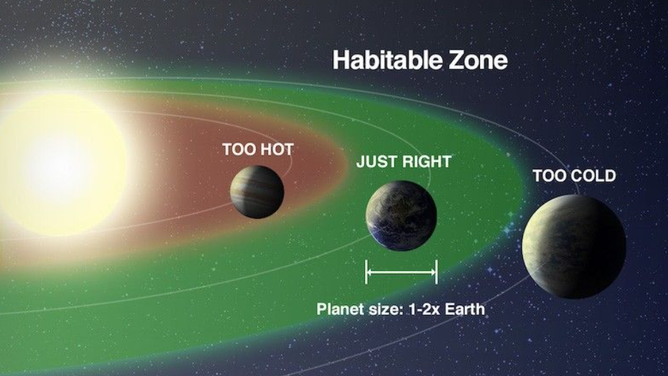
A traditional picture of the habitable zone.
(NASA)
Orange dwarfs are slightly cooler and less luminous than our star, which is considered by some scientists as potentially better for advanced life, burning steadily for billions of years, opening a vast timeframe for biological evolution in some forms.
When searching for a planet, scientists look for a world located in the habitable zone. This is the planet’s distance from a star at which liquid water could exist on the surface.
THE BEST EVIDENCE FOR LIFE OUTSIDE OUR SOLAR SYSTEM JUST GOT STRONGER
Similarly to Earth, the key to a habitable planet is a G-dwarf star, or, if possible, even better, a K-dwarf star.
A K star is otherwise known as a "Goldilocks star," which is where conditions are just right, not too hot, not too cold, to sustain life.
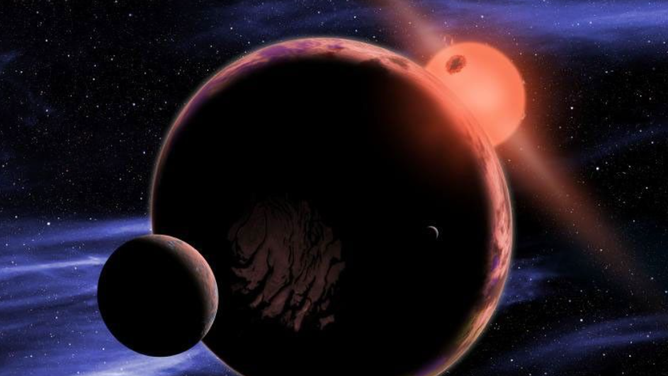
An artist's concept of a hypothetical exoplanet orbiting two moons.
(NASA)
"K-dwarf stars are in the ‘sweet spot,’ with properties intermediate between the rarer, more luminous, but shorter-lived solar-type stars [G stars] and the more numerous red dwarf stars [M stars]," a statement from Edward Guinan of Villanova University reads. "The K stars, especially the warmer ones, have the best of all worlds."
A K star has a longevity capable of living 40 billion years, compared to a G star, which lasts 10 billion years.
SEE IT: JAMES WEBB TELESCOPE CAPTURES DETAILED IMAGES OF DYING STAR
In short, when looking for exoplanets with habitability, the abundance of K stars increases the chances of finding life and inching closer to the goal of establishing human life on another world.