

See it: New Webb telescope image reveals massive galaxy M90 escaping cluster, heading toward Milky Way
Scientists say the massive galaxy poses no “immediate" threat to Earth, as it's about 59 million light-years away and would take billions of years to reach our vicinity.
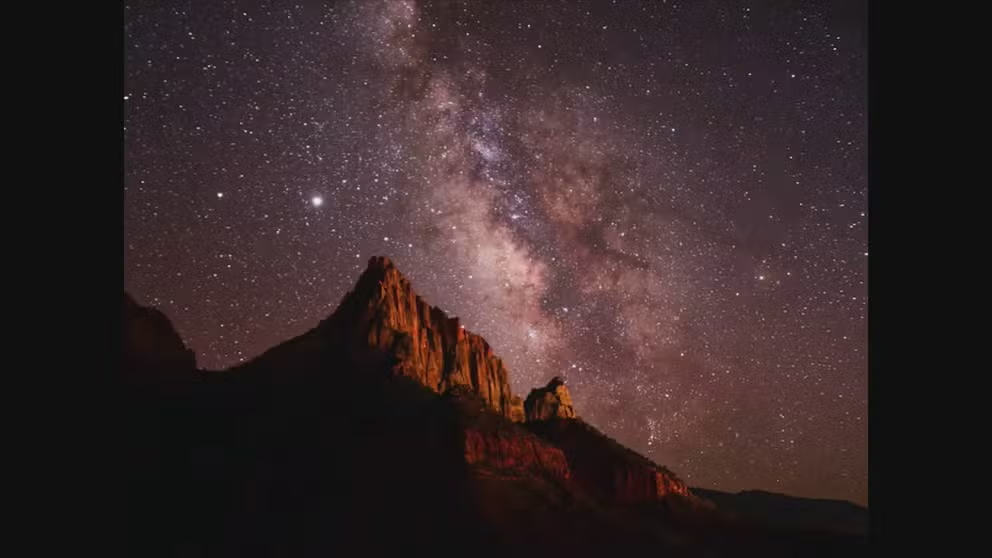
FILE: Watch: Timelapse of Milky Way over Zion National Park
Park Ranger Avery Sloss created this timelapse video of the Milky Way above Watchman Mountain in Zion National Park. Zion was certified an International Dark Sky Place by the International Dark Sky Association in 2021.
A new image from NASA’s Webb Telescope captures a stunning new look at Messier 90 (M90), a massive spiral galaxy escaping the Virgo Cluster and heading toward the Milky Way, Earth’s home galaxy.
Approximately 59 million light-years away, M90 is one of the few galaxies moving closer to Earth, NASA reports.
"Over time, its orbit through the Virgo Cluster accelerated so much that M90 is in the process of escaping the cluster entirely," the agency said.
SEE IT: JAMES WEBB TELESCOPE CAPTURES DETAILED IMAGES OF DYING STAR
About 300 million years ago, the galaxy passed near the center of the cluster, where dense gas stripped away vast amounts of its material.
Without this gas, M90 can no longer form new stars, and the spiral galaxy is slowly fading.
NASA STILL ON TRACK TO LAUNCH ARTEMIS II TEST FLIGHT AFTER ROLLBACK DUE TO REPAIRS
This process is flattening M90 as it transitions into a lenticular galaxy, NASA said.
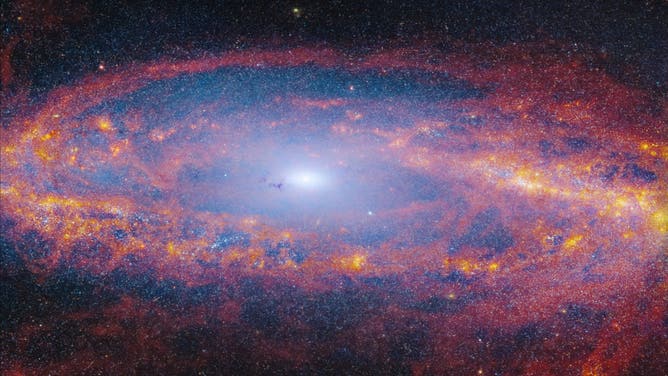
A new image from NASA’s Webb Telescope captures a stunning new look at M90, a massive spiral galaxy, heading toward the Milky Way.
(NASA, CSA, ESA, A. Leroy (The Ohio State University), and I. Lopez (INAF - Osservatorio di Astrofisica e Scienza dello Spazio); Processing: Gladys Kober (NASA/Catholic University of America))
NASA’s Webb Telescope team shared the new view of the large spiral, noting that the image allows scientists to peer more clearly through the galaxy’s dust and stars.
As it is part of their broader study of analyzing a set of 55 big galaxies that are still creating new stars, the data collected will add valuable information on how galaxies develop and transform over billions of years.
According to NASA, the ideal time to observe this bright spiral galaxy is in May.
Under a dark, clear sky, it is visible with binoculars, while larger telescopes can reveal more details, including its spiral arms and bright core.
What does this mean for Earth?
Scientists say the massive galaxy poses no "immediate" threat to Earth, as it's about 59 million light-years away and would take billions of years to reach our vicinity.