

See it: James Webb Telescope captures detailed images of dying star
In the latest footage captured by the James Webb Telescope, a nebula has been revealed surrounding a dying star.
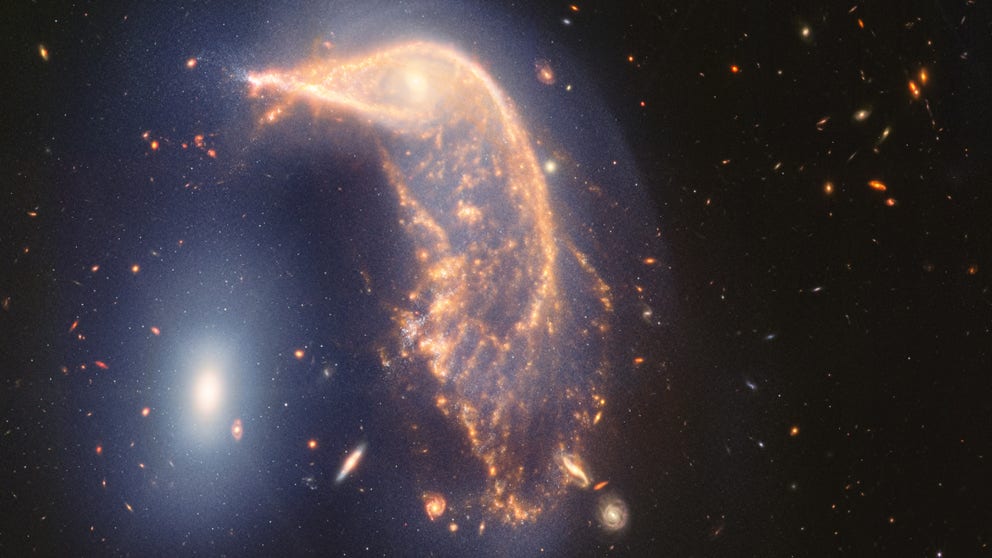
"Cosmic Dance" between two galaxies celebrates James Webb telescope's 2 years in service.
This video tours Arp 142, an interacting galaxy pair affectionately known as the Penguin and the Egg that lies 326 million light-years from Earth. (Video courtesy: NASA)
NASA’s James Webb Telescope captured an astonishing photograph of a star in outer space recently.
In the latest footage captured by the James Webb Telescope, a nebula has been revealed surrounding a dying star.
NASA'S JAMES WEBB SPACE TELESCOPE UNCOVERS FORMER STAR THAT EXPLODED INTO A SUPERNOVA
The James Webb Space Telescope is a powerful infrared space telescope that studies every phase in the history of our universe, ranging from the first luminous glows after the Big Bang to the formation of solar systems capable of supporting life on planets.
The space telescope launched on Dec. 25, 2021, and orbits the sun at a distance of one million miles from Earth, according to NASA.
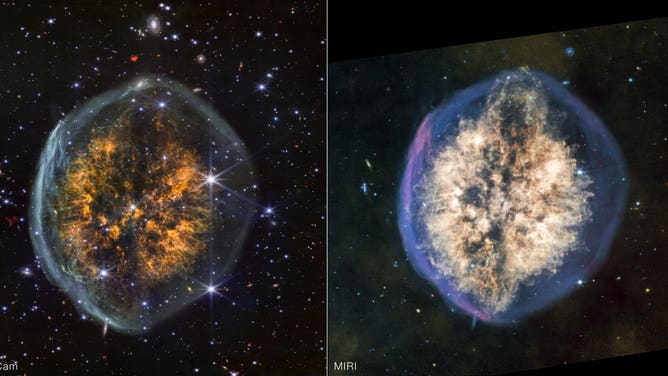
NASA’s James Webb Telescope captures a nebula surrounding a dying star.
( NASA, ESA, CSA, STScI; Image Processing: Joseph DePasquale (STScI) / @NASAWebb Via X)
According to NASA, the nebula was first captured by the now-retired Spitzer Space Telescope more than a decade ago. The James Webb Space Telescope offers a more detailed view of the nebula’s unique brain-like appearance.
Both images show distinct mesmerizing patterns of bright colors within the nebula.
BLOOD MOON TOTAL LUNAR ECLIPSE 2026: WHEN AND WHERE YOU CAN SEE THE ASTRONOMICAL PHENOMENON
"The nebula appears to have distinct regions that capture different phases of its evolution — an outer shell of gas that was blown off first and consists mostly of hydrogen, and an inner cloud with more structure that contains a mix of different gases," a statement from NASA reads.
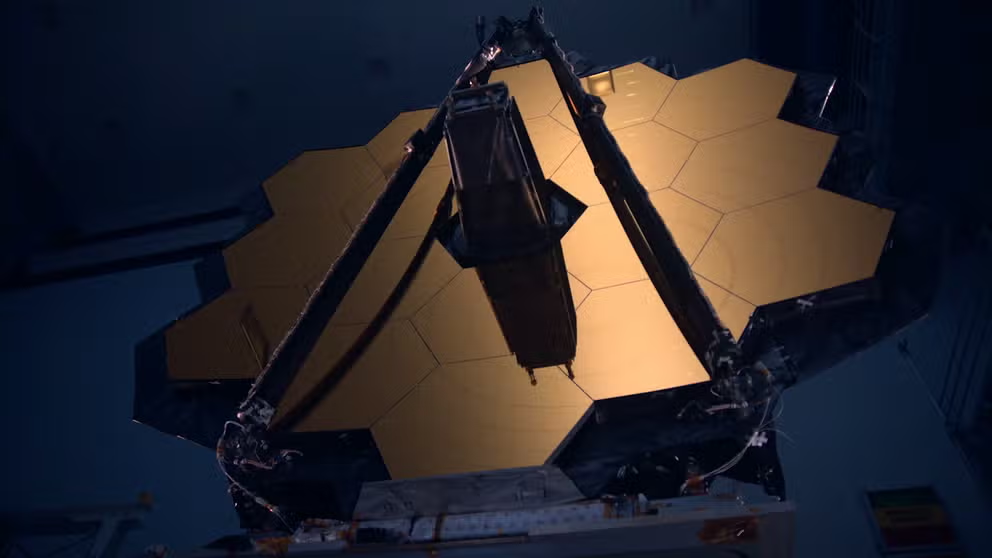
What is the James Webb Space Telescope?
According to NASA, the JWST sees the universe using infrared radiation, a form of light that we feel as heat and is invisible to human eyes.
Although there is much to be discovered about this nebula, experts are certain that it is being created by a star near the end of its fuel-burning life.
According to experts, depending on the star’s mass — which is yet to be determined — it could explode as a supernova if it is massive enough.
NEW DATA FROM NASA’S CURIOSITY ROVER HINTS AT HISTORY OF WATER ON MARS
Scientists will continue to monitor the phenomenon with the world’s premier space observatory, providing pristine detail.