

NASA rover uncovers bizarre ‘potato chip’ formations on Mars as scientists investigate their origins
In a Curiosity blog post published Nov. 11, NASA said the rover encountered an area covered in potato-chip-shaped formations while completing its drilling campaign at the “Nazca" drill site.

Mars rover Curiosity celebrates ten years
Mars rover Curiosity has been exploring the Red Planet for a decade (NASA)
THE TAKEAWAY
- NASA's Mars Curiosity rover discovered unusual potato-chip-shaped formations.
- The site is located in an area of Mars where scientists have observed unusual disk-shaped features.
- Drill samples were collected for analysis using the Sample Analysis at Mars.
NASA scientists are investigating unusual potato-chip-shaped formations discovered on Mars during the Curiosity rover’s mission.
NASA'S ARTEMIS PROGRAM: PAVING THE WAY FOR HUMANKIND'S RETURN TO THE MOON AND BEYOND
In a Curiosity blog post published Nov. 11, NASA said the rover encountered an area covered in potato-chip-shaped formations while completing its drilling campaign at the "Nazca" drill site.
The site is located in an area of Mars where scientists have observed unusual disk-shaped features in the bedrock.
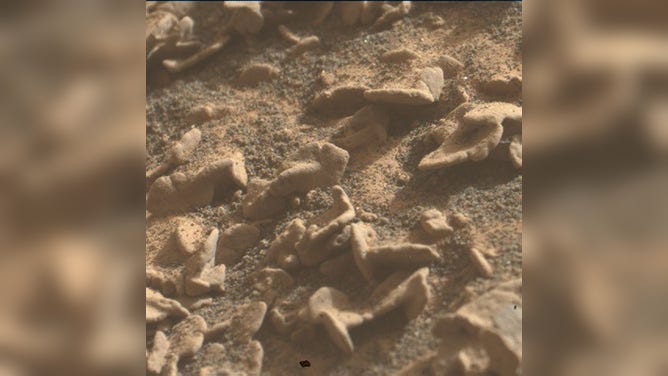
NASA's rover Curiosity acquired this image of chip-shaped crystal forms using its Mars Hand Lens Imager.
(JPL-Caltech/MSSS / NASA)
"This is an area characterized by bedrock containing disk-shaped (or, in a liberal interpretation, potato-chip shaped) crystal forms," NASA said in its blog.
Drill samples were collected for analysis using the Sample Analysis at Mars (SAM) instrument, so scientists can work to better understand how the unusual crystal formations developed.
WANT TO GO TO SPACE? NASA IS OFFERING THE PUBLIC A CHANCE TO 'HITCH A RIDE' TO SATURN
Meanwhile, Curiosity continues to study other crystal formations, rock layers and dark lenses along its route.

Curiosity Mars rover captured this view of Gediz Vallis channel on March 31. This area was likely formed by large floods of water and debris that piled jumbles of rocks into mounds within the channel.
(NASA/JPL-Caltech/MSSS / NASA)
The rover conducted laser-based chemical analyses of several targets and collected detailed images of rock formations, including a mosaic near the Nazca drill site.
"ChemCam LIBS observations were planned for each sol including a cluster of crystal forms, a resistant layer in the side of the Nazca block and a dark float rock," NASA said.
MASSIVE METEOR TURNS PACIFIC NORTHWEST NIGHT SKY ELECTRIC BLUE
In addition, Curiosity prioritized capturing a solar eclipse as Mars’ moon Phobos passed in front of the Sun.
The rover was scheduled to take nighttime images of crystal formations using its white-light and ultraviolet lamps before driving away from the Nazca drill site.

Curiosity is the largest rover ever sent to Mars.
(NASA / NASA)
NASA’s Curiosity rover has been exploring Mars since landing in August 2012.
The robotic explorer studies the planet’s geology and climate, analyzes rocks and soil, and investigates whether Mars once had conditions capable of supporting microbial life.
ARTEMIS II BRINGS PIECES OF THE PAST ON ITS HISTORIC DEEP SPACE VOYAGE
The rover is equipped with cameras, scientific instruments and a laser-based analysis system, which helps scientists better understand the planet.