

Artemis II brings pieces of the past on its historic deep space voyage
In 1903, the Wright Brothers made history in North Carolina when the Wright Flyer became the first powered flight. More than 120 years later, the Wright Brothers continue to be a part of history.
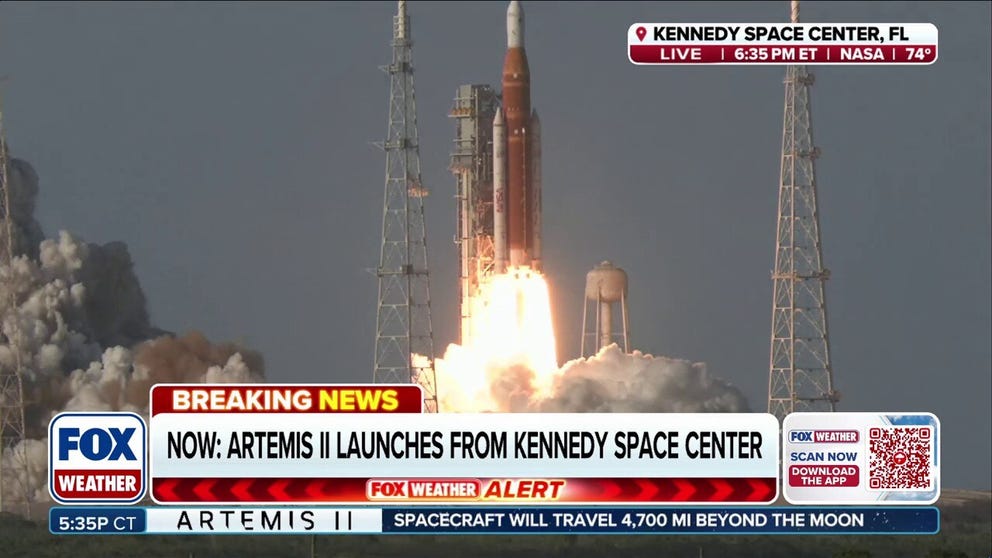
Artemis II lifts off from Kennedy Space Center
NEXT STOP, SPACE 🚀: Artemis II is roaring into space on a mission to make history after liftoff from Kennedy Space Center in Florida. This is humanity’s return to deep space, and the beginning of a bold journey around the Moon. Stay locked with FOX Weather for every second of this historic mission.
MERRITT ISLAND, Florida – The Artemis II mission is seeking to make history while carrying a piece of aviation history with them onboard the Orion spacecraft.
On April 1, four astronauts onboard Artemis II set off to fly further from Earth than ever before, taking monumental steps for humankind building upon the historic foundation of aviation.
ARTEMIS II MAKES HISTORY, BRINGING HUMANS AROUND THE MOON FOR THE FIRST TIME IN 50 YEARS
In 1903, the Wright Brothers made history in North Carolina when the Wright Flyer became the first powered flight. More than 120 years later, the Wright Brothers continue to be a part of history.
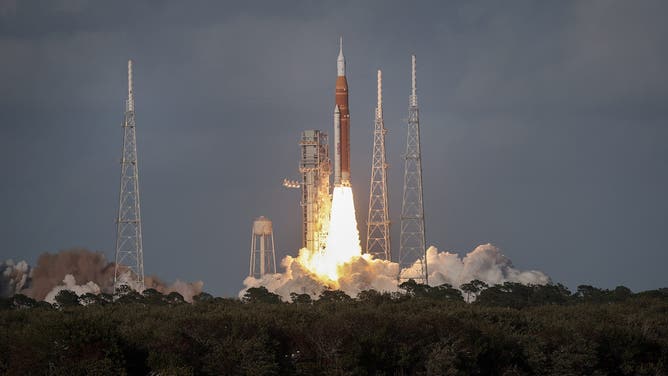
NASA's Artemis II Space Launch System rocket carrying the Orion spacecraft lifts off from Launch Complex 39B at Kennedy Space Center on April 1, 2026, in Cape Canaveral, Florida.
(Photo by Joe Raedle/Getty Images / Getty Images)
Onboard Artemis II is a 1-inch by 1-inch swatch of fabric from the original Wright Flyer used in the first powered flight, courtesy of the Smithsonian's National Air and Space Museum.
After the mission, the fabric will be reunited with two other 1903 Wright Flyer swatches at the museum, celebrating the nation’s history and innovation in aviation.
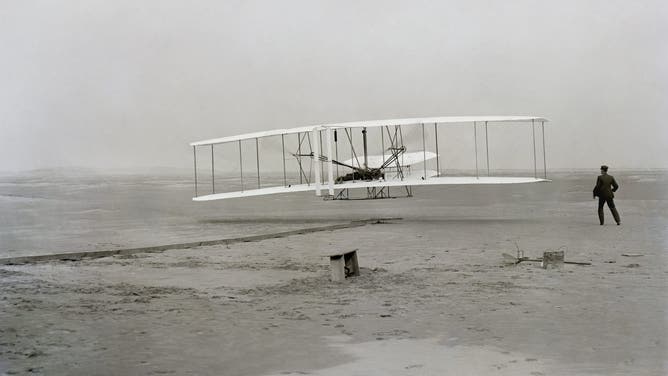
First flight of Wright brothers' aircraft, Kitty Hawk, North Carolina, USA, December 17, 1903. The first powered, heavier-than-air controlled flight in history flight lasted 12 seconds and flew a distance of 120 feet. Orville Wright piloted the historic flight while his brother, Wilbur, observed. The brothers took three other flights that day, each flight lasting longer than the other with the final flight going a distance of 852 feet in 59 seconds.
(Heritage Space/Heritage Images via Getty Images / Getty Images)
"Historical artifacts flying aboard Artemis II reflect the long arc of American exploration and the generations of innovators who made this moment possible," NASA Administrator Jared Isaacman said.
NASA'S ARTEMIS PROGRAM: PAVING THE WAY FOR HUMANKIND'S RETURN TO THE MOON AND BEYOND
A smaller square cut of the swatch previously flew aboard space shuttle Discovery on STS-51D in 1985 and is making its second journey into space.
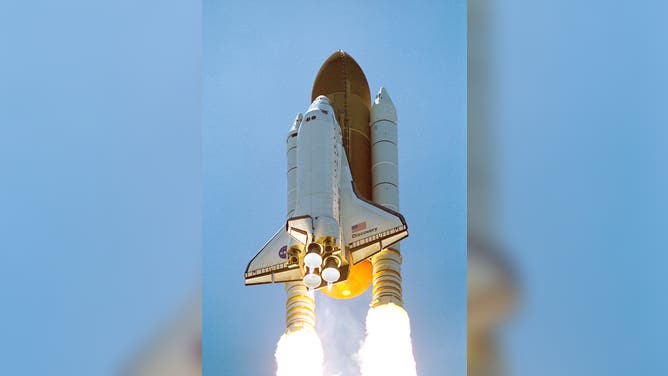
Space Shuttle Discovery and its seven-member crew launched on July 4, 2006.
(HUM Images/Universal Images Group via Getty Images / Getty Images)
The Wright Flyer fabric is merely one item included in the Artemis II flight kit that includes numerous relics from aviation and spaceflight history.
"This mission will bring together pieces of our earliest achievements in aviation, defining moments from human spaceflight, and symbols of where we’re headed next," Isaacman said. "During America’s 250th anniversary, Orion will carry astronauts around the Moon while also carrying our history forward into the next chapter beyond Earth."
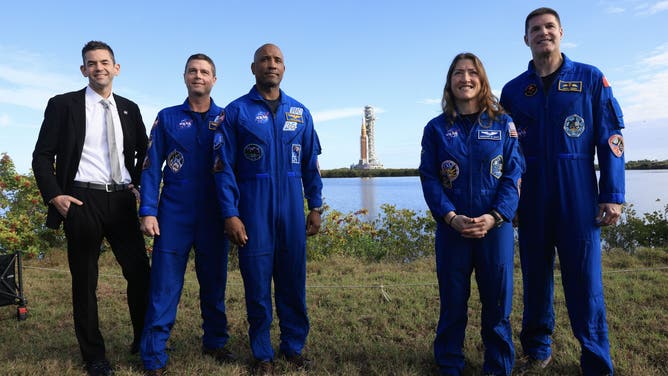
NASA Administrator Jared Isaacman, Artemis II Commander Reid Wiseman, pilot Victor Glover, mission specialist Christina Koch, and Jeremy Hansen pose for a photo as NASA's Artemis II is rolled from the Vehicle Assembly Building to Launch Pad 39B at NASA’s Kennedy Space Center.
(Photo by Joe Raedle/Getty Images / Getty Images)
Returning to space onboard Artemis II will be a 13-by-8-inch American flag, which flew with the first shuttle mission, STS-1, the final shuttle mission, STS-135, and NASA’s first crewed test flight of SpaceX’s Crew Dragon spacecraft, SpaceX Demo-2.
10 IMPORTANT ROCKET LAUNCHES IN THE HISTORY OF THE US SPACEFLIGHT
The Artemis program is building upon the monumental foundation established by the Apollo pioneers, who first blazed the trail to space.
A flag that was originally set to fly on NASA's Apollo 18 mission will make its first flight to space with Orion, serving as an emblem of the U.S.'s renewed commitment to lunar exploration.
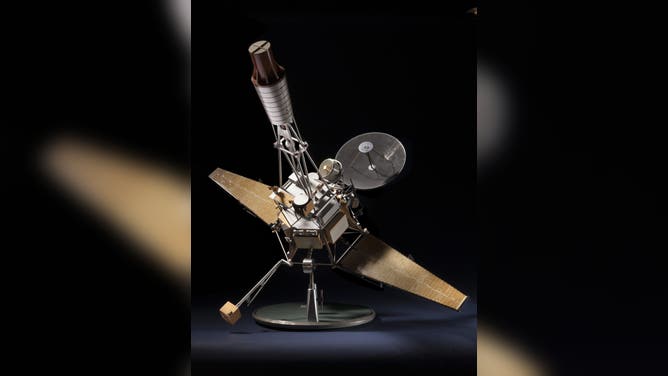
This is a 1/24th scale model of Ranger 1 and 2, the spacecraft series that sought to gather knowledge about the Moon in the first years of the space age, and which gave scientists their first close look at the lunar surface. Later versions of this spacecraft, Rangers 7, 8, and 9, were successful in the middle part of the 1960s in reaching the Moon and returning imagery of its surface. Those pictures revealed details that could not be seen through telescopes on Earth.
(Photo by Heritage Art/Heritage Images via Getty Images / Getty Images)
In another nod to the generation of wandering trailblazers that paved the way for space exploration, Orion will also carry a copy of a 4-by-5-inch negative of a photo from the Ranger 7 mission, the first U.S. mission to successfully make contact with the lunar surface.
Along for the ride
Bringing mementos to outer space on NASA spacecrafts has been a tradition since the 1960s, a legacy that the Artemis program has continued.
On Artemis I, the first unscrewed test flight that paved the way for Artemis II and the Orion and SLS, the ship carried a symbolic flight kit that included historical artifacts from Apollo missions, STEM items, digitized student essays and teacher pledges and more.
HOW LIGHTNING STRIKING APOLLO 12 FOREVER CHANGED NASA'S LAUNCH WEATHER POLICIES
Onboard Artemis II, about 10 pounds of mementos in total – including flags, pins, historical mementos, postcards, stickers and patches – on a mission to travel further than any artifacts, mementos or memorabilia have traveled from Earth in history.