

Want to go to space? NASA is offering the public a chance to 'hitch a ride' to Saturn
NASA is giving the public an opportunity to send their names to Saturn's largest moon, Titan, aboard the agency's Dragonfly rotorcraft.

FILE: NASA spacecraft discovers 'once-in-a-lifetime' moon crater
Bethany Ehlmann, president of The Planetary Society, joins FOX Weather to discuss how a NASA spacecraft spotted a "once-in-a-lifetime" moon crater during a routine data quality check.
There is now a chance to get a personalized boarding pass to space without ever stepping aboard a spacecraft.
NASA'S SWIFT TELESCOPE FACES FINAL COUNTDOWN WITH FIERY RETURN TO EARTH POSSIBLE WEDNESDAY
NASA is giving the public an opportunity to send their names to Saturn's largest moon, Titan, aboard the agency's Dragonfly rotorcraft.
Names submitted will be placed on a chip that will be aboard the spacecraft, and participants will receive a personalized boarding pass and have their names added to the Dragonfly passenger list.

The public can send their names to NASA to be aboard the agency's Dragonfly rotorcraft.
(NASA / NASA)
The spacecraft is scheduled to launch in 2028 and travel nearly a billion miles to reach Titan.
The public has until Jan. 15, 2027, at 11:59 p.m. EST to secure a spot on the mission.
NASA’S PLAN TO BUILD A MOON BASE STARTS WITH THESE ROVERS
According to NASA, Titan is a world with rivers, lakes, changing seasons, sweeping dunes and a landscape rich in organic material.
Dragonfly is expected to arrive in 2034, where it will investigate the moon's chemistry and uncover clues about the ingredients that may have helped life develop.
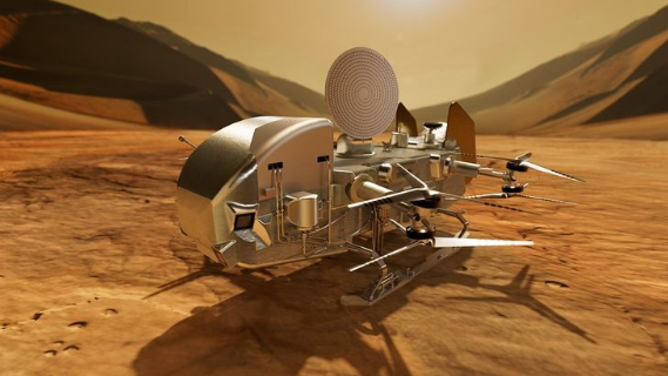
Artist's concept of Dragonfly on the surface of Titan.
(Johns Hopkins APL / NASA)
Dragonfly will use its rotorcraft to travel several miles across Titan's surface during its planned 3.3-year mission.
As it flies through Titan's yellowish, smoggy haze and nitrogen-rich atmosphere, Dragonfly will visit a variety of geological sites, collecting samples of surface material for analysis aboard the rotorcraft.
SCIENTISTS DISCOVER MASSIVE DWARF PLANET LURKING IN THE OUTER SOLAR SYSTEM
"Dragonfly isn't a mission to detect life — it's a mission to investigate the chemistry that came before biology here on Earth," Dragonfly Principal Investigator and Johns Hopkins Applied Physics Laboratory planetary scientist Zibi Turtle said.

The Dragonfly rotorcraft is expected to arrive at Titan in 2034.
(NASA / NASA)
Dragonfly is expected to complete one flight every one to two Titan days, known as a sol. Each sol lasts approximately 16 Earth days.
During its mission, Dragonfly will investigate how far prebiotic chemistry has progressed, identify compounds and search for chemical indicators that could point to water-based or hydrocarbon-based life.
A journey nearly a billion miles away is ahead, and the public has a chance to be part of it — without ever leaving Earth.