

Longer missions to Mars and the moon could be closer than you think
Officials said they anticipate being able to deploy a fission surface power system capable of producing safe, efficient and plentiful electrical power to space in the next four years.

See the Mars surface from the Curiosity rover
NASA’s Curiosity rover captured a clear panorama of Mars' Gale Crater in August.
A system in the making could revolutionize the space industry by taking steps toward innovation.
The U.S. Department of Energy (DOE) is working with the National Aeronautics and Space Administration (NASA) to develop a fission surface power system, which aims to extend missions on the moon, Mars and beyond.
NASA DISCOVERS NEW STARLESS, DARK-MATTER ASTRONOMICAL OBJECT DUBBED 'CLOUD-9' IN SPACE
The agencies announced their intent to support and develop the power system, with plans to deploy nuclear reactors on the moon and in orbit, including the development of a lunar surface reactor by 2030.
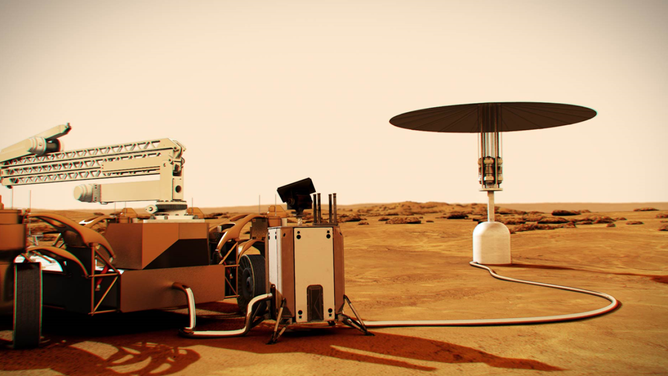
Renderings of a fission surface power system on the moon.
(NASA)
A recently signed memorandum of understanding between the DOE and NASA solidifies this collaboration and "advances President Trump's vision of American space superiority."
"Under President Trump’s national space policy, America is committed to returning to the moon, building the infrastructure to stay, and making the investments required for the next giant leap to Mars and beyond," NASA Administrator Jared Isaacman said in a statement.
NASA said in order to achieve this future, they'll need to harness nuclear power. Officials said they anticipate being able to deploy a fission surface power system capable of producing safe, efficient and plentiful electrical power to space in the next four years.
In constructing the system, officials hope it'll be able to operate for years without needing to refuel. NASA said deploying a lunar surface reactor will enable future sustained lunar missions by "providing continuous and abundant power, regardless of sunlight or temperature."
NASA RADAR ACCIDENTALLY FINDS SECRET COLD WAR 'CITY UNDER THE ICE' IN GREENLAND
What is a fission surface power system?
Department of Energy officials said a fission surface power system works by splitting uranium atoms inside a reactor to generate heat, which is then converted to electricity.
It's the same physical process used by terrestrial reactors to generate power for use in homes, businesses and industrial applications, the agency said.
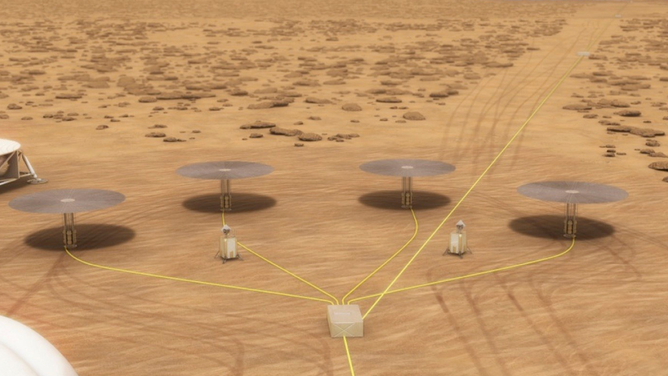
Fission surface power systems can be scaled up to help meet future mission energy needs.
The DOE said the fission surface power system will "leverage the latest innovations in advanced reactor development," and it must meet certain requirements such as the ability to operate on its own to match energy demand.
How will it work?
The system is expected to generate up to 40 kilowatts of electricity, which is enough power to run 400, 100-watt light bulbs, or enough to continuously run 30 households for 10 years.
"That may not seem like a lot of juice, but it will be enough to power a portion of the infrastructure and equipment needed by astronauts on the lunar surface," the DOE said.
NASA RETURNING SPACEX CREW-11 EARLY AFTER ASTRONAUT MEDICAL ISSUE ABOARD INTERNATIONAL SPACE STATION
As the need for power grows, the system could be scaled up to produce higher power levels to support permanent habitats, in-situ resource utilization and additional complex infrastructure and science operations, according to the DOE.
Fission power systems will operate where the sun doesn't shine, meaning they'll provide a consistent base load power regardless of the resources available on a planet or its environment.
See it: New photo shows zoomed in look of Circinus galaxy black hole
A new photo from the James Webb Space Telescope gives insight into the black hole within the Circinus galaxy located 13 million light-years from Earth.
NASA plans to land astronauts at the moon's south pole where solar energy is unable to provide necessary power for extended missions.
The DOE said lunar nights are equivalent to 14 days on Earth, and the reliable electricity provided by fission power systems will be needed to survive extreme temperatures.
WEATHER SATELLITES EXPLAINED: HOW NASA, NOAA MAKE FORECASTING POSSIBLE
The system has to be able to withstand the harsh vibration forces that happen during a launch or landing on a planet's surface. In order to accomplish this, the units will have structural robustness to protect the coolant, reactor core and electronic control systems, along with the support system that holds them all together, according to the DOE.
What is the timeline?
The initial demonstration is expected to last for a minimum of a year, but the system will be designed for longer operation to gather more information.
ARTEMIS 1: NASA SAYS FRIDAY LAUNCH 'DEFINITELY IN PLAY' AFTER SCRUBBING FIRST ATTEMPT
Nuclear space reactors were first developed in the United States in the 1950s by NASA and the Atomic Energy Commission, now known as the DOE, through its SNAP program. SNAP-10A, a sodium-potassium cooled fast reactor, was launched into space in 1965 as a part of a research project for the U.S. Department of Defense to power a satellite.
The reactor produced 500 watts of power and operated for 43 days during its test flight. But since then, advancements in nuclear fuels and materials research have led to smaller, compact advanced reactor systems that are currently being designed today, according to the DOE.