

Potential to see extraordinary ‘sungrazer’ comet squashed as it likely disintegrated near the sun
A sungrazer comet was expected to grace the New York City sky, but didn't survive its close approach to the sun.
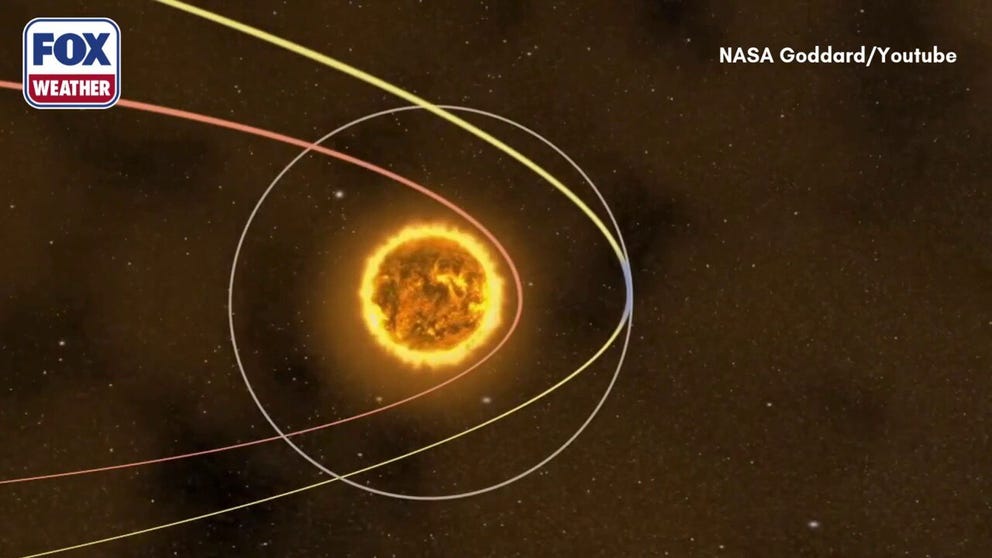
FILE: What is a ‘sungrazer’ comet?
Between April 5–8, a ‘sungrazer’ comet is expected to grace the New York City sky—if it survives its close pass by the Sun, hence the name sungrazer, it could put on a dazzling show visible to the naked eye! Check out this amazing video explaining what a 'sungrazer' is and why it could be such an amazing sight!
NEW YORK CITY, N.Y. — These past few weeks have been packed with nothing short of spectacular celestial wonders. Skywatchers have been treated to this month’s blood moon, the spring equinox, planetary conjunctions and peak ‘fireball season,’ bringing sudden surprises of shooting stars.
Not to mention, NASA’s first mission in over 50 years to send astronauts into orbit around the moon—the Artemis II mission—launched Wednesday night.
FINAL PREPARATIONS UNDERWAY FOR THE LAUNCH OF NASA'S ARTEMIS II SPACE MISSION
And the excitement continues, with the chances of more celestial treats.
Between April 5 and 8, a sungrazer comet was expected to grace the New York City sky—but it did not survive its close approach to the sun, ruining the hopes of a dazzling light show visible to the naked eye.
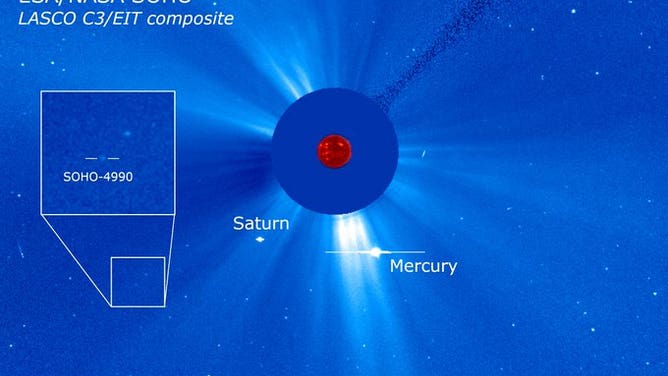
FILE: An image of the Sun from NASA's SOHO spacecraft showing a sungrazing comet highlighted in an inset box.
According to NASA, a sungrazer comet can be defined as a distinct type of comet that passes extremely close to the sun at its closest point, known as perihelion.
And a comet is classified as a sungrazer if it approaches within roughly 850,000 miles of the sun at perihelion, with some coming even closer—sometimes just a few thousand miles away.
'FIREBALL SEASON' EXPLAINED: WHY METEORS ARE LIGHTING UP SKIES ACROSS THE COUNTRY
This particular sungrazer is called C/2026 A1 (MAPS), sweeping significantly close to the sun, roughly less than a million miles at one point, according to EarthSky.org.
NASA notes that because these comets get so close to the sun, it is exposed to intense solar radiation and strong gravitational forces, which put significant stress on it.
THE BEST CELESTIAL EVENTS IN 2026 YOU WON'T WANT TO MISS
Hence why the comet C/2026 A1 (MAPS) did not make it to skywatchers' views, as it likely disintegrated into dust and gas after getting as close as about 100,000 miles from the solar surface, according to officials.
EarthSky.org initially reported that the comet’s perihelion would occur on April 4 to 5 and that, as of mid-March, the comet was brightening as it approached the inner solar system. It had brightened to around magnitude 10 by then.

Janet’s Planet CEO shares how the historic Artemis II mission could bring hope for humanity
Janet Ivey, CEO and founder of Janet’s Planet, joins FOX Weather ahead of the Artemis II launch scheduled for Wednesday night, as it remains at 80% of its planned launch time. Ivey notes that she believes the power of Artemis II can offer
Magnitude is a scale astronomers use to measure how bright a celestial object appears from Earth, with lower numbers representing brighter objects and higher numbers representing fainter objects.
HERE'S WHAT TO KNOW AS ARTEMIS II IS SET TO LAUNCH WEDNESDAY
That said, comet C/2026 A1 (MAPS) had been shaping up to be remarkably bright, with the potential to be seen by the naked eye, but it could not survive its journey past the sun's surface and died out.