

Comet 3I/ATLAS: Journey through the solar system
Multiple space telescopes have been monitoring the comet's journey, as the research helps scientists in their ongoing mission to find, track and better understand solar system objects.
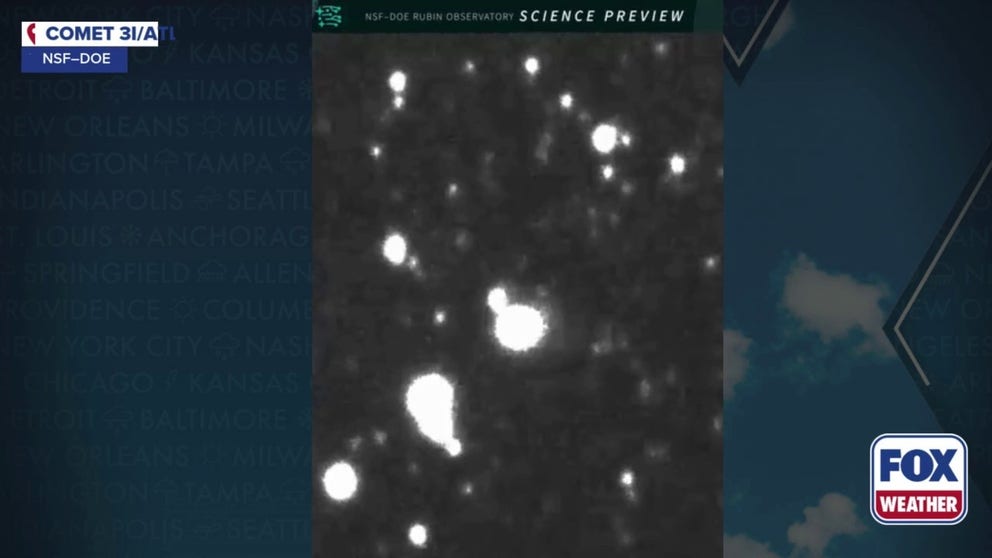
FILE: Interstellar comet 3I/ATLAS as seen by Rubin Observatory
The recently discovered interstellar comet 3I/ATLAS was spotted by the new NSF-DOE Vera C. Rubin Observatory in Chile.
Interstellar comet 3I/ATLAS's first reported sighting was on July 1, and it's going to be the closest it's ever been to Earth on Friday.
Along the way, it reached several milestones leading up to what’s going to be its closest approach to Earth on Dec. 19.
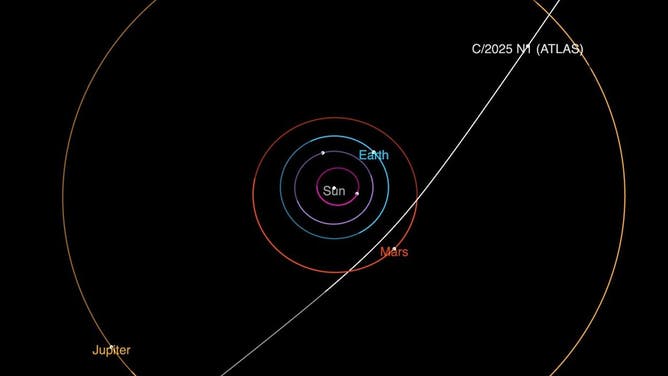
The diagram shows the trajectory of interstellar comet 3I/ATLAS.
(FOX Weather)
The comet marks the third known discovered object to pass through the galaxy from the outside and is classified as interstellar due to its high velocity and trajectory.
Multiple space telescopes have been monitoring its journey, as the research helps scientists in their ongoing mission to find, track and better understand solar system objects.
July 2025: Journey begins with first reported observation
The ATLAS survey telescope in Rio Hurtado, Chile, first reported observations of the interstellar comet, arriving from the constellation Sagittarius on July 1, 2025, located 420 million miles away at the time, according to NASA.
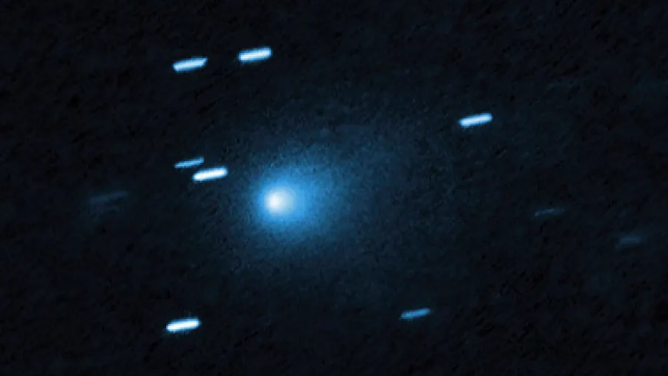
Hubble Space Telescope image of comet 3I/ATLAS 227 million miles from Earth on July 21, 2025
(NASA, ESA, David Jewitt (UCLA); Image Processing: Joseph Depasquale (STScI) / FOX Weather)
After its discovery, the comet received the name 3I/ATLAS, coming from the telescope that first reported the sighting – the ATLAS survey telescope – and the ‘3I’ indicates that it’s the third known interstellar object to pass through the solar system.
NASA explains that prior to its first reported sighting, findings extend back to June 14. Observations were gathered from the archives of three different ATLAS telescopes around the world and the Zwicky Transient Facility at the Palomar Observatory in San Diego County, California.
JAMES WEBB SPACE TELESCOPE REVEALS 'UNUSUAL' CHEMICAL MAKEUP OF INTERSTELLAR COMET 3I/ATLAS
By July 21, astronomers were able to make an estimate on the size and physical properties of the comet using NASA’s Hubble Space Telescope, as it captured the sharpest-ever picture, NASA said.
Astronomers observed that the upper limit on the diameter of the nucleus is 3.5 miles, but could be as small as 1,000 feet, according to research reports.
August 2025: JWST and SPHEREx observe comet 3I/ATLAS
On Aug. 6, NASA’s James Webb Space Telescope (JWST) observed the comet with its Near-Infrared Spectrograph instrument, analyzing more data to further understand its properties, size and chemical makeup.
Next, NASA’s SPHEREx, Spectro-Photometer for the History of the Universe, Epoch of Reionization and Ices Explorer, observed the comet Aug. 7 through Aug. 15, releasing new images and analyzing insights from the data.
September 2025: Spacecraft missions observe comet 3I/ATLAS
NASA’s Psyche observed the comet from Sept. 8 to 9 for eight hours, using the mission’s multispectral imager as it was 33 million miles from the spacecraft. This type of imaging helps astronomers refine the trajectory of the comet.
According to NASA, "the imager’s sensitivity to the comet’s reflected sunlight meant that the mission could precisely track the object." As a result, scientists were able to gather more detailed information about 3I/ATLAS’s faint coma and its central nucleus.
Following NASA’s Psyche mission, NASA’s STEREO, Solar Terrestrial Relations Observatory, observed the comet from Sept. 11 through Oct. 2.
This mission was designed to study the Sun’s activity and influence across the solar system, as scientists say comet 3I/ATLAS turns blue near the Sun.
GIGANTIC INTERSTELLAR 3I/ATLAS COMET ACCELERATES AND TURNS BLUE NEAR SUN, SCIENTISTS SAY
From Sept. 15 through the 17, NASA’s Lucy Spacecraft captured a series of photos as the comet was zooming 240 million miles away from the spacecraft. Scientists worked to understand the three-dimensional structure of the comet and how its dust scatters sunlight by comparing this data with the data collected Las Cumbres Observatory in Cerro Tololo, Chile.
According to NASA, on Sept. 20 through Oct. 3, the PUNCH mission, Polarimeter to Unify the Corona and Heliosphere, captured photos of the comet's tail 231 million to 235 million miles from Earth, showing it appears as a short elongation to the right.
INTERSTELLAR COMET 3I/ATLAS TAIL CHANGING AS IT ZOOMS THROUGH SOLAR SYSTEM
On Sept. 28, MAVEN, Mars Atmosphere and Volatile EvolutioN, an ultraviolet instrument, captured Hydrogen atoms surrounding the comet.
October 2025: Closer images of comet 3I/ATLAS released
On Oct. 2, NASA said that the Mars Reconnaissance Orbiter (MRO) captured images of the comet from the closest location any of the agency’s spacecraft may get, at 18.6 million miles, and by Oct. 9, instruments on the MAVEN spacecraft on Mars revealed a halo of gas and dust surrounding the comet making up its coma.
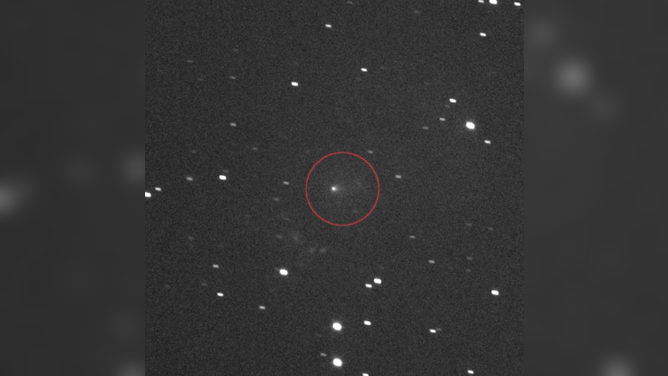
Stacked images show a fuzzy halo of gas around 3I/ATLAS
(NASA/Goddard/SwRI/JHU-APL / FOX Weather)
INTERSTELLAR COMET 3I/ATLAS SPOTTED BY EUROPE'S MARS SPACECRAFT IN CLOSEST LOOK YET
NASA shares that the ESA, European Space Agency, and the SOHO, NASA Solar and Heliospheric Observatory, captured a glimpse of the interstellar object on Oct. 15 through the 26, at a view of approximately 222 million miles away.
November 2025: New images released from NASA’s Wide Field Camera 3 instrument
On Nov. 30, NASA released new images of the comet from its Wide Field Camera 3 instrument, which allows for panchromatic views of space objects. The comet was 178 million miles from Earth at this time and is expected to get closer later in December.
December 2025: Comet 3I/ATLAS will make its closest approach to Earth
Scientists say that this rare installer comet will be closest to Earth on Dec. 19, at approximately 167 million miles away.
DON'T MISS IT: RARE INTERSTELLAR COMET 3I/ATLAS TO PASS CLOSEST TO EARTH ON DEC. 19
"When 3I/ATLAS is closest to the Earth, all the features that we are looking for will be easier to detect with our telescopes," Darryl Z. Seligman, assistant professor of physics and astronomy at Michigan State University (via space.com), said.
Reports say that interstellar comet 3I/ATLAS is scientifically important because its differences from other comets in our solar system may provide more understanding into the composition of our solar system.
"Observations of interstellar objects are still rare enough that we learn something new on every occasion," said Shane Byrne, HiRISE principal investigator at the University of Arizona in Tucson.