

NASA’s James Webb Space Telescope reveals stunning never-before-seen details in the Red Spider Nebula
For the first time, the new view reveals the nebula's outstretched lobes, which form the 'legs' of the spider, in full extent, notes NASA.
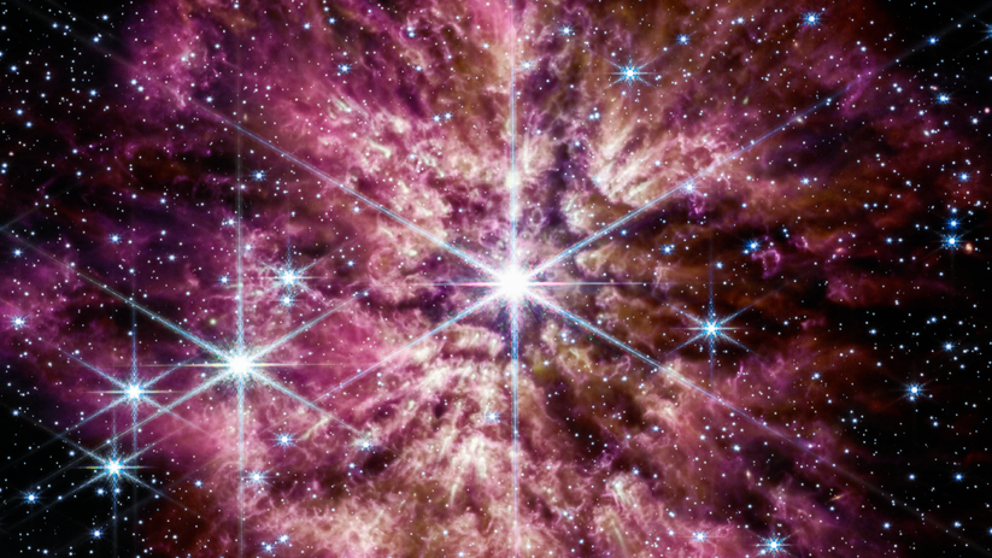
FILE: Rarely seen prelude to supernova captured by James Webb Space Telescope
The luminous, hot star Wolf-Rayet 124 (WR 124) is prominent at the center of the James Webb Space Telescope’s composite image combining near-infrared and mid-infrared wavelengths of light from Webb’s Near-Infrared Camera and Mid-Infrared Instrument.
Using its Near-InfraRed Camera (NIRCam), NASA’s James Webb Space Telescope (JWST) captured unprecedented details on the Red Spider Nebula.
For the first time, the new view reveals the nebula's outstretched lobes, which form the 'legs' of the spider, in full extent, notes NASA.
THE JAMES WEBB SPACE TELESCOPE: HOW JWST IS DELVING DEEPER INTO OUR UNIVERSE THAN EVER BEFORE
Second to the Hubble Space Telescope, the JWST launched in 2021 as the world’s premier space science observatory and can detect infrared radiation all over the universe.
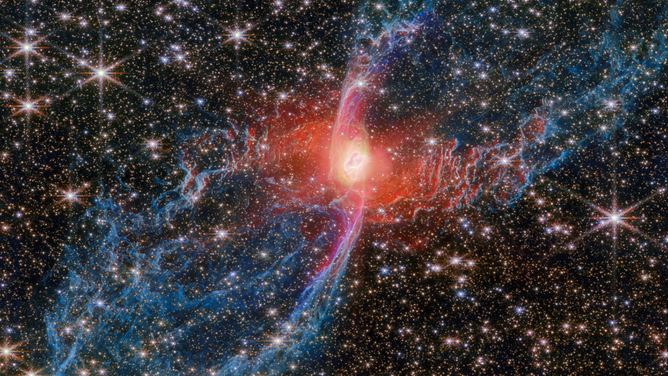
Photo captured by NASA's JWST of Red Nebula Spider
(ESA/Webb, NASA & CSA, J. H. Kastner (Rochester Institute of Technology) / FOX Weather)
In the photo captured by the scope, the lobes are visible in blue and are traced by light emitted from H2 molecules, containing two hydrogen atoms bonded together.
"These lobes are shown to be closed, bubble-like structures that each extend about 3 light-years," NASA points out, and that outflowing gas from the center of the nebula has filled bubbles over thousands of years.
The NIRCam infrared imagery provided high-resolution imagery for the investigation and will help with a wide variety of other analyses.