

Don't miss it: Rare interstellar comet 3I/ATLAS to pass closest to Earth on Dec. 19
Scientists have been following the comet's journey since its first sighting was reported in July and it will be seen at its closest approach yet - about 167 million miles from Earth - this Friday using ground-based telescopes, according to NASA.
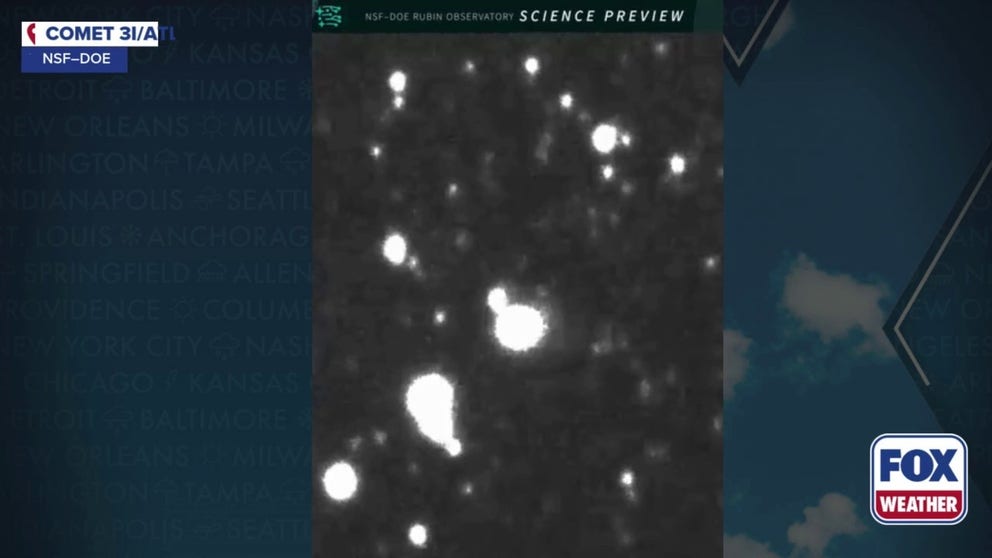
FILE: Interstellar comet 3I/ATLAS as seen by Rubin Observatory
The recently discovered interstellar comet 3I/ATLAS was spotted by the new NSF-DOE Vera C. Rubin Observatory in Chile.
Comet 3I/ATLAS will make its closest approach to Earth yet on Friday, Dec. 19 and NASA said people at home will also be able to see it using ground-based telescopes.
INTERSTELLAR COMET 3I/ATLAS SPOTTED BY EUROPE'S MARS SPACECRAFT IN CLOSEST LOOK YET
Scientists have been following the comet's journey since its first sighting was reported on July 1, 2025, with the NASA-funded ATLAS survey telescope in Rio Hurtado, Chile, 227 million miles from Earth.
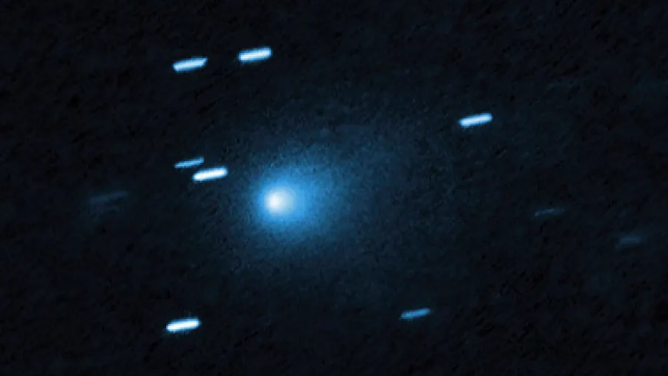
Hubble Space Telescope image of comet 3I/ATLAS 227 million miles from Earth on July 21, 2025
(NASA, ESA, David Jewitt (UCLA); Image Processing: Joseph Depasquale (STScI) / FOX Weather)
Since then, scientists have been able to gain knowledge of its size and physical properties, deeming it to be interstellar due to its high velocity and trajectory.
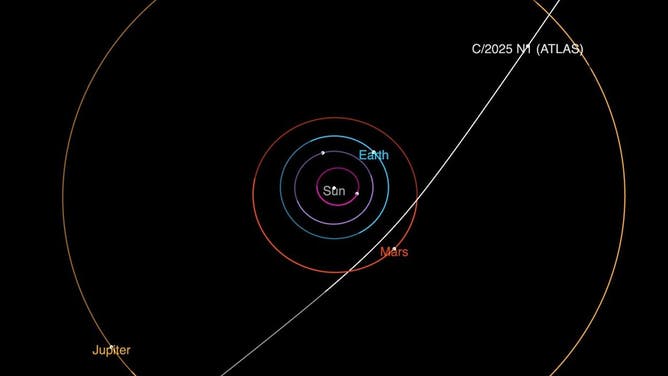
The diagram shows the trajectory of interstellar comet 3I/ATLAS.
(FOX Weather)
It marks the third known discovered object to pass through the galaxy from the outside, "which makes it fascinating, exciting, and scientifically very important," said NASA Associate Administrator Amit Kshatriya.
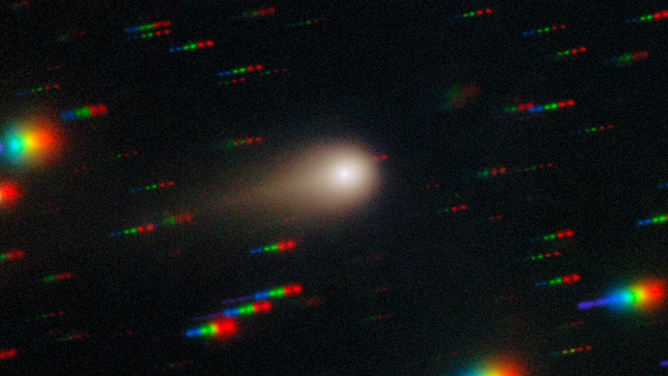
Comet 3I/ATLAS streaks across a dense star field in this image captured by the Gemini Multi-Object Spectrograph (GMOS) on Gemini South at Cerro Pachón in Chile, one half of the International Gemini Observatory, partly funded by the U.S. National Science Foundation (NSF) and operated by NSF NOIRLab. This image is composed of exposures taken through four filters — red, green, blue and ultraviolet. As exposures are taken, the comet remains fixed in the center of the telescope’s field of view. However, the positions of the background stars change relative to the comet, causing them to appear as colorful streaks in the final image.
(International Gemini Observatory/NOIRLab/NSF/AURA/Shadow the Scientist / FOX Weather)
The comet is zooming through the solar system at an astonishing 130,000 miles per hour, making it the highest recorded solar system visitor, according to NASA.
In its most recent sighting on Nov. 30, the comet was 178 million miles from Earth, but officials say the comet will come no closer than 170 million miles from our planet and poses no threat.
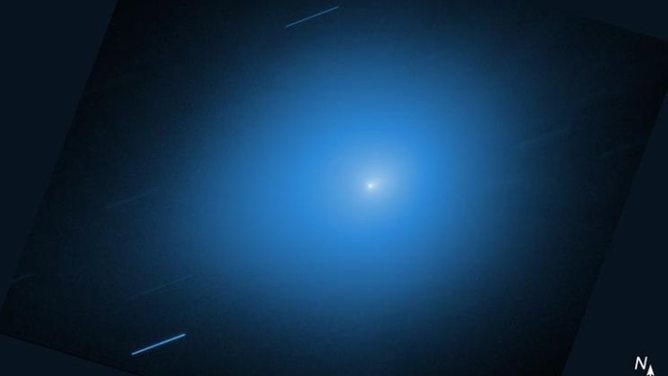
NASA's Hubble Space Telescope Wide Field Camera 3 Instrument view of comet 3I/ATLAS Nov. 30.
(NASA, ESA, STScI, D. Jewitt (UCLA), M.-T. Hui (Shanghai Astronomical Observatory). Image Processing: J. DePasquale (STScI) / FOX Weather)
However, this Friday’s sighting could be slightly closer at around 167 million miles from Earth.
"Astronomers can glean information about celestial bodies by observing the light reflected off them with telescopes. When 3I/ATLAS is closest to the Earth, all the features that we are looking for will be easier to detect with our telescopes," said Darryl Z. Seligman, Assistant Professor of Physics and Astronomy at Michigan State University (via space.com).
After coming close to Earth, comet 3I/ATLAS will head towards Jupiter and pass that planet’s orbit in the spring of 2026, according to LiveNOW from FOX.
Scientists will continue to follow its journey throughout our solar system until it vanishes to better understand near-Earth objects.
Editor's Note: This story was corrected to adjust the distance 3I/ATLAS will be from Earth.