

Photos: New images captured by NASA's Hubble Space Telescope reveal journey of interstellar comet 3I/ATLAS
The Wide Field Camera 3 instrument gives the telescope the ability to capture a panchromatic view of objects flying through the solar system, other galaxies and exoplanets, NASA explains, bringing valuable data on for ongoing research.
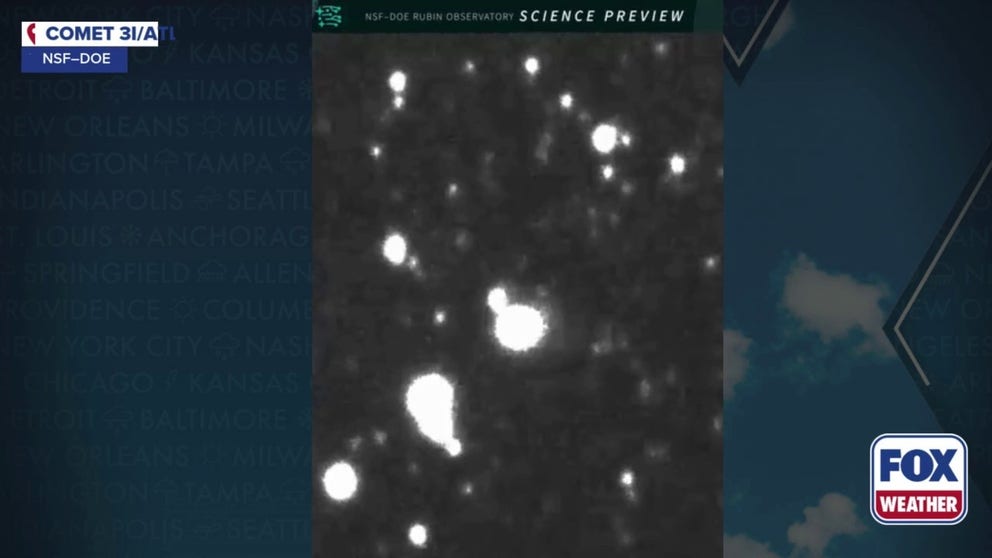
FILE: Interstellar comet 3I/ATLAS as seen by Rubin Observatory
The recently discovered interstellar comet 3I/ATLAS was spotted by the new NSF-DOE Vera C. Rubin Observatory in Chile.
NASA’s Hubble Space Telescope captured a deeper look at interstellar comet 3I/ATLAS, with its Wide Field Camera 3 instrument, as it zoomed through the solar system on Nov. 30.
The Wide Field Camera 3 instrument gives the telescope the ability to capture a panchromatic view of objects zipping through the solar system, other galaxies and exoplanets, NASA explains, and allows astronomers to study stars and galaxies farther back in time more than ever.
ASTRONOMERS SPOT RARE INTERSTELLAR COMET SPEEDING THROUGH SOLAR SYSTEM
NASA first spotted interstellar comet 3I/ATLAS zooming through the solar system in summer 2025 with the NASA-funded ATLAS survey telescope in Rio Hurtado, Chile.
Scientists determined it to be interstellar due to its high velocity and trajectory, as it’s only the third known discovered object to pass through from the outside.
GIGANTIC INTERSTELLAR 3I/ATLAS COMET ACCELERATES AND TURNS BLUE NEAR SUN, SCIENTISTS SAY
Officials say that comet will come no closer than 170 million miles from Earth and poses no threat.
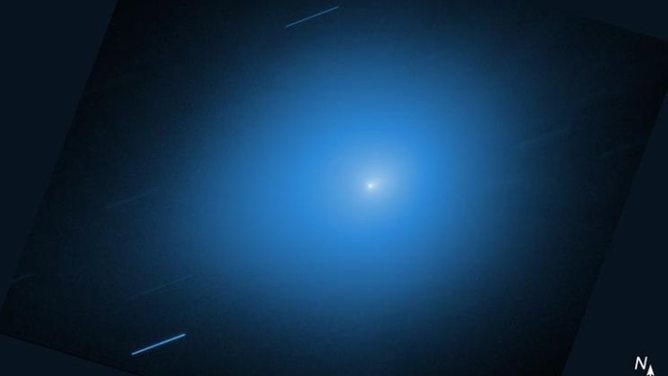
NASA's Hubble Space Telescope Wide Field Camera 3 instrument view of comet 3I/ATLAS Nov. 30.
(NASA, ESA, STScI, D. Jewitt (UCLA), M.-T. Hui (Shanghai Astronomical Observatory). Image Processing: J. DePasquale (STScI) / FOX Weather)
In its most recent siting, the comet was about 178 million miles from our planet.
The Hubble tracked the comet as it sped through the solar system, resulting in background stars looking like streaks of light, as seen in the image above.
NASA explains that it’s on a hyperbolic trajectory, meaning it moves too fast to be bound to the Sun's gravity, causing it not to follow a closed orbital path around the Sun.
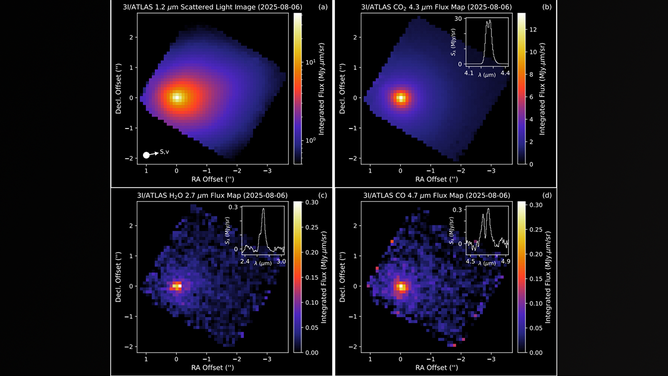
Spectral data for 3I/ATLAS observed using JWST’s NIRSpec.
(NASA/ESA/CSA / NASA)
This means it’s merely just passing through our solar system before it vanishes.
NEW IMAGES RELEASED OF ‘INTERSTELLAR WANDERER’ ZOOMING THROUGH OUR SOLAR SYSTEM
"So we use all the tools at our disposal to observe it before it disappears back into the cosmic dark," said NASA, as a host of their missions have come together to observe the interstellar object to its fullest extent.
Observations are expected to continue for several more months and NASA’s space telescopes will help the ongoing mission to find, track, and gain more valuable knowledge on solar system objects.