

The world’s biggest desert has zero sand and it is not where you think
Geologically, deserts are classified by precipitation, not temperature, with NASA defining them as receiving 10 inches or less annually.
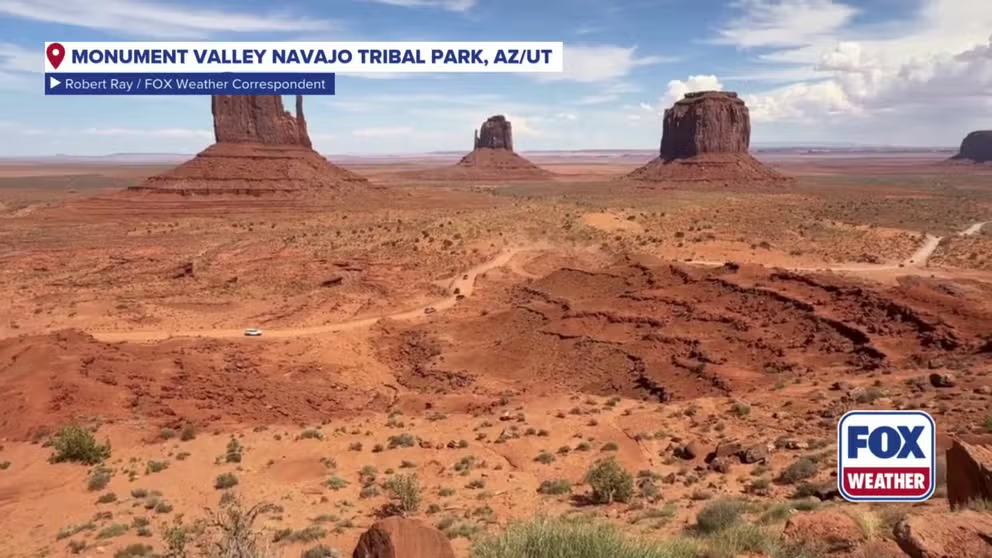
FILE: Breathtaking Views Of Monument Valley In Desert Southwest
The majestic red landscape of Monument Valley along the Arizona-Utah border is what many imagine when they think of the American West. Here is what FOX Weather Correspondent Robert Ray said, after visiting the park: "Not an easy place to get to, but the payoff is beyond words."
When we hear the word "desert," most of us picture the blistering heat of the Sahara, Death Valley or a dusty stretch of Arizona highway. But the largest desert on Earth looks nothing like that.
SEE IT: NASA SATELLITE REVEALS HUMMINGBIRD-SHAPED SECRET BENEATH ANTARCTICA'S ICE
It is a frozen continent covered in miles of ice, battered by lashing winds, and defined by one of the harshest environments on the planet: Antarctica.
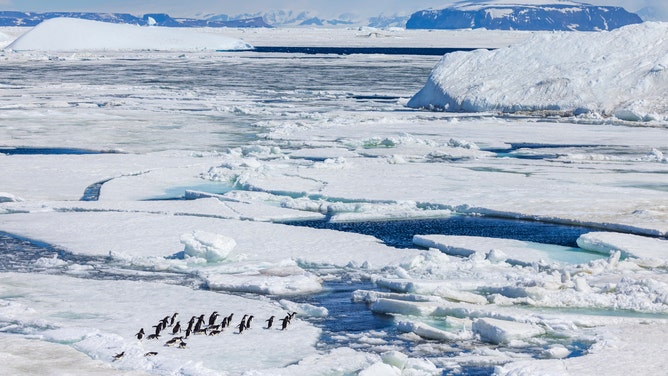
Adélie penguin is a species of penguin common along the entire coast of the Antarctic continent.
(Andrew Peacock / Getty Images)
This frozen landscape completely turns our traditional understanding of a desert inside out, highlighting that the ultimate record-breaker isn't defined by heat at all, but by thirst.
Geologically, deserts are classified by precipitation, not temperature. According to NASA, they are primarily defined by an extreme lack of moisture caused by low annual precipitation, typically receiving roughly 10 inches or fewer per year.
EMPEROR PENGUINS DECLARED ENDANGERED SPECIES AMID THE DECLINE IN SEA ICE
True to this definition, Antarctica is not only the coldest and windiest continent, but also one of the driest.
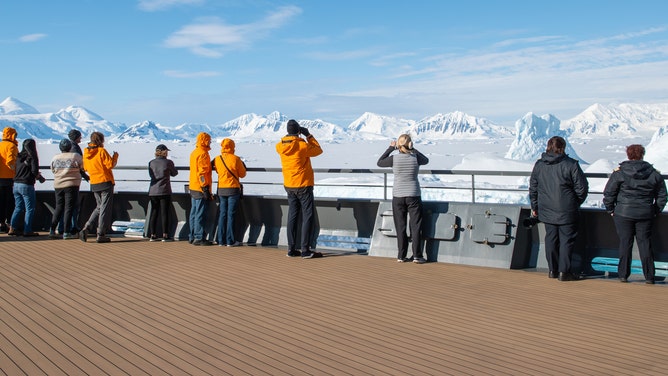
Hanusse Bay, Antarctica - January 14, 2024: Cruise passengers of Seabourn Pursuit expedition ship enjoying the beautiful snow-capped mountains in Antarctica.
(NANCY PAUWELS / Getty Images)
According to the United States Antarctic Program, the continent receives only about 2 inches of precipitation per year — making this frozen continent a true desert.
Spanning approximately 5.4 million square miles, this expanse is roughly 1.5 times the size of the Sahara Desert.
THE MYSTERY BEHIND THE 'SAILING STONES' OF DEATH VALLEY NATIONAL PARK
This means that when you see snow blowing across the landscape, it isn't a new storm, but rather ancient crystals being endlessly recycled by the fierce winds.
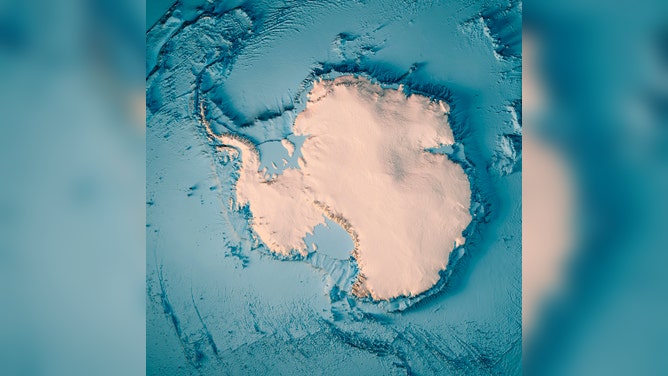
3D Render of a Topographic Bathymetry Map of the Antarctica. All source data is in the public domain. Color texture: Made with Natural Earth. http://www.naturalearthdata.com/downloads/10m-raster-data/10m-cross-blend-hypso/ Relief texture: ETOPO 2022 data courtesy of USGS. URL of source image: https://www.ncei.noaa.gov/products/etopo-global-relief-model Water texture lakes: Made with Natural Earth. https://www.naturalearthdata.com/downloads/10m-physical-vectors/ Water texture: HIU World Water Body Limits: http://geonode.state.gov/layers/?limit=100&offset=0&title__icontains=World%20Water%20Body%20Limits%20Detailed%202017Mar30
(FrankRamspott / Getty Images)
Ironically, despite receiving almost no new rain or snow, this massive landmass is buried under miles of thick ice — holding about 90% of the world's ice and 70% of its fresh water.
Because of these ultra-dry, sub-zero conditions, NASA often compares the Antarctica Desert to Mars.
As the agency notes, "The desert conditions in Antarctica are like the conditions on Mars. NASA tested robots in Antarctica that later landed on Mars."
Antarctica truly challenges our assumptions about what a desert can be.