

How cold does it need to be in Florida for iguanas to fall from trees?
The Florida Fish and Wildlife Conservation Commission advises people to leave cold-stunned iguanas alone, as they can become defensive when awakening from their frozen state.
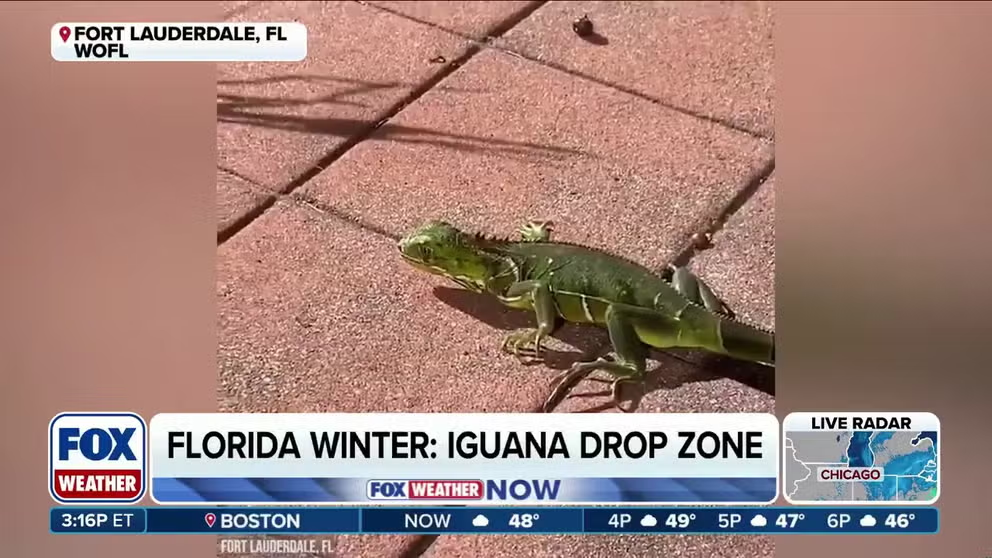
When temperatures drop in Florida, iguanas may fall from the trees
Temperatures in Florida in the wintertime can get into the 40s and 50s, and when that happens, iguanas are often found "frozen" on sidewalks due to being cold-stunned. Ron Magill, the communications director for Zoo Miami, joins FOX Weather to talk about the phenomenon and why it happens.
Floridians know to keep an eye on the sky for any falling reptiles when the temperatures drop. If you're not from Florida, you might be wondering why reptiles drop from the sky when it gets cold.
Specifically, when the temperatures drop below the 60s in Florida, green iguanas, which like to perch high up in trees, start to experience something called torpor.
Green iguanas are invasive in Florida and are cold-blooded, so their bodies don't handle sharp contrasts in temperature well.
FIRST-OF-ITS-KIND OVERPASS AIMS TO STOP ANIMAL-VEHICLE CRASHES IN COLORADO
Torpor is a temporary state where animals seize up and appear as if they're dead — losing all muscle control, according to the Florida Fish and Wildlife Conservation Commission.
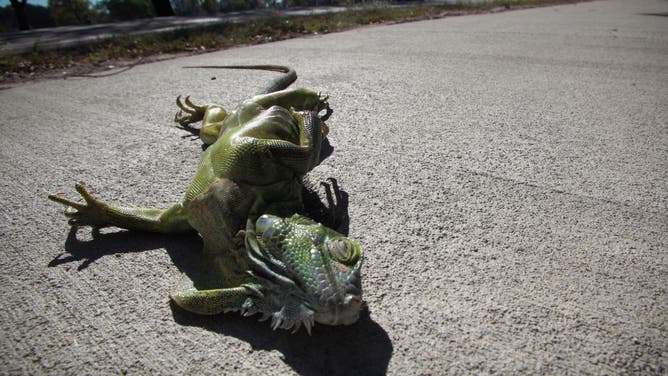
Iguanas typically begin to lose mobility when temperatures reach 50 degrees. Below that, the cold can completely immobilize them.
((Cristobal Herrera/South Florida Sun Sentinel/Tribune News Service via Getty Images) / Getty Images)
When temperatures get into the 50s, iguanas begin to get sluggish and slow down. At 40 degrees, they can become cold-stunned for up to eight hours.
TWO ORGANIZATIONS TEAM UP TO SAVE COLD-STUNNED SEA TURTLES
When temperatures dip below 40 degrees, iguanas enter torpor for an unspecified amount of time.
As the iguanas start to seize up, they often fall from their perches high in the trees or vegetation where they like to bask in the sun away from predators.
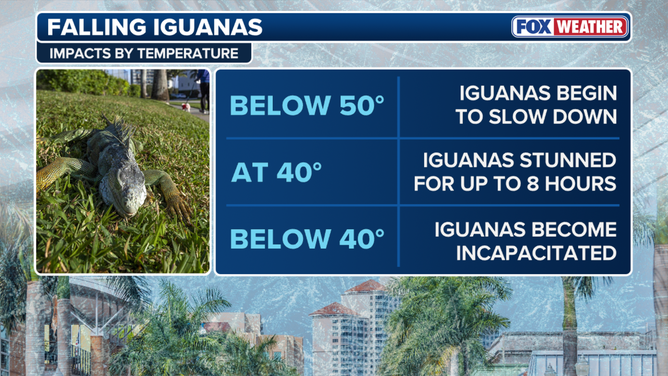
Temperature impacts on Iguanas
(FOX Weather / FOX Weather)
The bigger the iguana, the colder it needs to be to slow them down.
Smaller iguanas could start slowing down in the 50s, Zoo Miami Communications Director Ron Magill said.
"Larger ones might take a little longer," Magill said. "That takes into the low 40s, high 30s and that's when those big guys start falling out of trees."
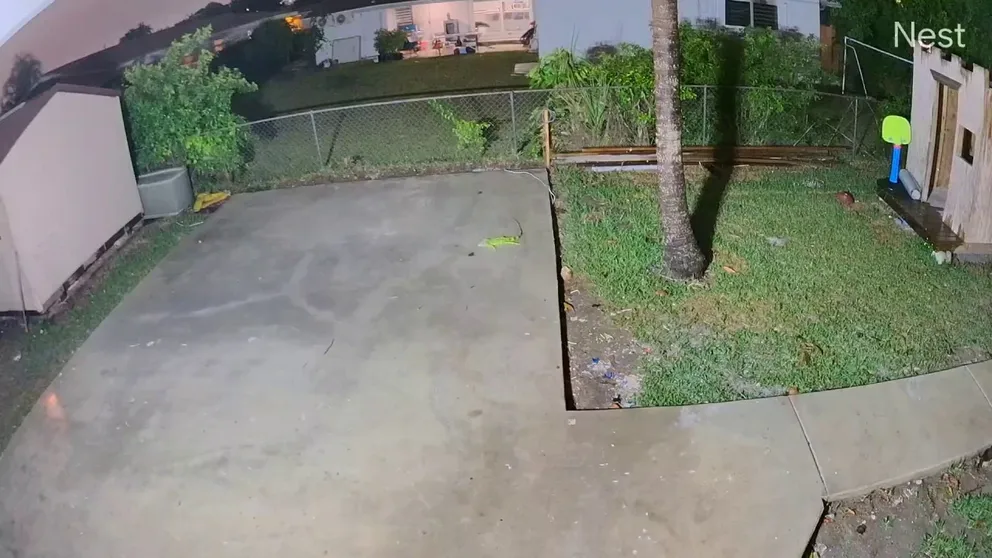
FILE: Cold-stunned iguana falls from tree in Miami
A video captured on Wednesday, Jan. 22, 2025 in Miami Beach shows a cold-stunned iguana falling from a tree and landing hard on a concrete pad before slowly crawling away.
The Florida FWC warns residents not to mess with iguanas that have fallen from their perches.
"You have to understand, they are usually not dead," Magill said. "That's not to say they can't die from extended periods of that very cold temperature, that will kill them."
WATCH: COLD-STUNNED IGUANA TUMBLES FROM MIAMI TREE DURING ARCTIC BLAST
Once the iguanas awaken from their torpor, they can become defensive, especially if left in a place with people or pets to warm up.
Possessing iguanas in the state of Florida is illegal, so the best thing to do if you see a fallen one is leave it alone and not touch it.