

Photos: 25 cold-stunned turtles rescued from Cape Cod Bay during bitter arctic blast
The turtles arrived in banana boxes and are being treated by Turtle Hospital staff.
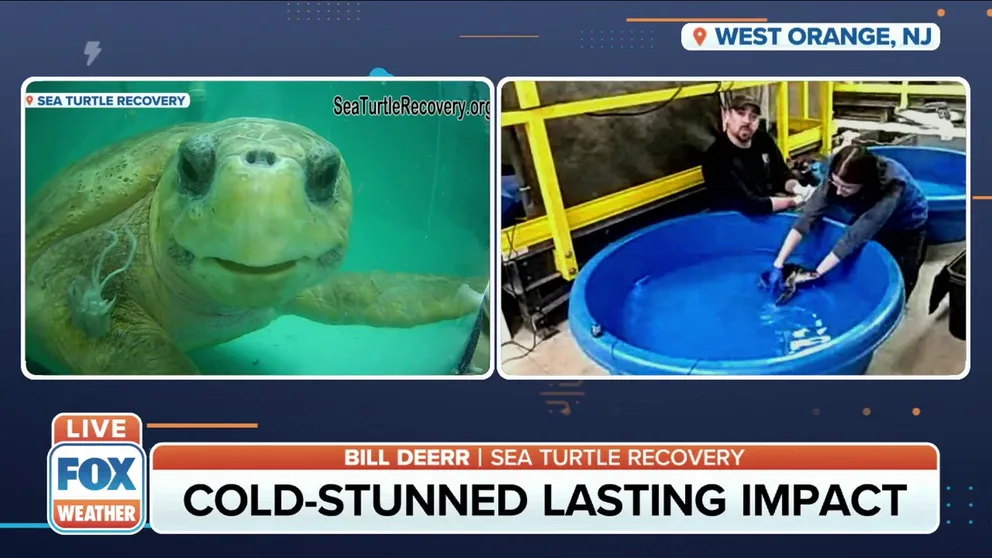
FILE: Saving hypothermic sea turtles
The race is on to save hypothermic sea turtles that have been stranded.
MARATHON, Fla. - Over two dozen cold-stunned turtles were rescued from Cape Cod Bay and are now being treated in the Florida Keys.
A group of young Kemp's Ridley turtles were left stranded, hypothermic and unable to swim on Tuesday. The turtles were flown from New England Aquarium to Florida Keys Marathon International Airport by volunteer pilots with LightHawk, which is a conservation aviation organization.
SEE IT: 'ADDIE' THE SEA TURTLE RELEASED ALONG FLORIDA BEACH AFTER MONTHS OF REHAB, TUMOR REMOVALS
They arrived in banana boxes and are being treated by Turtle Hospital staff. Cape Cod has seen freezing weather over the past few days.
![]() Image 1 of 4
Image 1 of 4Two critically endangered Kemp's ridley sea turtles await processing Tuesday, Dec. 10, 2025, at the Turtle Hospital in Marathon, Florida. The juvenile turtles, marked with identification numbers, were among 25 flown to the Florida Keys to warm up after being rescued from Cape Cod Bay beaches where they became stranded and hypothermic during a cold-stunning event. Each turtle received blood chemistry tests, measurements and weight checks before beginning treatment that could last up to one year. (Mark Hedden/Florida Keys News Bureau)
![]() Image 2 of 4
Image 2 of 4Turtle Hospital manager Bette Zirkelbach unloads one of 25 critically endangered Kemp's ridley sea turtles Tuesday, Dec. 10, 2025, at Florida Keys Marathon Airport in Marathon, Florida. The juvenile turtles were carefully packed in Chiquita banana boxes and flown from New England by LightHawk volunteer pilots after being rescued from Cape Cod Bay beaches where they became stranded, hypothermic and unable to swim during a cold-stunning event. Treatment began immediately upon arrival at the Marathon facility. (Mark Hedden/Florida Keys News Bureau)
![]() Image 3 of 4
Image 3 of 4A Turtle Hospital staff member examines critically endangered Kemp's ridley sea turtles Tuesday, Dec. 10, 2025, during intake processing in Marathon, Florida. Twenty-five juvenile sea turtles arrived from New England after being rescued from Cape Cod Bay beaches where they became stranded and hypothermic during a cold-stunning event. Staff performed blood chemistry tests, measurements and weights before administering treatment for pneumonia and other cold-related ailments. (Mark Hedden/Florida Keys News Bureau)
![]() Image 4 of 4
Image 4 of 4A Kemp's ridley sea turtle swims Tuesday, Dec. 10, 2025, at the Turtle Hospital in Marathon, Florida, far from the cold Cape Cod Bay waters that left it hypothermic and unable to swim. The critically endangered juvenile was among 25 cold-stunned turtles flown to the Florida Keys by LightHawk volunteer pilots. After passing a swim test, the turtle was admitted to a hospital tank to begin treatment for pneumonia and other cold-related ailments. (Mark Hedden/Florida Keys News Bureau)


THE TALE OF THE TURTLE NAMED IAN FOR THE HURRICANE THAT NEARLY KILLED HIM
Hospital staff said there's a lot more at stake than recovery as the turtles represent hope for a critically endangered species.
Sea turtles follow the Gulf Stream north during the summer months, and they're attracted to Cape Cod Bay because there's an abundance of food.
"Sea turtles are ectothermic," Turtle Hospital Manager Bette Zirkelbach said. "They take on the temperature of the air and water surrounding them. They cannot regulate their body temperature, so they experience a cold stunning in temperatures below 55 degrees water temperature."
When animals are cold-stunned, their metabolism slows, they stop eating and float helplessly or wash ashore. The hospital said Kemp's Ridley turtles could face extinction within our lifetime.
The turtles were rescued by volunteers who comb Cape Cod beaches once temperatures drop.