

Why will the Artemis II spacecraft land in the ocean and not on land?
The ocean is an easily accessible option for military personnel to safely secure the area from the public and provide a cool liquid cushion to serve as a shock absorber for the spacecraft to land on, rather than on land.

Artemis II space mission nearing completion
CLOSER TO SPLASHDOWN 🚀: FOX Weather Correspondent Brandy Campbell reports from San Diego, California, where the Orion spacecraft will be splashing down in the ocean on Friday after a successful orbit around the moon.
SAN DIEGO, Calif. – The Artemis II space mission has been nothing short of a success, as the four crew members on the Orion spacecraft have made history during their journey around the moon.
As the Artemis II team wraps up their mission to orbit the moon, they are now on a trajectory back to Earth after physically capturing images of the dark side for the first time in human history.
WHEN WILL NASA LAND ON THE MOON? TRACKING THE ARTEMIS PROGRAM'S JOURNEY BACK TO THE LUNAR SURFACE
As the final days of the mission are upon us, the Orion spacecraft is scheduled to return to Earth on Friday, along the shores of San Diego, where NASA and Naval Recovery crews are waiting for the team to arrive, but why does it land in the ocean?
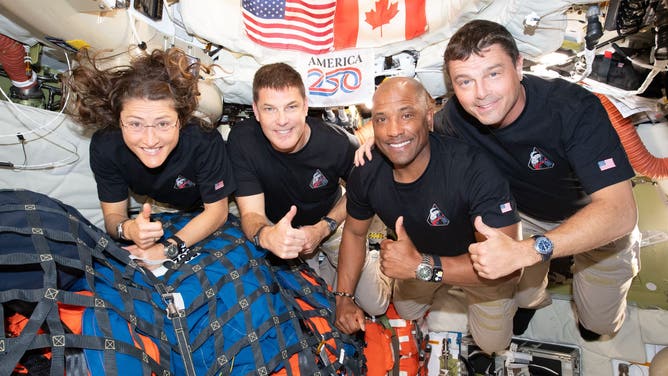
![IN SPACE - APRIL 07: (EDITOR'S NOTE: This Handout image was provided by a third-party organization and may not adhere to Getty Images' editorial policy.) In this handout image provided by NASA, The Artemis II crew – (from left) Mission Specialist Christina Koch, Mission Specialist Jeremy Hansen, Pilot Victor Glover, and Commander Reid Wiseman – pause for a group photo inside the Orion spacecraft on their way home. Following a swing around the far side of the Moon on April 6, 2026, the crew exited the lunar sphere of influence (the point at which the Moon's gravity has a stronger pull on Orion than the Earth's) on April 7, and are headed back to Earth for a splashdown in the Pacific Ocean on April 10.]() Image 1 of 3
Image 1 of 3IN SPACE - APRIL 07: (EDITOR'S NOTE: This Handout image was provided by a third-party organization and may not adhere to Getty Images' editorial policy.) In this handout image provided by NASA, The Artemis II crew – (from left) Mission Specialist Christina Koch, Mission Specialist Jeremy Hansen, Pilot Victor Glover, and Commander Reid Wiseman – pause for a group photo inside the Orion spacecraft on their way home. Following a swing around the far side of the Moon on April 6, 2026, the crew exited the lunar sphere of influence (the point at which the Moon's gravity has a stronger pull on Orion than the Earth's) on April 7, and are headed back to Earth for a splashdown in the Pacific Ocean on April 10. (NASA)
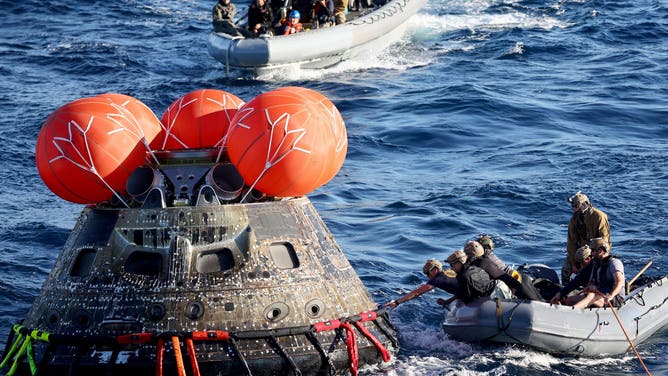
![US Navy divers secure NASA's Orion Capsule during recovery operations following a successful uncrewed Artemis I moon mission after it splashed down in the Pacific Ocean off the coast of Baja California, Mexico, on December 11, 2022. Orion was launched November 16 on the Artemis rocket for a 25-day mission to the Moon. The main goal of this mission was to test Orion's heat shield -- for the day when it is humans and not test mannequins riding inside.]() Image 2 of 3
Image 2 of 3US Navy divers secure NASA's Orion Capsule during recovery operations following a successful uncrewed Artemis I moon mission after it splashed down in the Pacific Ocean off the coast of Baja California, Mexico, on December 11, 2022. Orion was launched November 16 on the Artemis rocket for a 25-day mission to the Moon. The main goal of this mission was to test Orion's heat shield -- for the day when it is humans and not test mannequins riding inside. (Mario Tama / POOL / AFP)
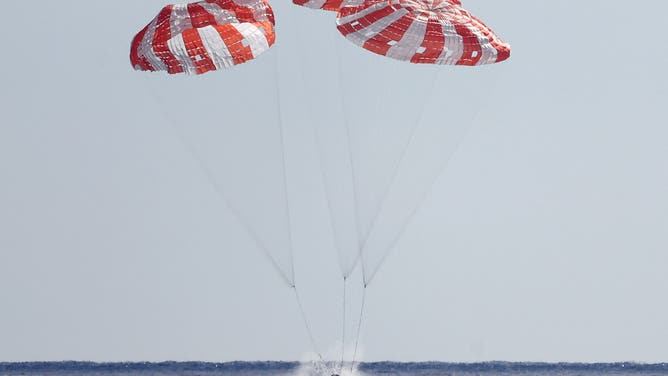
![AT SEA, PACIFIC OCEAN - DECEMBER 11: NASA's Orion Capsule splashes down after a successful uncrewed Artemis I Moon Mission on December 11, 2022 seen from aboard the U.S.S. Portland in the Pacific Ocean off the coast of Baja California, Mexico. A 26-day mission took the Orion spacecraft to the moon and back which completed a historic test flight that coincided with the 50th anniversary of the landing of Apollo 17 on the moon, the last time that NASA astronauts walked there.]() Image 3 of 3
Image 3 of 3AT SEA, PACIFIC OCEAN - DECEMBER 11: NASA's Orion Capsule splashes down after a successful uncrewed Artemis I Moon Mission on December 11, 2022 seen from aboard the U.S.S. Portland in the Pacific Ocean off the coast of Baja California, Mexico. A 26-day mission took the Orion spacecraft to the moon and back which completed a historic test flight that coincided with the 50th anniversary of the landing of Apollo 17 on the moon, the last time that NASA astronauts walked there. (Mario Tama)
Simply put, the ocean is an easily accessible option for military personnel to safely secure the area from the public and provide a cool liquid cushion to serve as a shock absorber for the spacecraft to land on, rather than on land.
HERE'S WHAT HAPPENS IN THE MOMENTS FOLLOWING THE ARTEMIS II SPLASHDOWN
"The Navy divers will then assess the environment surrounding the capsule to make sure there are no hazards present," a statement from NASA said "Teams will stabilize Orion before the crew exits the capsule in the open water by installing an inflatable collar."
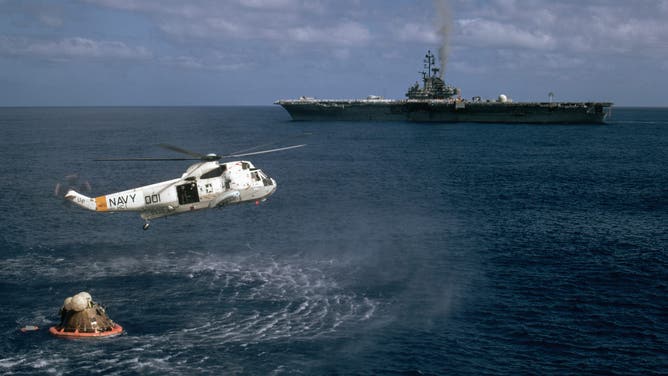
A Navy helicopter flies over the Apollo 17 after it splashes down in the Pacific Ocean. Nearby the aircraft carrier Ticonderoga cruises to pick up the capsule and astronauts. The Apollo 17 was the last flight of humans to the moon.
(Dean Conger/Corbis)
To safely extract the astronauts, divers will install an inflatable raft, called the front porch, under Orion’s side hatch to aid in the spacecraft’s exit.
The astronauts will be transported to a medical bay on one of the naval ships for a post-mission evaluation, before flying to the Johnson Space Center, according to NASA.
In past missions, such as Apollo 17, the last time humans landed on the moon, the four-person crew ended their 13-day mission by splashing down in the Pacific Ocean, where military recovery teams from the U.S.S. Ticonderoga monitored the spacecraft’s descent and the retrieval of the astronauts.
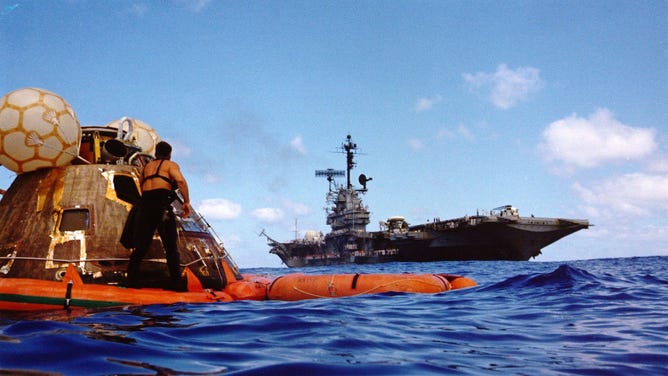
Apollo 17 recovery operations, Pacific Ocean, December 19, 1972. A water-level view of the Apollo 17 Command Module (CM) "America" floating in the sea following splashdown and prior to recovery. The prime recovery ship, the USS Ticonderoga, is in the background. When this picture was taken, the three-man crew of astronauts Eugene A. Cernan, Ronald E. Evans and Harrison H. Schmitt, had already been picked up by helicopter and flown to the deck of the recovery ship. The spacecraft was later hoisted aboard the Ticonderoga. A US Navy UDT diver stands on the flotation collar. Apollo 17 splashdown occurred at 2:24:59 p.m. (EST), Decirca 19, 1972, about 350 nautical miles southeast of Samoa. Artist NASA.
(Heritage Space/Heritage Images / Getty Images)
The splashdown methods have not changed much since the early days of NASA's space exploration.
The Artemis II space crew will be the first to splash down with humans from the moon’s orbit in over 50 years.
EYES TURN TO ARTEMIS II SPLASHDOWN AS LIGHT RAIN POSSIBLE FOR RECOVERY ZONE
After the Orion spacecraft is aboard the naval vessel, NASA technicians will drain any water from the ship before returning to the Naval Base in San Diego.