

Here's what happens in the moments following the Artemis II splashdown
NASA plans to have the Orion spacecraft splashdown off the coast of San Diego at 5:07 p.m. PST, putting an end to the first crewed mission to the moon in over 50 years.
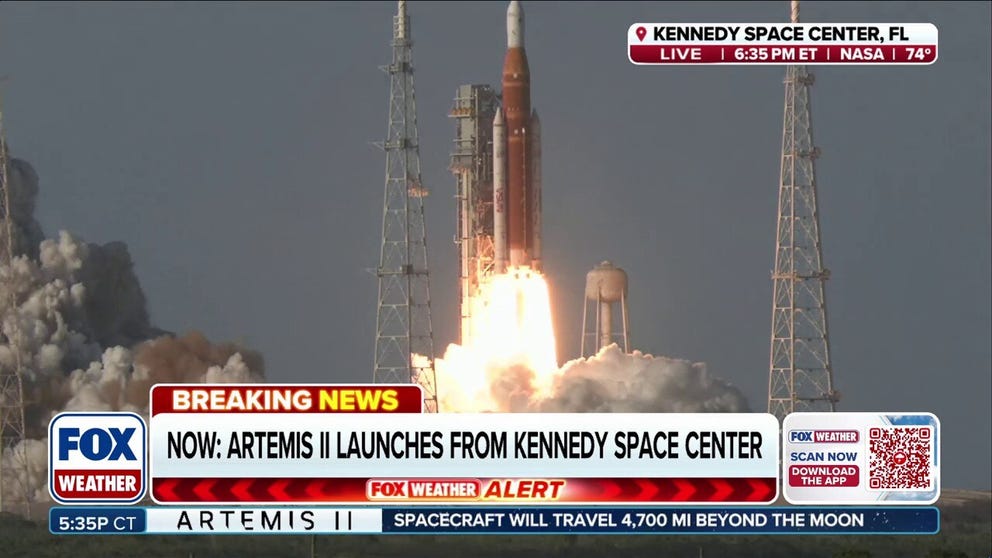
Artemis II lifts off from Kennedy Space Center
NEXT STOP, SPACE 🚀: Artemis II is roaring into space on a mission to make history after liftoff from Kennedy Space Center in Florida. This is humanity’s return to deep space, and the beginning of a bold journey around the Moon. Stay locked with FOX Weather for every second of this historic mission.
HOUSTON, Texas – The historic Artemis II mission has taken four astronauts aboard the Orion spacecraft coined "Integrity" further away from Earth than any human ever, and now they're coming home.
After a successful launch and slingshot around the moon, Integrity is on its way back to Earth and the countdown to splashdown is on.
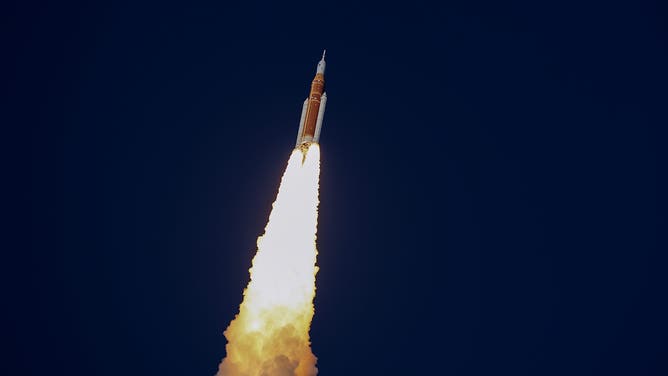
Artemis II aims to take NASA astronauts Commander Reid Wiseman, Pilot Victor Glover and Mission Specialist Christina Koch and Canadian Space Agency Mission Specialist Jeremy Hansen around the moon and back for a splashdown on the California Coast in the Pacific Ocean.
(Joe Raedle/Getty Images / Getty Images)
As of now, NASA plans to have the Orion spacecraft splashdown off the coast of San Diego at 5:07 p.m. PST, putting an end to the first crewed mission to the moon in over 50 years.
But what happens once they splash down?
EYES TURN TO ARTEMIS II SPLASHDOWN AS LIGHT RAIN POSSIBLE FOR RECOVERY ZONE
RECOVERING THE CREW
Once Integrity splashes down in the Pacific Ocean, a coalition of forces will be there to greet them as the first steps of the meticulously, well-practiced recovery begin.
About three hours before the capsule enters the atmosphere, U.S. Navy and NASA personnel will be staged in open water, with prepared recovery teams ready to provide support from both sea and air.
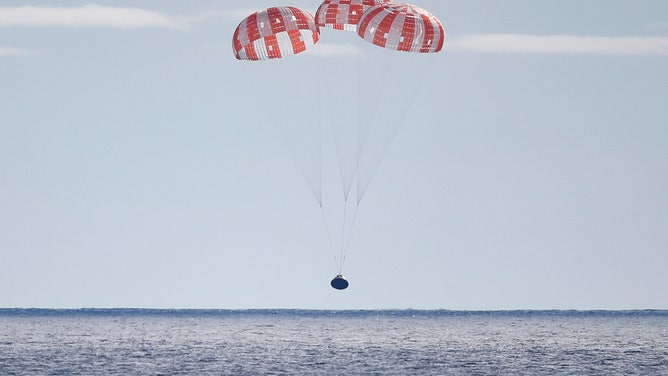
ARTEMIS I FILE PHOTO: NASA's unmanned Orion spaceship comes in for a splashdown in the Pacific Ocean off Baja California, Mexico, on December 11, 2022.
(Photo by CAROLINE BREHMAN/POOL/AFP via Getty Images / Getty Images)
Two MH-60S Sea Hawk helicopters equipped with NASA imagery equipment will track the Orion space capsule as it travels through Earth’s atmosphere.
Artemis II Landing and Recovery Director Liliana Villarreal said, "Once we get through splashdown…It's go time for everybody. The ships, the helicopters, the small boats are now just going as fast as they can towards the capsule."
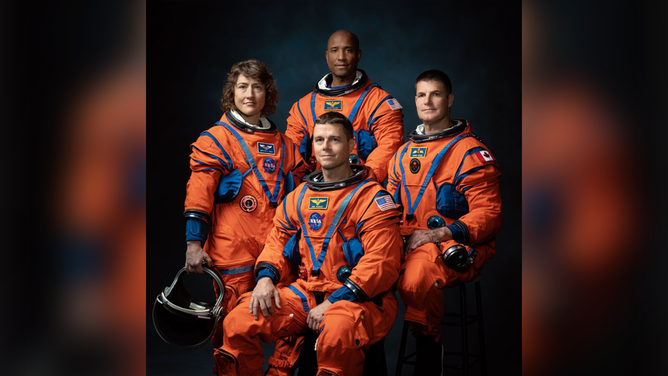
The crew of NASA's Artemis II mission (left to right): NASA astronauts Christina Hammock Koch, Reid Wiseman (seated), Victor Glover, and Canadian Space Agency astronaut Jeremy Hansen.
(NASA)
After landing in the Pacific, the crew will perform a post-landing checklist with NASA Mission Control – securing the capsule and preparing them for the power-down sequence.
Once the power-down sequence is performed and the hatch on Orion is opened, the crew will first be greeted by a dive medical officer from the U.S. Navy, who will assess the condition of the crew.
TIMELINE: A DAY-BY-DAY GUIDE TO THE 10-DAY ARTEMIS II MISSION TO BRING HUMANITY BACK TO THE MOON
Following immediate health assessments, Navy recovery divers will assist the four crew members in emerging from the capsule onto Orion's front porch, where the astronauts will dress the crew members in "Astronaut Recovery Vests."
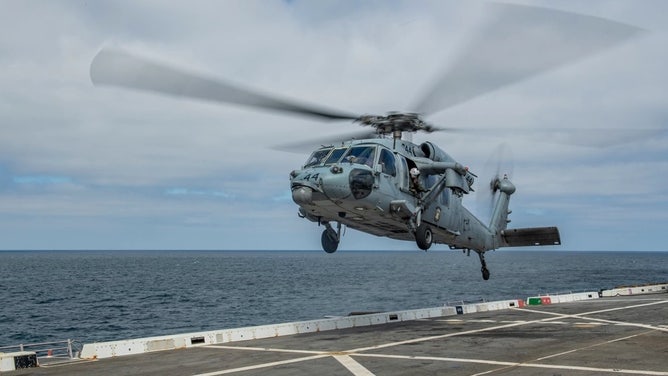
Helicopter Sea Combat Squadron (HSC) 23s will pick up the Artemis II crew and transfer them to the USS John P. Murtha.
(Naval Air Force, Pacific Fleet)
Using the recovery vests, the four crew members will be hoisted up to two HSC-23 helicopters and delivered to the USS John P. Murtha.
Once the four astronauts, who traveled further from Earth than any humans before them, are safely secured on the USS John P. Murtha – recovery crews turn their focus to the capsule.
RECOVERING THE CAPSULE
Practice makes perfect.
Recovery teams performed a staggering 12 Underway Recovery Tests (URTs) to identify the best recovery method, and practice it until it was perfect for splashdown day.
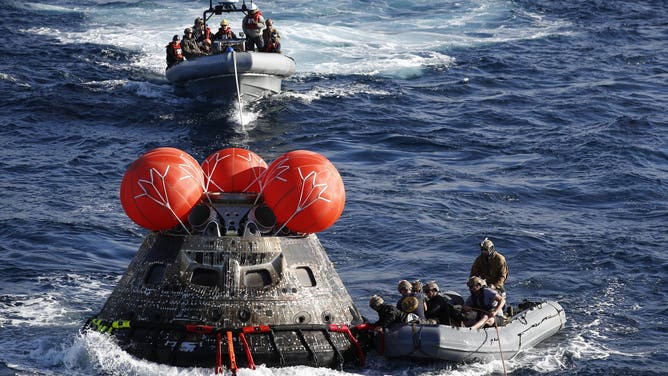
ARTEMIS I FILE PHOTO: U.S. Navy divers attach winch cables to NASA's Orion Capsule of the successful un-crewed Artemis I Moon Mission for capture by the U.S.S. Portland on December 11, 2022, in the Pacific Ocean off the coast of Baja California, Mexico.
(Photo by CAROLINE BREHMAN/POOL/AFP via Getty Images / Getty Images)
Recovery teams will secure the capsule in the same manner as NASA and U.S. Navy crews did over three years ago in the Artemis I splashdown.
"It's actually the same process we did on Artemis I," Villarreal said.
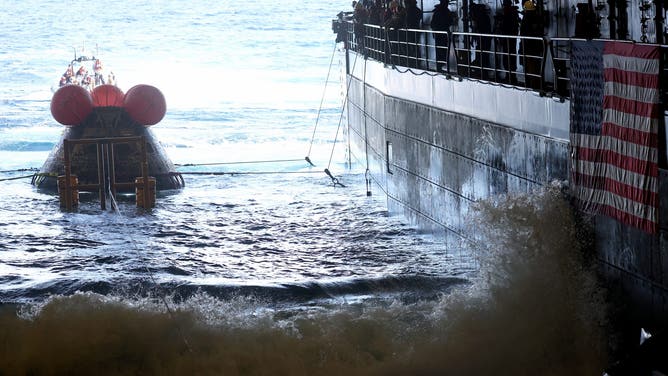
NASA's Orion Capsule floats on the well deck of the U.S.S. Portland during recovery operations after it splashed down after a successful un-crewed Artemis I Moon Mission on December 11, 2022, seen from aboard the U.S.S. Portland in the Pacific Ocean off the coast of Baja California, Mexico.
(Pool photo by Mario Tama/Getty Images / Getty Images)
Once the spacecraft is shutdown and the hatch is closed, the capsule is towed using a winch line deployed from the back of the USS John P. Murtha, where the Orion capsule is towed into a weld deck area.
ARTEMIS II'S SAFE RETURN HINGES ON ITS HEAT SHIELD - NASA IS CONFIDENT IT'S FIXED
In what Villarreal referred to as the "big milestone" – water is then drained from the weld deck area and the capsule is secured.