

Solar eclipse 2026 guide: Everything you need to know about Wednesday's must-see sky show
Regardless of how much or how little the moon covers the sun, here is a look at the best locations to experience the event, when it occurs and how to safely watch.
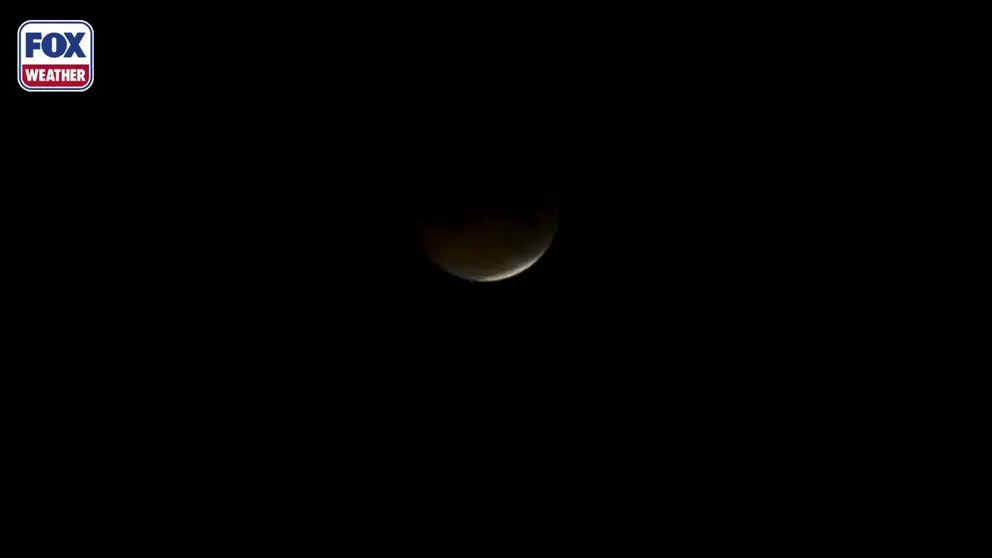
FILE: Timelapse: Total lunar eclipse over the U.S.
GOODNIGHT MOON 🌑: Watch as the Earth casts its shadow on the moon during this morning's total lunar eclipse over the U.S. This timelapse was caught over Los Angeles, CA. The next time this phenomenon will occur is 2028-2029!
A total solar eclipse is nearing and expected to put on a show for millions, as some people around the world could experience total darkness.
Despite the magnitude of this event, some locations, such as parts of the U.S., won’t experience the complete darkness that others do — but a partial eclipse is still likely.
Locations such as Reykjavík, Iceland, and Valencia, Spain, will experience 100% darkness, or totality.
Although other parts of the world won’t experience complete darkness, skywatchers will be able to see some coverage during the event.
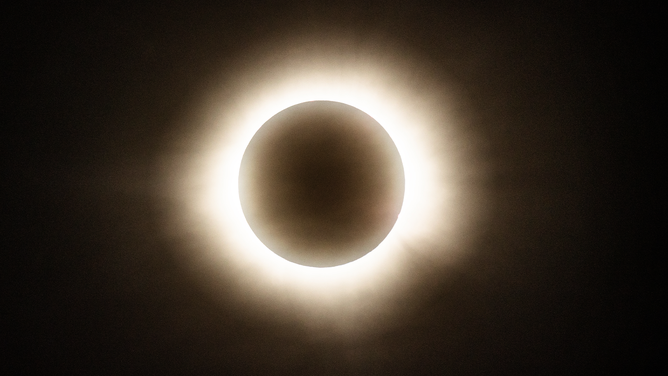
MAZATLAN, MEXICO - APRIL 08: The sun disappears behind the moon during the Great North American Eclipse on April 08, 2024 in Mazatlan, Mexico. Millions of people have flocked to areas across North America that are in the "path of totality" in order to experience a total solar eclipse. During the event, the moon will pass in between the sun and the Earth, appearing to block the sun. (Photo by Hector Vivas/Getty Images)
(Hector Vivas / Getty Images)
The greatest chance of darkness will be in northern Russia, Greenland, Iceland, northern Spain and part of Portugal.
In contrast, parts of the U.S. will only experience a partial eclipse.
4 MAJOR CELESTIAL EVENTS TO DOMINATE THE NIGHT SKY THIS WEEK
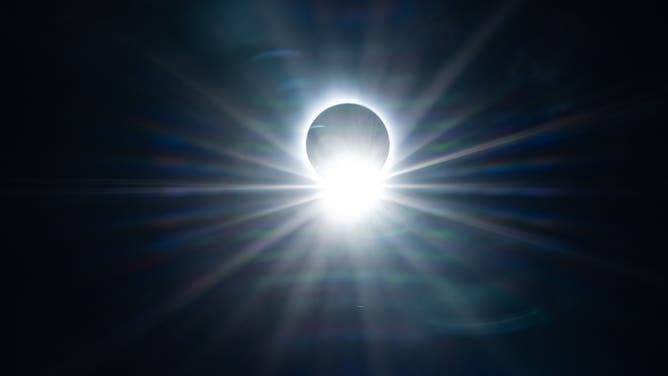
TUPPER LAKE, NEW YORK, UNITED STATES - 2024/04/08: View of total solar eclipse hosted by Adirondack Sky Center and Observatory at LP Quinn Elementary School. Total solar eclipse was visible across the United States with Western and Northern parts of New York State mostly in the path of the eclipse. Hundreds of people gathered on the grounds of LP Quinn Elementary School as Adirondack Sky Center is one of twelve locations nationwide providing NASA (National Aeronautics and Space Administration) with a live video feed of the eclipse.
(Lev Radin/Pacific Press/LightRocket / Getty Images)
Regardless of how much or how little the moon covers the sun, here is a look at the best locations to experience the event, when it occurs and how to safely watch.
NASA ANNOUNCES ARTEMIS III ASTRONAUTS IN NEXT PHASE OF MISSION TO RETURN HUMANS TO THE MOON
Total or near-complete darkness
The few locations and times in which near or total darkness will occur from the eclipse are as follows:
- Reykjavík, Iceland at 100% — 1:48 to 1:49 p.m.
- Valencia, Spain at 100% — 2:32 to 2:33 p.m.
- Barcelona at 99.9% — 2:29 p.m.
- Madrid at 99.9% — 2:32 p.m.
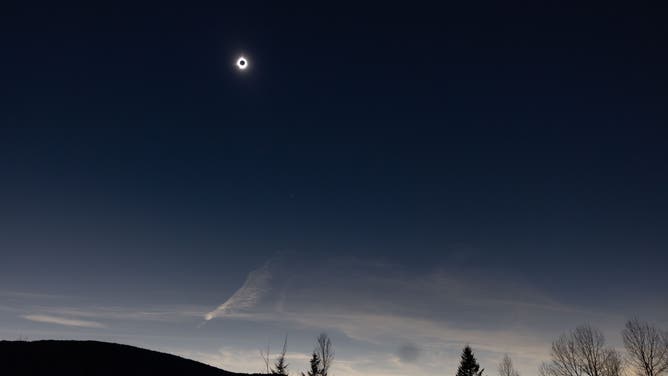
COLEBROOK, NEW HAMPSHIRE - APRIL 8: Darkness during totality of the Great North American Eclipse on April 8, 2024 in Colebrook, New Hampshire. Millions of people have flocked to areas across North America that are in the "path of totality" in order to experience a total solar eclipse. During the event, the moon will pass in between the sun and the Earth, appearing to block the sun.
(Scott Eisen / Getty Images)
Locations to experience partial darkness
Unfortunately, many states across the U.S. won’t experience significant changes in daylight, but there are a few locations in Alaska and Maine that have the best chance of experiencing totality.
- Fairbanks at 37% — 12:27 p.m.
- Anchorage at 28% — 12:21 p.m.
- Juneau at 17% — 12:24 p.m.
- Caribou at 29% — 1:50 p.m.
- Bangor at 24% — 1:53 p.m.
- Portland at 19% — 1:53 p.m.
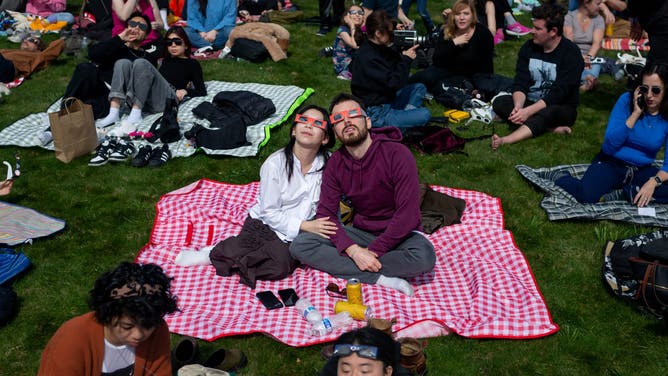
BROOKLYN, NEW YORK, UNITED STATES - 2024/04/08: People gather at Greenwood Cemetery in Brooklyn to witness a partial solar eclipse. Thousands gathered in parks and open spaces across the city to view up to 90% of the sun covered by the moon.
(Michael Nigro/Pacific Press/LightRocket / Getty Images)
How to safely watch a solar eclipse
NASA experts offer these safety tips if you plan to observe the event.
SUNLIGHT FOR SALE: GIANT SPACE MIRROR COULD ONE DAY BRING DAYLIGHT TO EARTH AT NIGHT
- View the sun through eclipse glasses or a handheld solar viewer during the partial eclipse phases before and after totality.
- You can view the eclipse directly without proper eye protection only when the moon completely obscures the sun’s bright face – during the brief and spectacular period known as totality. (Note: You’ll know it’s safe when you can no longer see any part of the sun through eclipse glasses or a solar viewer).
- As soon as you see even a little bit of the bright sun reappear after totality, immediately put your eclipse glasses back on or use a handheld solar viewer to look at the sun.
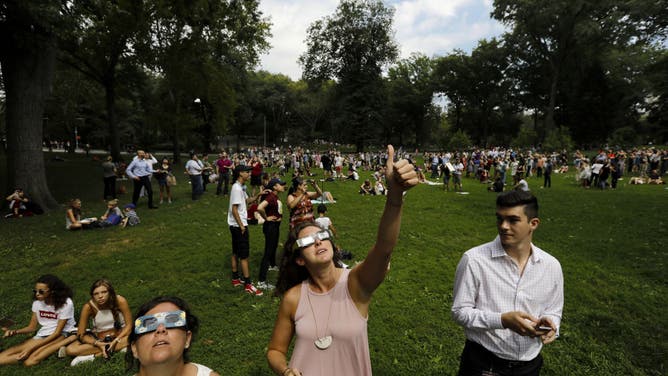
A woman wearing solar viewing glasses, center, holds up her thumb while looking at the sun during a solar eclipse at Central Park in New York, U.S., on Monday, Aug. 21, 2017. Millions of Americans across a 70-mile-wide (113-kilometer) corridor from Oregon to South Carolina will see the sky darken as the sun disappears from view total during the eclipse. Photographer: Peter Foley/Bloomberg via Getty Images
(Peter Foley/Bloomberg / Getty Images)
The safest way to view any eclipse is to use a special-purpose solar viewer.
These viewing tools come in the form of eclipse glasses and handheld solar viewers.
THE BEST CELESTIAL EVENTS IN 2026 YOU WON'T WANT TO MISS
"Viewing any part of the bright sun through a camera lens, binoculars or a telescope without a special-purpose solar filter secured over the front of the optics will instantly cause severe eye injury," NASA said.
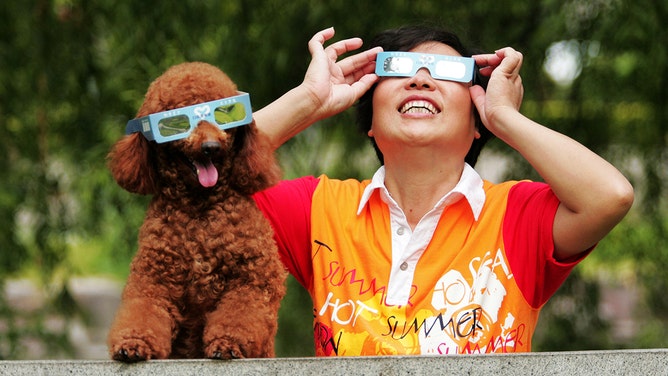
![A woman observes the solar eclipse with her poodle on July 22, 2009 in Hangzhou of Zhejiang Province, China.]() Image 1 of 6
Image 1 of 6A woman observes the solar eclipse with her poodle on July 22, 2009 in Hangzhou of Zhejiang Province, China. (Visual China Group)
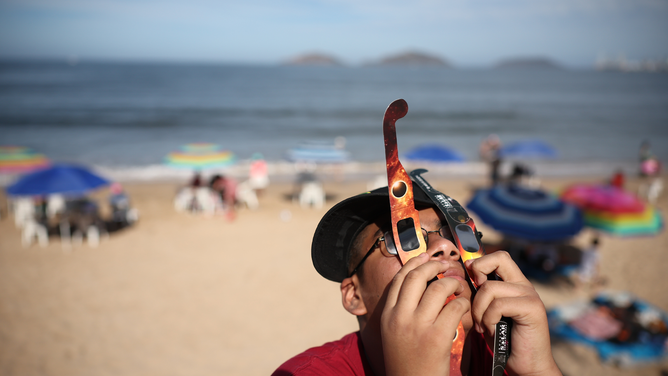
![MAZATLAN, MEXICO - APRIL 08: A person uses two sets of glasses to see the eclipse on April 08, 2024 in Mazatlan, Mexico. Millions of people have flocked to areas across North America that are in the "path of totality" in order to experience a total solar eclipse. During the event, the moon will pass in between the sun and the Earth, appearing to block the sun. (Photo by Hector Vivas/Getty Images)]() Image 2 of 6
Image 2 of 6MAZATLAN, MEXICO - APRIL 08: A person uses two sets of glasses to see the eclipse on April 08, 2024 in Mazatlan, Mexico. Millions of people have flocked to areas across North America that are in the "path of totality" in order to experience a total solar eclipse. During the event, the moon will pass in between the sun and the Earth, appearing to block the sun. (Photo by Hector Vivas/Getty Images) ( )
![]() Image 3 of 6
Image 3 of 6People watch the solar eclipse at Saluki Stadium on the campus of Southern Illinois University on August 21, 2017 in Carbondale, Illinois. Although much of it was covered by a cloud, with approximately 2 minutes 40 seconds of totality the area in Southern Illinois experienced the longest duration of totality during the eclipse. Millions of people are expected to watch as the eclipse cuts a path of totality 70 miles wide across the United States from Oregon to South Carolina on August 21. (Scott Olson)
![Total Solar Eclipse Stretches Across North America From Mexico To Canada]() Image 4 of 6
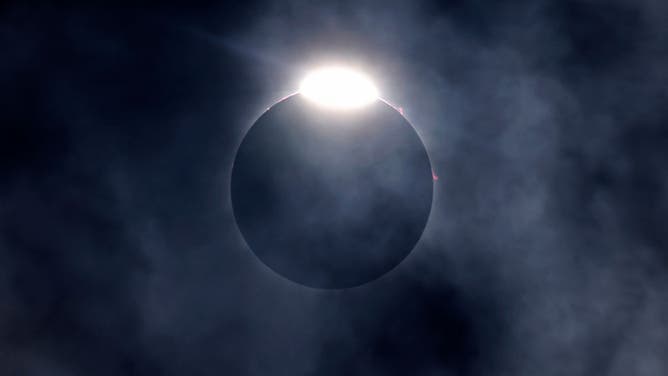
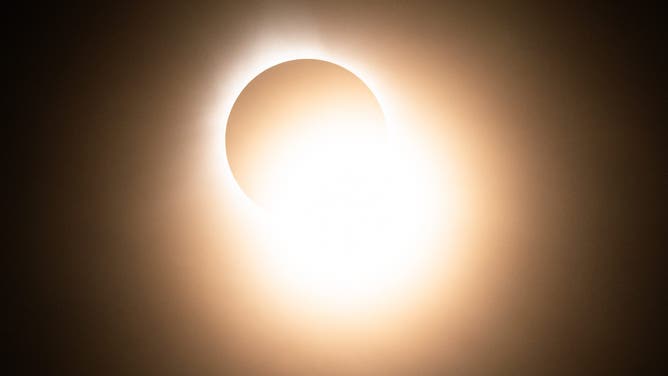
Image 4 of 6FORT WORTH, TEXAS - APRIL 8: The diamond ring effect as well as Bailey's Beads are seen as the moon eclipses the sun on April 8, 2024 in Fort Worth, Texas. Millions of people have flocked to areas across North America that are in the "path of totality" in order to experience a total solar eclipse. During the event, the moon will pass in between the sun and the Earth, appearing to block the sun. (Photo by Ron Jenkins/Getty Images) (Ron Jenkins/Getty Images)
![]() Image 5 of 6
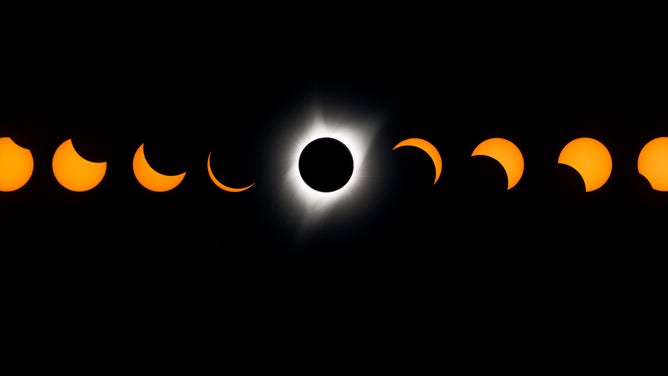
Image 5 of 6A composite image of the total solar eclipse seen from the Lowell Observatory Solar Eclipse Experience August 21, 2017 in Madras, Oregon. (Stan Honda)
![LAKE CARMI, VERMONT - APRIL 08: The "diamond ring" effect is seen during a total solar eclipse on April 08, 2024 in Lake Carmi, Vermont. Millions of people have flocked to areas across North America that are in the "path of totality" in order to experience a total solar eclipse. During the event, the moon will pass in between the sun and the Earth, appearing to block the sun.]() Image 6 of 6
Image 6 of 6LAKE CARMI, VERMONT - APRIL 08: The "diamond ring" effect is seen during a total solar eclipse on April 08, 2024 in Lake Carmi, Vermont. Millions of people have flocked to areas across North America that are in the "path of totality" in order to experience a total solar eclipse. During the event, the moon will pass in between the sun and the Earth, appearing to block the sun. (Photo by Noam Galai/Getty Images) (Noam Galai)

Solar viewers are much darker than normal glasses and are supposed to comply with the ISO 12312-2 international standard for filters for direct observation of the sun.
Do not use eclipse glasses or handheld viewers with cameras, binoculars or telescopes, as they require proper solar filters and can cause harm.
Despite this, NASA does not approve any specific brand of solar viewers.
AUGUST SKYWATCHING GUIDE: FROM A PLANETARY PARADE AND ECLIPSES TO A METEOR SHOWER
Thousands of people across Europe will flock to view the celestial event, which offers a rare opportunity to see a sunset eclipse, as it occurs later in the day than in North America.