

August skywatching guide: From a planetary parade and eclipses to a meteor shower
The fun thing about these August skywatching events is that some overlap, bringing what we could call a buy-one-get-one deal for skywatchers.
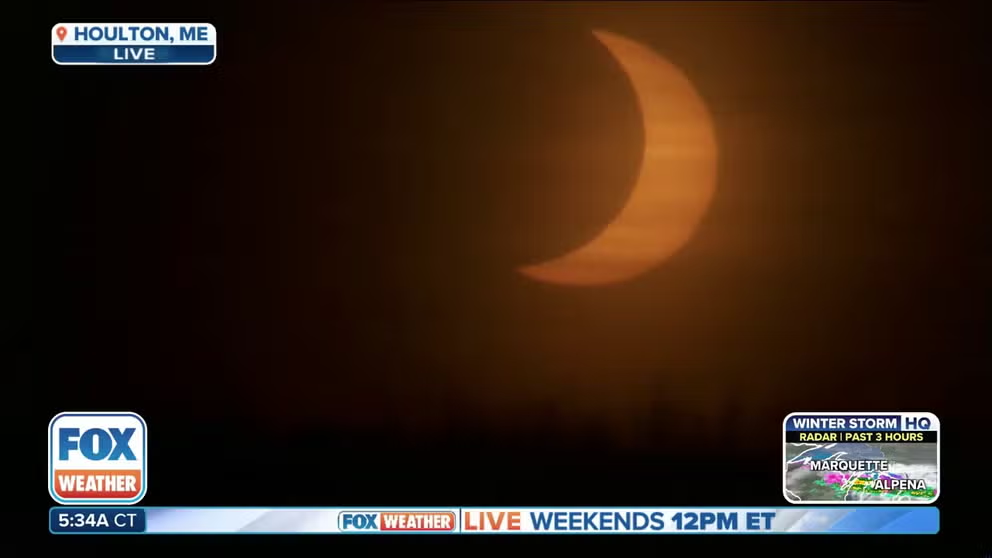
FILE: Partial solar eclipse puts on a show at sunrise in Maine
Parts of the Northeast that managed to dodge the clouds were treated to a partial solar eclipse Saturday morning.
A new month always brings fresh reasons to look up, and August is no exception.
Not only does August feature the peak of the annual Perseid meteor shower, but this month's skies will also dazzle with planetary alignments and conjunctions, along with eclipses.
THE BEST CELESTIAL EVENTS IN 2026 YOU WON'T WANT TO MISS
Silhouettes of father, daughter and astronomical telescope under starry skies.
(m-gucci / Getty Images)
The fun thing about some of these events is that they overlap, bringing what we could call a buy-one-get-one deal for skywatchers.
NASA ANNOUNCES ARTEMIS III ASTRONAUTS IN NEXT PHASE OF MISSION TO RETURN HUMANS TO THE MOON
Here's a breakdown of August’s celestial events.
Planetary alignments and conjunctions
August 3:
On the night of Monday, Aug. 3, the moon will appear in close conjunction with Saturn.
According to In-The-Sky.org, the pair will be too wide to be viewed together through a telescope or binoculars.
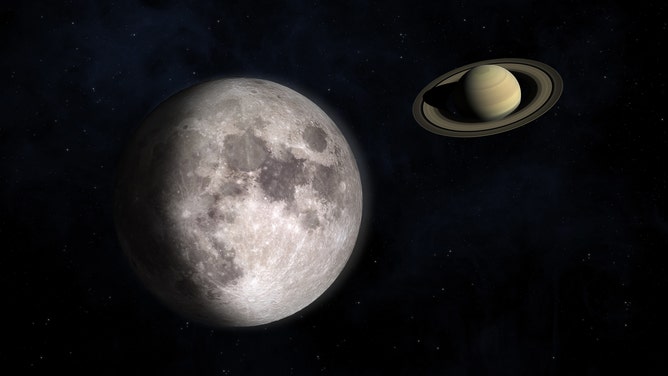
Conjunction Moon and Saturn. Meeting of the Saturn and Moon. Earth and planets of solar system. Elements of this image furnished by NASA. ______ Url(s): https://solarsystem.nasa.gov/resources/843/rare-full-moon-on-christmas-day/ https://science.nasa.gov/missions/cassini/a-valentine-from-cassini-with-love/ Adobe Photoshop CC 2023. Knoll light factory. Adobe After Effects CC 2021.
(buradaki / Getty Images)
Although they are in conjunction, they only look closer while remaining vast distances apart in space.
Because of this wide separation, the best way to view the event is with the naked eye.
NASA WILL CONDUCT DARING RESCUE MISSION TO REPOSITION TELESCOPE SINKING INTO EARTH'S ATMOSPHERE
August 12:
On the 12th, six planets will align, featuring Mercury, Jupiter, Uranus, Saturn, Neptune and Mars.
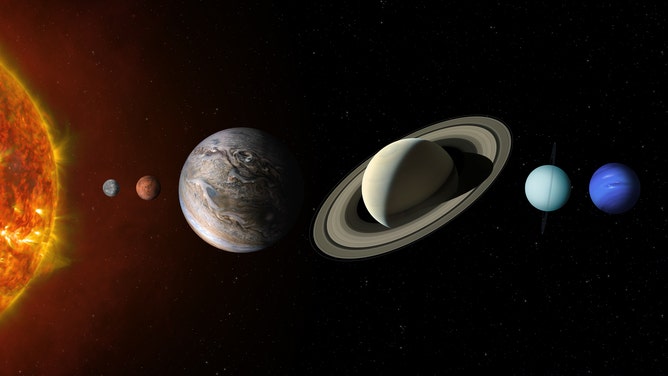
A planetary alignment, or a "planet parade" see six planets: Jupiter, Mercury, Uranus, Mars, Neptune and Saturn. Solar System planets. High resolution images. This image elements furnished by NASA. ______ Url(s): https://photojournal.jpl.nasa.gov/catalog/?IDNumber=PIA23344 https://www.nasa.gov/content/goddard/one-giant-sunspot-6-substantial-flares https://photojournal.jpl.nasa.gov/catalog/PIA13840 https://photojournal.jpl.nasa.gov/catalog/pia01492 https://solarsystem.nasa.gov/resources/17549/saturn-mosaic-ian-regan https://photojournal.jpl.nasa.gov/catalog/PIA22949 Software: Adobe Photoshop CC 2023. Knoll light factory. Adobe After Effects CC 2021.
(buradaki / Getty Images)
The planetary parade will be best viewed in the pre-dawn hours.
While Uranus and Neptune will require optics to see, the remaining four planets will be visible without any equipment.
SCIENTISTS DISCOVER THE SAME SUGAR FOUND IN RASPBERRIES DEEP IN SPACE FOR THE FIRST TIME
Meteor showers and eclipses
August 12:
August 12 also brings a new moon, causing a total and partial solar eclipse.
According to NASA, the total solar eclipse will grace the skies in Greenland, Iceland, northern Russia, the Atlantic Ocean, Spain and a small corner of Portugal, while the Northern Hemisphere will experience a partial solar eclipse.
HOW OFTEN DO METEORITES CRASH IN THE US?
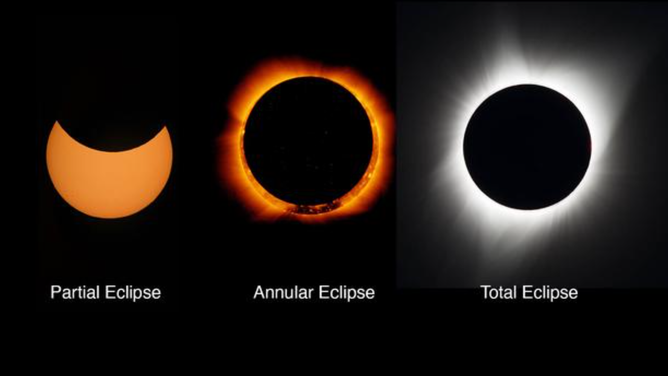
Types of solar eclipses
(NASA)
This includes parts of the northern U.S., from Alaska to North Carolina, along with much of Canada, Europe, and northwestern Africa.
August 12–13:
Adding to the show, the Perseid meteor shower is set to peak overnight from Aug. 12 through Aug. 13.
THE PERSEID METEOR SHOWER IS HERE AND SKYWATCHERS COULD SEE UP TO 100 SHOOTING STARS PER HOUR
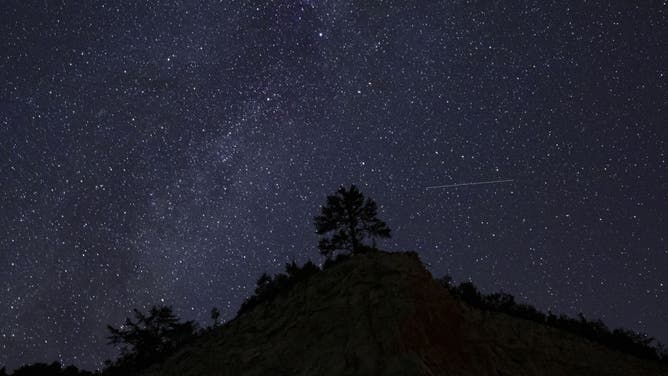
A view of the Perseid meteor shower over Lake Cubuk in Goynuk district of Bolu, Turkiye on August 13, 2024.
(Photo by Isa Terli/Anadolu via Getty Images / Getty Images)
Given the new moon on the 12th, this year's display is expected to be one of the best in years because the skies will be darker, making even the smallest meteors easier to spot.
Skywatchers could see up to 100 shooting stars per hour.
August 27-28:
The month will close out with the final eclipse of 2026.
This deep partial lunar eclipse will leave 96% of the moon shadowed and darkened.