

Total solar eclipse to create complete darkness for parts of Europe as some US states may see a partial show
Parts of the U.S. stretching from Alaska to North Carolina may see a partial solar eclipse where you can view the moon taking a small bite out of the sun.
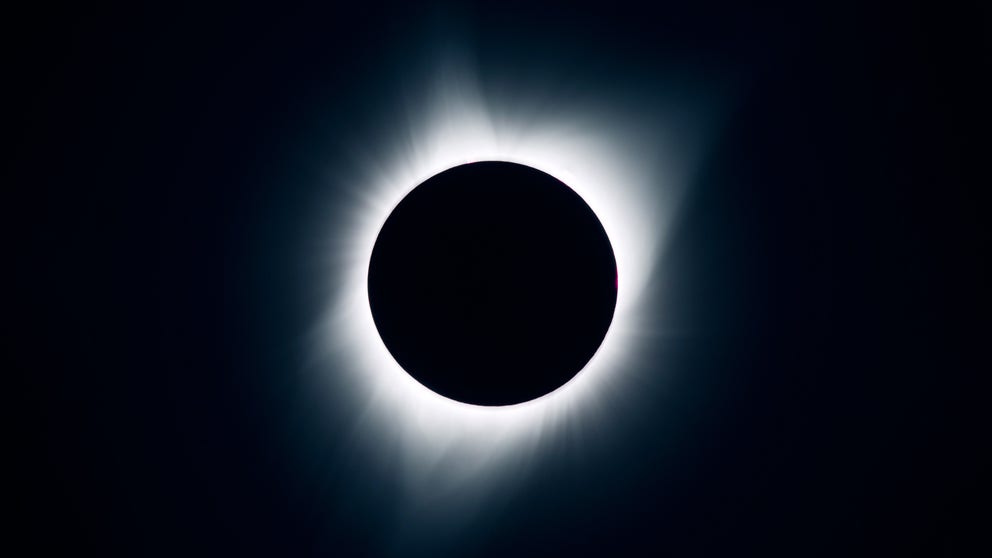
Total eclipse countdown: The Great North American Solar Eclipse is officially less than 1 year away
In 2023 and 2024, Americans will have the rare opportunity to witness two spectacular celestial events: an annular solar eclipse and a total solar eclipse.
This Wednesday is setting up to be a blockbuster day for skywatchers across the world as a total solar eclipse will steal the show for millions who are lucky enough to see it.
On Aug. 12, northern Russia, Greenland, Iceland, northern Spain, and a small corner of Portugal will see complete darkness in the path of totality.
Check out the full list below for the best times to view maximum coverage based on location outside the U.S. in Eastern Daylight Time.
- Reykjavík, Iceland at 100% — 1:48-1:49 p.m.
- Valencia, Spain at 100% — 2:32-2:33 p.m.
- Barcelona at 99.9% — 2:29 p.m.
- Madrid at 99.9% — 2:32 p.m.
According to NASA, a total solar eclipse occurs when the moon passes between the sun and Earth, completely blocking the sun's light.
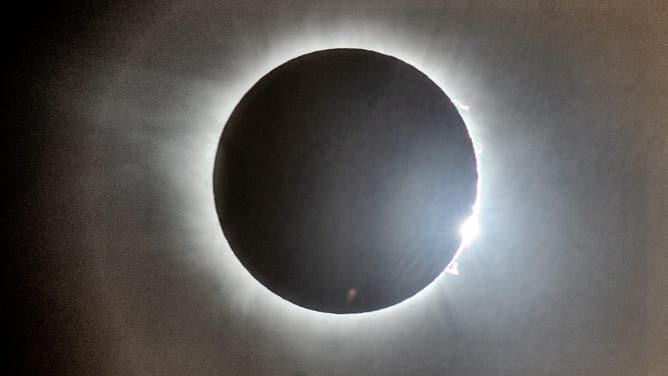
Solar eclipse of April 8 2024, Nazas, Mexico.
(Edwin Remsberg/VWPics/Universal Images Group / Getty Images)
During this event, the sky will briefly darken as if it were dawn or dusk.
Depending on the location, parts of the U.S. from Alaska to North Carolina will see between 3% and 37% eclipse coverage, giving viewers a look at the moon taking a small bite out of the sun.
Particularly across the Northeast, the best chance for viewing will be northern New England — specifically Maine — where 30% coverage will occur.
AUGUST SKYWATCHING GUIDE: FROM A PLANETARY PARADE AND ECLIPSES TO A METEOR SHOWER
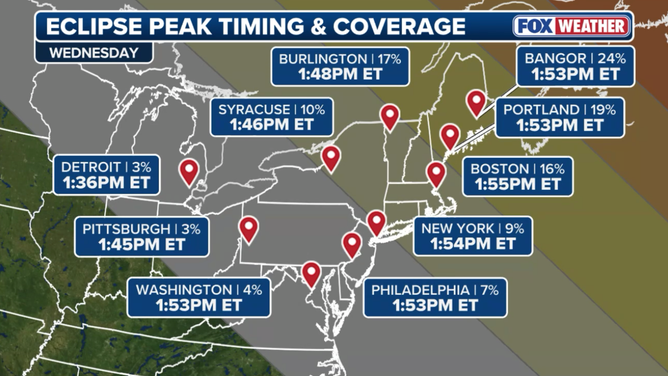
Eclipse peak timing overview.
(FOX Weather)
Check out the full list below for the best times to view maximum coverage based on location within the U.S. in Eastern Daylight Time.
Alaska
- Fairbanks at 37% — 12:27 p.m.
- Anchorage at 28% — 12:21 p.m.
- Juneau at 17% — 12:24 p.m.
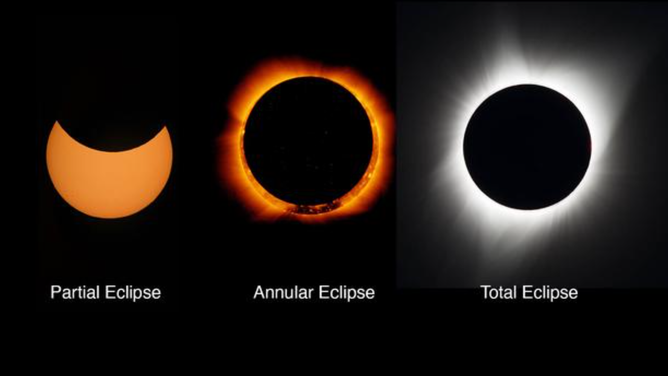
Types of solar eclipses
(NASA)
Maine
- Caribou at 29% — 1:50 p.m.
- Bangor at 24% — 1:53 p.m.
- Portland at 19% — 1:53 p.m.
Other cities
- Burlington, Vermont at 17% — 1:48 p.m.
- Boston, Massachusetts at 16% — 1:55 p.m.
- New York at 9% — 1:54 p.m.
- Philadelphia, Pennsylvania at 7% — 1:53 p.m.
- Washington D.C. at 4% — 1:53 p.m.
- Detroit, Michigan at 3% — 1:53 p.m.
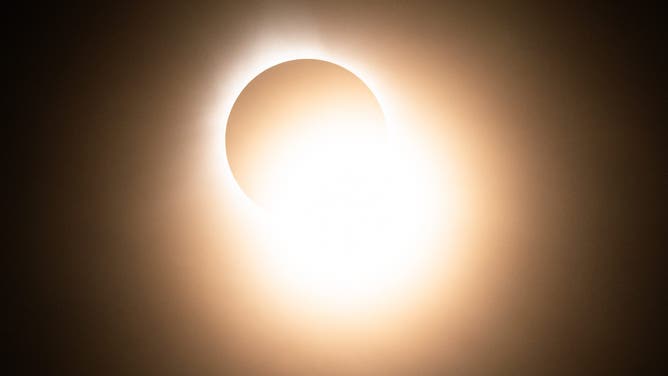
![LAKE CARMI, VERMONT - APRIL 08: The "diamond ring" effect is seen during a total solar eclipse on April 08, 2024 in Lake Carmi, Vermont. Millions of people have flocked to areas across North America that are in the "path of totality" in order to experience a total solar eclipse. During the event, the moon will pass in between the sun and the Earth, appearing to block the sun.]() Image 1 of 3
Image 1 of 3LAKE CARMI, VERMONT - APRIL 08: The "diamond ring" effect is seen during a total solar eclipse on April 08, 2024 in Lake Carmi, Vermont. Millions of people have flocked to areas across North America that are in the "path of totality" in order to experience a total solar eclipse. During the event, the moon will pass in between the sun and the Earth, appearing to block the sun. (Photo by Noam Galai/Getty Images) (Noam Galai)
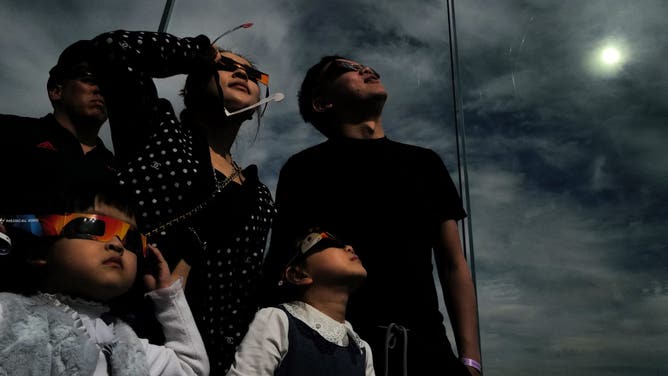
![A woman looks toward the sky at the 'Edge at Hudson Yards' observation deck during a total solar eclipse across North America, in New York City on April 8, 2024. This year's path of totality is 115 miles (185 kilometers) wide and home to nearly 32 million Americans, with an additional 150 million living less than 200 miles from the strip. The next total solar eclipse that can be seen from a large part of North America won't come around until 2044.]() Image 2 of 3
Image 2 of 3A woman looks toward the sky at the 'Edge at Hudson Yards' observation deck during a total solar eclipse across North America, in New York City on April 8, 2024. This year's path of totality is 115 miles (185 kilometers) wide and home to nearly 32 million Americans, with an additional 150 million living less than 200 miles from the strip. The next total solar eclipse that can be seen from a large part of North America won't come around until 2044. (Charly TRIBALLEAU / AFP)
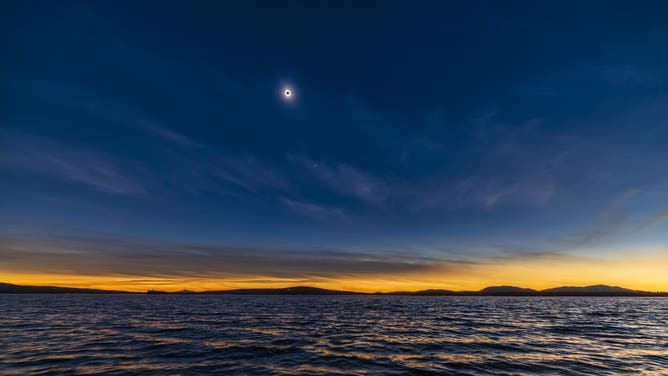
![This is the total eclipse of the Sun over the waters of Lac Brome, in the Eastern Townships of Quebec, Canada, on April 8, 2024. The twilight sky colours are from the light of the Sun from areas outside the path of totality. This is looking southwest, the direction toward the eclipsed Sun but (to the right) also the direction the lunar shadow arrived from and where the sky brightened first at the end of totality. This is from the Tiffany Park area of Lac Brome in the Eastern Townships of Quebec, on the east side of the lake where several dozen cars and eclipse chasers gathered this day for a fine view. The bright object below the eclipsed Sun is Venus. High cirrus clouds added to the sky colouration and visibility of the shadow passage. This was taken near mid-eclipse. This is a single 1/6s-exposure from a 1200-frame time-lapse, with the Canon RF15-35mm lens at f/2.8 and Canon Ra at ISO 125. Sky detail and contrast emphasized with Luminar Neo Enhance filters.]() Image 3 of 3
Image 3 of 3This is the total eclipse of the Sun over the waters of Lac Brome, in the Eastern Townships of Quebec, Canada, on April 8, 2024. The twilight sky colours are from the light of the Sun from areas outside the path of totality. This is looking southwest, the direction toward the eclipsed Sun but (to the right) also the direction the lunar shadow arrived from and where the sky brightened first at the end of totality. This is from the Tiffany Park area of Lac Brome in the Eastern Townships of Quebec, on the east side of the lake where several dozen cars and eclipse chasers gathered this day for a fine view. The bright object below the eclipsed Sun is Venus. High cirrus clouds added to the sky colouration and visibility of the shadow passage. This was taken near mid-eclipse. This is a single 1/6s-exposure from a 1200-frame time-lapse, with the Canon RF15-35mm lens at f/2.8 and Canon Ra at ISO 125. Sky detail and contrast emphasized with Luminar Neo Enhance filters. ( Alan Dyer/VWPics/Universal Images Group)
If you are in the path of totality, it is important to view the event safely by wearing certified eclipse glasses or a safe solar viewer, as normal sunglasses are not safe for the eyes.
THE BEST CELESTIAL EVENTS IN 2026 YOU WON'T WANT TO MISS
And don't forget — there are still other incredible skywatching events all happening on the same night, including the Perseids meteor shower, planet parade and new moon.