

See It: Millions of red crabs take over Australia's Christmas Island as they begin mass migration
According to a 2013 Princeton University study, published in Global Change Biology, "a lack of rain can delay or entirely cancel" the migration.

Watch: Millions of crabs take over Australia's Christmas Island as they begin mass migration
Millions of red crabs have taken over Christmas Island as they begin their annual mass migration toward the island's beaches, where they breed.
THE TAKEAWAY
- Millions of red crabs have taken over Christmas Island as they begin their annual mass migration toward the island's beaches.
- The migration is closely tied to both the phase of the moon, the tidal cycle and rainfall.
- Lack of rain due to El Niño events can prevent the migration.
CHRISTMAS ISLAND, AUSTRALIA — Millions of red crabs have taken over Christmas Island as they begin their annual mass migration toward the island's beaches, where they breed.
WHERE DID IT GO? NATIONAL PARK SERVICE INVESTIGATES 88-YEAR MYSTERY OF MISSING SNAKE FOSSIL
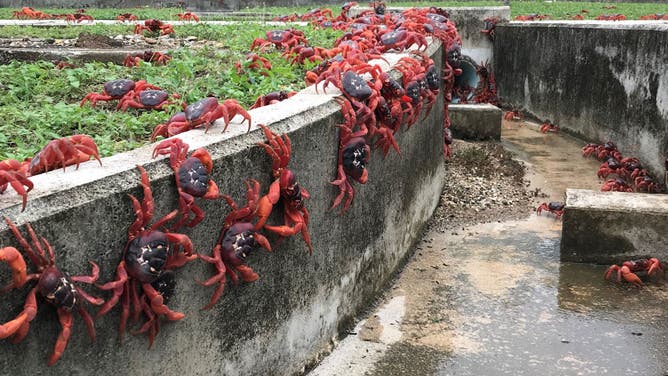
FILE - CHRISTMAS ISLAND - NOVEMBER 23: In this handout image provided by Parks Australia, thousands of red crabs are seen walking in a drain on November 23, 2021 in Christmas Island. The annual migration of red crabs begins with first rains of the wet season on Christmas Island, usually around October or November. Millions of the red crabs make their way across the island to the ocean to mate and spawn.
((Photo by Parks Australia via Getty Images ) / Getty Images)
Video from Australia’s national parks agency, Parks Australia, shows waves of red crabs marching across the island, overtaking roads and climbing over specialized crab bridges, designed to facilitate the migration.
The sheer volume of crabs produces a scraping and chittering sound that can be heard in the video and sounds like rainfall at times.
DANGEROUS VIRUS DETECTED IN CALIFORNIA FISH FOR FIRST TIME, RAISING CONCERNS FOR AQUATIC WILDLIFE
The Christmas Island red crab is a species unique to the Australian territory, which is located in the Indian Ocean more than 200 miles off the Indonesian island of Java.
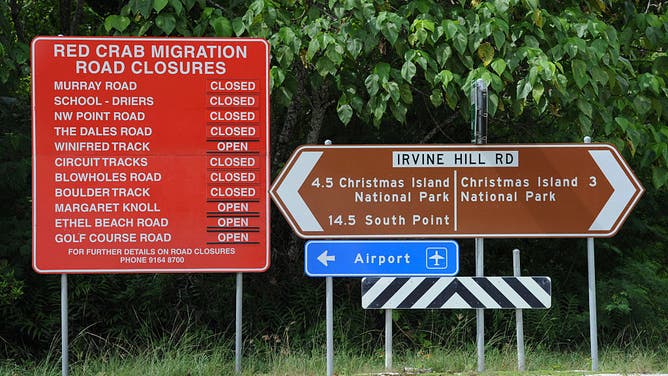
FILE - The annual red crab migration on Christmas Island on 1, January 2007 in Christmas Island, Australia.
(James D. Morgan/Getty Images / Getty Images)
Every year, generally in October and November, the crabs emerge from their habitat in the forest and head to the beach to mate and spawn, according to Parks Australia's website.
Roads and other parts of the island are closed during migration to protect the animals.
The annual migration is closely tied to both the phase of the moon, the tidal cycle and rainfall.
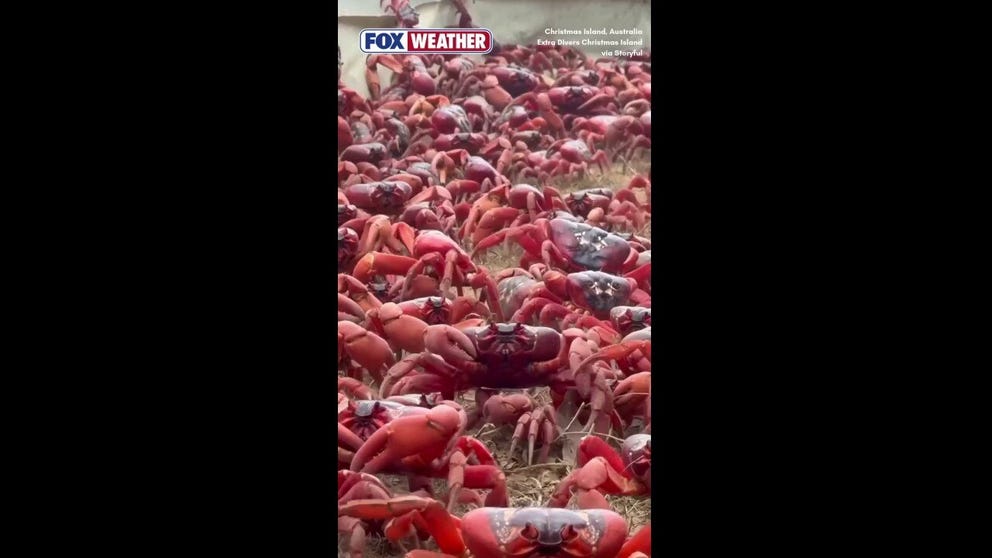
Watch: Crabs swarm Christmas Island during annual mass migration
Millions of red crabs have taken over Christmas Island as they begin their annual mass migration toward the island's beaches, where they breed.
"Red crabs always spawn before dawn on a receding high-tide during the last quarter of the moon," the agency said.
"However, because crabs wait until the first rainfall to start their trek, they sometimes have to hurry. If the rains arrive close to the optimal spawning date, they will move rapidly."
DREAM OF GOING TO SPACE? NASA IS SEARCHING FOR ITS NEXT GENERATION OF ASTRONAUTS
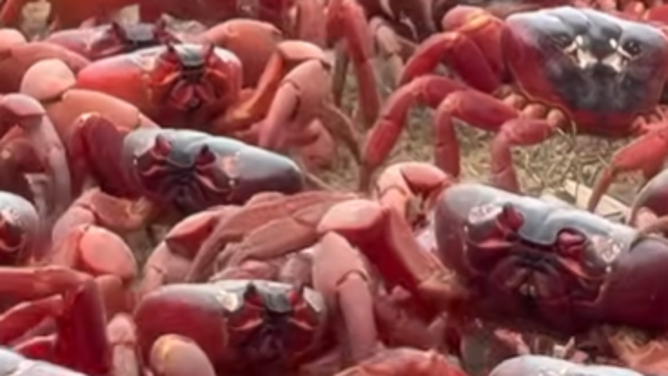
Red crabs migrate on Australia's Christmas Island on Nov. 15, 2026.
(Extra Divers Christmas Island via Storyful / FOX Weather)
According to a 2013 Princeton University study, published in Global Change Biology, "a lack of rain can delay or entirely cancel" the migration.
"During the especially dry 1997 season, the crabs never migrated or mated," Princeton University said in a summary of its research.
SUPER EL NIÑO DECLARED AS FORECASTERS WARN OF MAJOR SHIFTS IN WEATHER DURING WINTER SEASON
"The culprit was a strong El Niño, the warm-water climate pattern that creates dry conditions in the Indian Ocean."
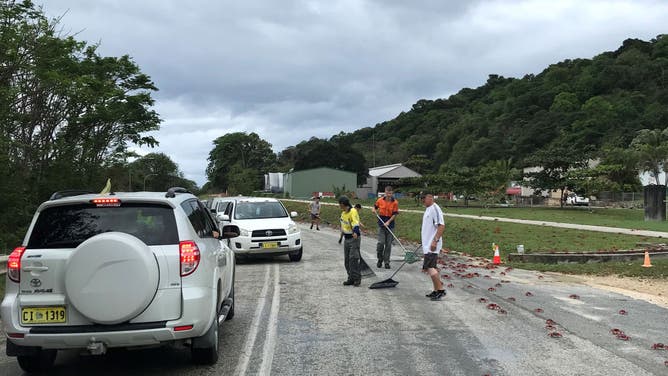
FILE - CHRISTMAS ISLAND - NOVEMBER 23: In this handout image provided by Parks Australia, members of the public and Parks Australia staff rack away thousands of red crabs off a road on November 23, 2021 in Christmas Island. The annual migration of red crabs begins with first rains of the wet season on Christmas Island, usually around October or November. Millions of the red crabs make their way across the island to the ocean to mate and spawn.
((Photo by Parks Australia via Getty Images ) / Getty Images)
It appears that enough rain has fallen over the region this year to prompt the migration, despite Super El Niño conditions being present this fall, according to NOAA.
After mating, the female crabs will move into the sea and release their eggs, which hatch almost immediately.
"Most years, no or very few baby crabs will emerge from the sea at all. But once or twice a decade, a huge number will survive, which is enough to maintain the island’s large red crab population," Parks Australia said.
The migration has fascinated naturalists worldwide for decades.