

Dangerous virus detected in California fish for first time, raising concerns for aquatic wildlife
Largemouth Bass Virus doesn't pose a risk to humans or warm-blooded animals, so anyone who eats an infected fish or swims in virus-infected waters can't be impacted.
FILE: Extremely rare deep-sea fish seen during ocean expedition off California
: A deep-sea barreleye fish (Macropinna microstoma) observed with MBARI’s remotely operated vehicle (ROV) Doc Ricketts in the outer Monterey Canyon at a depth of approximately 600 meters during an expedition aboard MBARI’s flagship research vessel David Packard. Footage opens with Research Specialist Shannon Johnson excitedly calling out her sighting of a barreleye fish to MBARI submersible pilots during the ROV’s ascent back to the surface. Credit: © 2026 MBARI
NEVADA COUNTY, Calif.– A highly pathogenic virus that infects fish was found in a large private lake in Nevada County, California, after more than 200 fish died there in September.
The virus, called Largemouth Bass Virus, was identified in bluegill and largemouth bass during necropsies performed by the California Department of Fish and Wildlife's (CDFW) Fish Health Lab.
The source of the infection wasn't found, but CDFW said the virus can be introduced through contaminated equipment, infected baitfish, stocking infected largemouth bass and introducing other carrier species that are infected.
'ONE-IN-A-MILLION' BRIGHT YELLOW FISH DISCOVERED IN NEW YORK IN STUNNING FIND
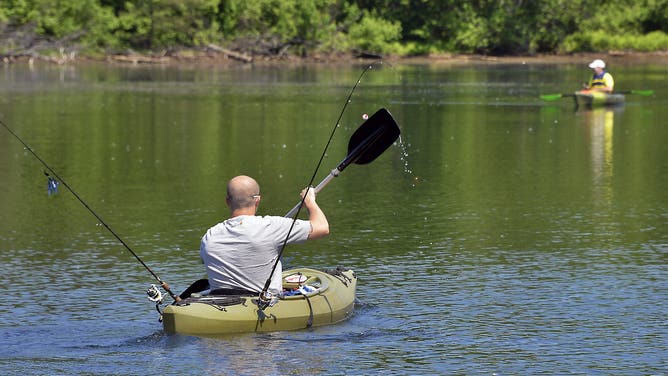
Kayak fishermen Nick Raymond, left, of Colonie and Joe Villani of Albany hunt for largemouth bass at Six Mile Waterworks Tuesday May 29, 2018 in Albany, NY.
(John Carl D'Annibale /Albany Times Union / Getty Images)
It's the first time Largemouth Bass Virus has been detected in California.
Largemouth Bass Virus doesn't pose a risk to humans or warm-blooded animals, so anyone who eats an infected fish or swims in virus-infected waters can't be impacted.
CDFW recommends that fish are properly prepared to prevent other food-borne illnesses.
"This is a sobering discovery given how widely distributed largemouth bass are in California, how popular they are as a sport fish and their economic importance to our rural communities," said Jay Rowan, CDFW Fisheries Branch Chief. "We’re asking all Californians to help prevent any further spread by not moving fish, alive or dead, from one waterbody to another and by cleaning, draining and drying their boats and fishing equipment after use."
SEE IT: JUVENILE HUMPBACK WHALE SPOTTED SWIMMING THROUGH MURKY WATERS OF THE NEW YORK HARBOR
The virus was first detected in Florida in the 1990s. Since then, it has spread across the country, CDFW said.
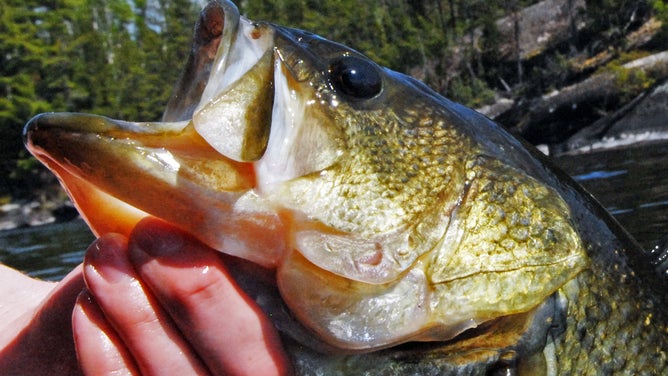
The largemouth bass.
(Dennis Anderson/Star Tribune / Getty Images)
Largemouth Bass Virus is very difficult to eradicate, once a population of largemouth bass is infected.
Outbreaks can last days or weeks before they resolve on their own. There are no available treatments or vaccines to prevent an outbreak.
"Typically, an outbreak will result in the mortality of a high percentage of the larger size classes of largemouth bass in the infected waterbody," CDFW said. "Surviving fish eventually build resistance to the virus over time and populations can recover. However, there can be significant impacts to populations of larger fish for years after an initial outbreak."
VIDEO: GROUP OF 70 SHORT-FINNED PILOT WHALES CAUGHT ON VIDEO OFF SOUTHERN CALIFORNIA COAST
Signs of the virus in infected fish include: skin sores or ulcers, darkened skin, distended body cavity, bulging eyes, redness, lethargy, erratic swimming behavior, surface swimming and difficulty submerging.
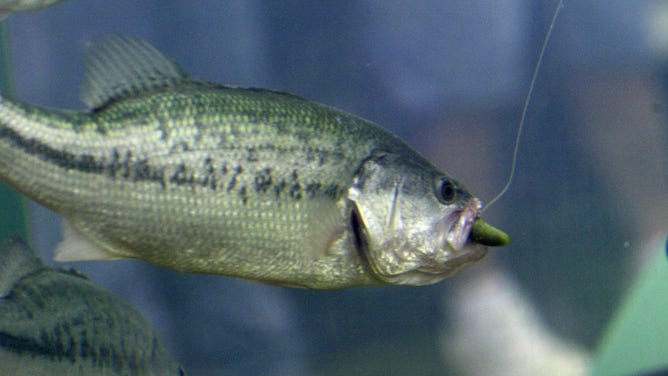
09-16-04: A large mouth bass fish taste a lure on the end of a line in the bass tank by Lee Morris at the Charles County fair Thursday.
(Mark Gail/The The Washington Post / Getty Images)
CDFW said stressful events and environmental conditions such as high water temperatures in the summer, poor water quality and how heavily a body of water is fished on, can activate the disease in infected fish.
MYSTERIOUS DEEP-SEA FISH WITH EERIE APPEARANCE CAPTURED ON CAMERA DURING RESEARCH EXPEDITION
Anglers and people using bodies of water recreationally should always assume the virus is present, and follow these directions:
- Never touch or move alive or dead fish unless it is eaten immediately.
- If cleaning a fish, do so at the water body where they were caught or at home and place all fish parts into the trash.
- Place leftover bait in the trash.
- Any watercraft or boat used should be drained of any water before leaving the area. This includes water in bait tanks, bilges, live wells, washing down lines, etc.
- Handle the fish you intend to release with care. Stress seems to increase fatalities of fish infected with the virus.
- Any fishing or recreational equipment that comes in contact with water or mud after use should be rinsed, cleaned or dried before leaving the area.
- Wash gear in hot water and allow it to dry thoroughly before using it in a different water body.
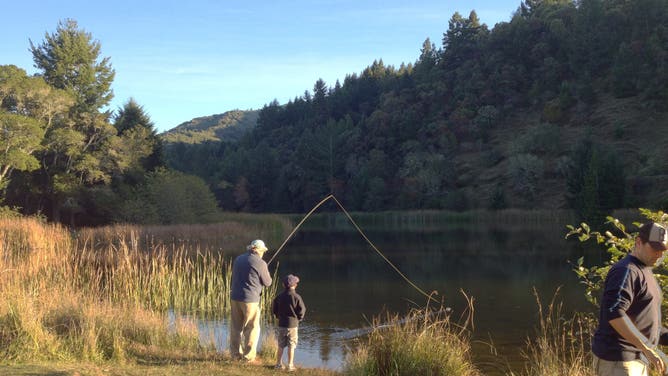
Adult male with son fishing in lake in California.
(Colleen Proppe / Getty Images)
CDFW is working to determine if Largemouth Bass Virus is present in other bodies of water in California.
California residents are asked to please report any significant largemouth bass mortality events to your nearest CDFW regional office.