

Mysterious deep-sea fish with eerie appearance captured on camera during research expedition
In the almost 40 years of MBARI's ocean exploration missions, they've completed 7,000 ROV dives, recorded 41,000 hours of deep-sea video, and yet they've only encountered a barreleye fish 11 times.
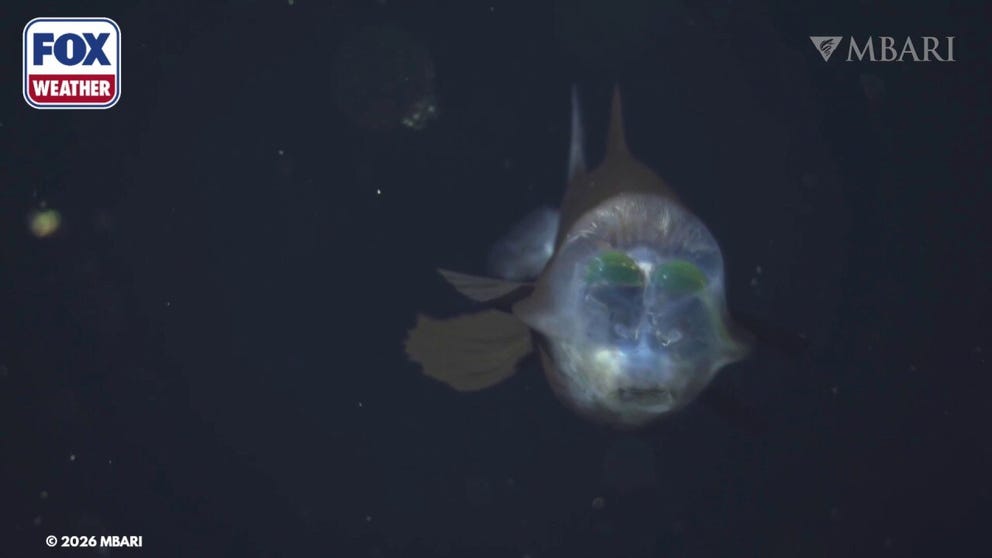
See it: Extremely rare deep-sea fish seen during ocean expedition off California
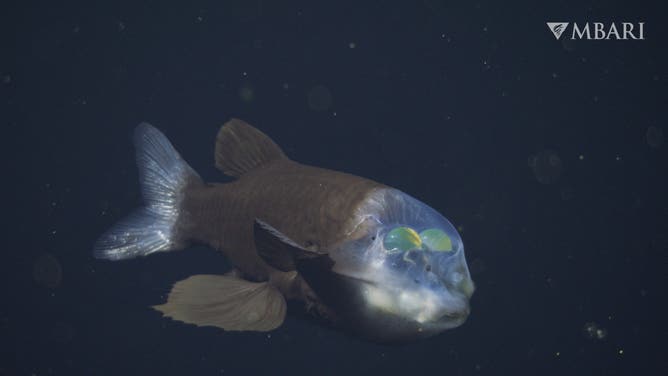
A deep-sea barreleye fish (Macropinna microstoma) observed with MBARI’s remotely operated vehicle (ROV) Doc Ricketts in the outer Monterey Canyon at a depth of approximately 600 meters during an expedition aboard MBARI’s flagship research vessel David Packard. Footage opens with Research Specialist Shannon Johnson excitedly calling out her sighting of a barreleye fish to MBARI submersible pilots during the ROV’s ascent back to the surface. Credit: © 2026 MBARI
An incredibly rare deep-sea fish with an eerie transparent head was documented on a recent research mission done by the Monterey Bay Aquarium Research Institute (MBARI) about 55 miles offshore of California.
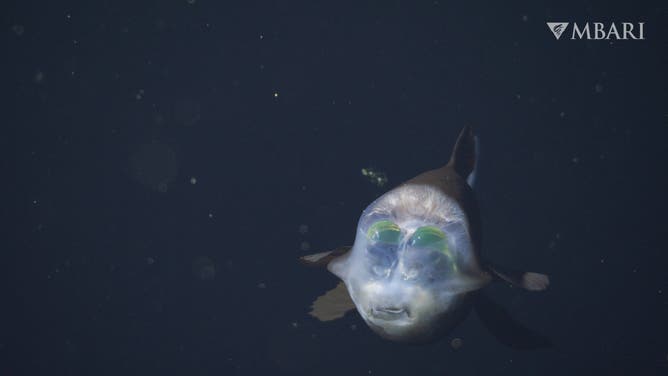
This fish, called a barreleye fish (Macropinna Microstoma), lives in the ocean’s twilight zone, scanning the waters above for the silhouettes of prey. It has tubular eyes beneath a transparent head that keep prey in sight after finding its next meal.
SECOND MOST VALUABLE DINOSAUR FOSSIL IN THE WORLD IS SOLD FOR OVER $47 MILLION
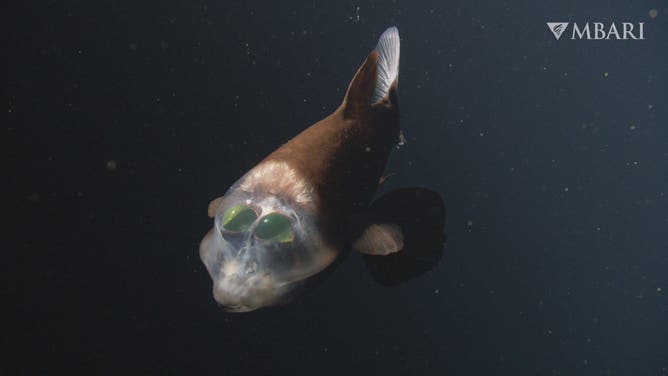
A deep-sea barreleye fish (Macropinna microstoma) observed with MBARI’s remotely operated vehicle (ROV) Doc Ricketts in the outer Monterey Canyon at a depth of approximately 600 meters during an expedition aboard MBARI’s flagship research vessel David Packard. Researchers from MBARI’s Biodiversity and Biooptics Team observed this individual with the vehicle’s VR camera, illuminating the fish with dramatic studio lighting and capturing 3D stereo imagery that can contribute to future research and education efforts.
(© 2026 MBARI / FOX Weather)
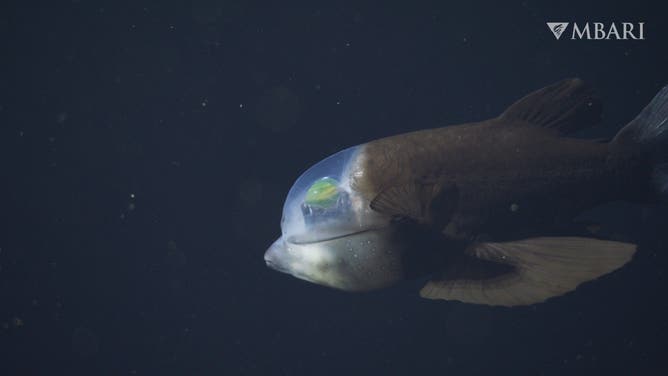
The gelatinous shield over its greenish-yellow eyes also protects the fish’s eyes when plucking small crustaceans caught in the stinging tentacles of deep-sea siphonophores, the MBARI said.
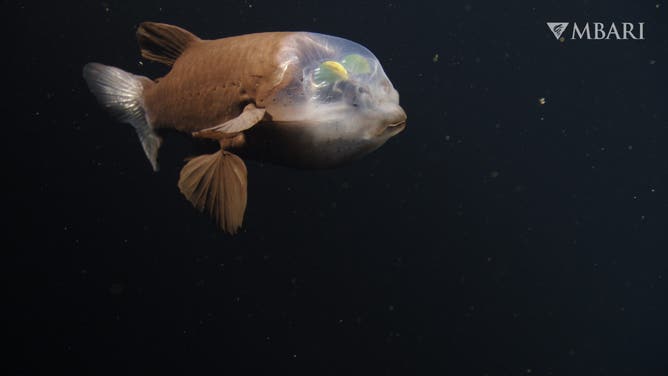
Large fins keep the fish stable and help it move into place, as its eyes focus on the water above.
WATCH: GREAT WHITE SHARK GIVES KAYAKER FRIGHT OF HIS LIFE WHILE FISHING OFF CALIFORNIA COAST
The MBARI was on an eight-day mission to study gelatinous animals like jellies, siphonophores and ctenophores through a combination of blue-water scuba diving near the surface of the water and deep-sea ROV surveys hundreds of meters beneath the surface.
![]() Image 1 of 4
A deep-sea barreleye fish (Macropinna microstoma) observed with MBARI’s remotely operated vehicle (ROV) Doc Ricketts in the outer Monterey Canyon at a depth of approximately 600 meters during an expedition aboard MBARI’s flagship research vessel David Packard. Researchers from MBARI’s Biodiversity and Biooptics Team observed this individual with the vehicle’s VR camera, illuminating the fish with dramatic studio lighting and capturing 3D stereo imagery that can contribute to future research and education efforts. (© 2026 MBARI)
![On October 20, 2026, MBARI scientists observed a deep-sea barreleye fish (Macropinna microstoma) during an expedition aboard MBARI’s flagship research vessel David Packard. The team was studying deep-sea jellies at a research site 90 kilometers offshore of Monterey, California, and recovering MBARI’s remotely operated vehicle (ROV) Doc Ricketts when they encountered this fish at a depth of 600 meters during the submersible’s return to the surface. This represents MBARI’s eleventh sighting of Macropinna and is the institute’s first sighting filmed in 4K]() Image 2 of 4
On October 20, 2026, MBARI scientists observed a deep-sea barreleye fish (Macropinna microstoma) during an expedition aboard MBARI’s flagship research vessel David Packard. The team was studying deep-sea jellies at a research site 90 kilometers offshore of Monterey, California, and recovering MBARI’s remotely operated vehicle (ROV) Doc Ricketts when they encountered this fish at a depth of 600 meters during the submersible’s return to the surface. This represents MBARI’s eleventh sighting of Macropinna and is the institute’s first sighting filmed in 4K (© 2026 MBARI)
![On October 20, 2026, MBARI scientists observed a deep-sea barreleye fish (Macropinna microstoma) during an expedition aboard MBARI’s flagship research vessel David Packard. The team was studying deep-sea jellies at a research site 90 kilometers offshore of Monterey, California, and recovering MBARI’s remotely operated vehicle (ROV) Doc Ricketts when they encountered this fish at a depth of 600 meters during the submersible’s return to the surface. This represents MBARI’s eleventh sighting of Macropinna and is the institute’s first sighting filmed in 4K]() Image 3 of 4
On October 20, 2026, MBARI scientists observed a deep-sea barreleye fish (Macropinna microstoma) during an expedition aboard MBARI’s flagship research vessel David Packard. The team was studying deep-sea jellies at a research site 90 kilometers offshore of Monterey, California, and recovering MBARI’s remotely operated vehicle (ROV) Doc Ricketts when they encountered this fish at a depth of 600 meters during the submersible’s return to the surface. This represents MBARI’s eleventh sighting of Macropinna and is the institute’s first sighting filmed in 4K (© 2026 MBARI)
![: On October 20, 2026, MBARI scientists observed a deep-sea barreleye fish (Macropinna microstoma) during an expedition aboard MBARI’s flagship research vessel David Packard. The team was studying deep-sea jellies at a research site 90 kilometers offshore of Monterey, California, and recovering MBARI’s remotely operated vehicle (ROV) Doc Ricketts when they encountered this fish at a depth of 600 meters during the submersible’s return to the surface. This represents MBARI’s eleventh sighting of Macropinna and is the institute’s first sighting filmed in 4K.]() Image 4 of 4
: On October 20, 2026, MBARI scientists observed a deep-sea barreleye fish (Macropinna microstoma) during an expedition aboard MBARI’s flagship research vessel David Packard. The team was studying deep-sea jellies at a research site 90 kilometers offshore of Monterey, California, and recovering MBARI’s remotely operated vehicle (ROV) Doc Ricketts when they encountered this fish at a depth of 600 meters during the submersible’s return to the surface. This represents MBARI’s eleventh sighting of Macropinna and is the institute’s first sighting filmed in 4K. (© 2026 MBARI)
The mission was to help understand how gelatinous animals have adapted to life in the deep water column.
On the day they found the barreleye fish, MBARI said its submersible pilots were sending their ROV "Doc Ricketts" back to the surface for recovery, when Research Specialist Shannon Johnson yelled out for them to stop 1,970 feet underwater.
MANHATTAN’S NEWEST CELEBRITIES ARE CAUSING A STIR — AND THEY’RE NOT WHO YOU’D EXPECT
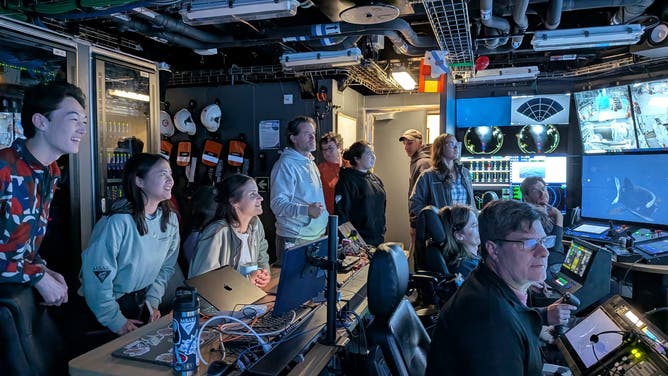
Once news spread that the expedition team had encountered a rarely seen deep-sea barreleye fish (Macropinna microstoma), it was standing room only in the submersible control room aboard MBARI’s flagship research vessel David Packard.Once news spread that the expedition team had encountered a rarely seen deep-sea barreleye fish (Macropinna microstoma), it was standing room only in the submersible control room aboard MBARI’s flagship research vessel David Packard.
(Kyra Schlining © 2026 MBARI / FOX Weather)
MBARI said most of the science team had relocated to the ship’s wet lab to prepare to catalog the incoming specimens from the ROV when they heard Johnson calling and came running back into the control room.
"The sighting of a barreleye fish was an exhilarating surprise, capping off a long and productive week of deep-sea research," MBARI said.
ENDANGERED WEASEL ONCE THOUGHT TO BE EXTINCT IS SPOTTED IN BADLANDS NATIONAL PARK
The expedition team spent 20 minutes watching the fish using a high-resolution 4K camera on ROV Doc Ricketts to get a closer look at the animal’s body and behavior.
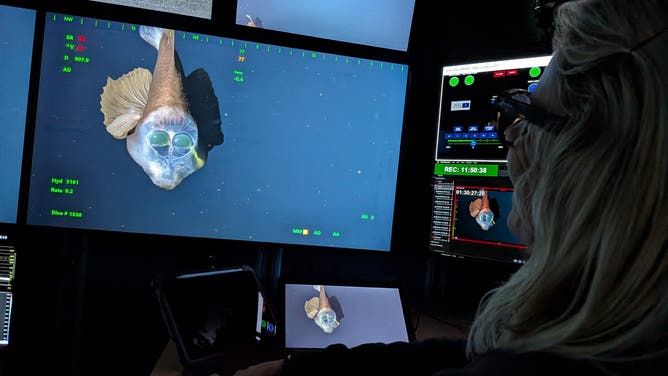
The scientific name Macropinna microstoma translates to "large fins, small mouth." These distinctive features of this species of barreleye fish were on full display as Research Specialist Shannon Johnson (pictured) logged details of this sighting in MBARI’s annotation software.
(Kyra Schlining © 2026 MBARI / FOX Weather)
They used different lighting to highlight the fish’s unique transparent head shield.
One of the ROV pilots/technicians was able to drive the Doc Ricketts close enough to record the fish with the vehicle’s VR camera, capturing 3D imagery that can contribute to future education and outreach efforts, MBARI said.
"Macropinna reminds us of the surprising ways that animals have adapted to thrive in the ocean’s midwater," said Senior Scientist Steven Haddock. "So many of them survive by looking for subtle optical cues, like a shadow passing overhead, and this sets off evolutionary competition, pitting bioluminescent camouflage against increasingly sophisticated visual capabilities."
VENOMOUS ANIMAL WITH AN ADORABLE APPEARANCE MAKES REMARKABLE COMEBACK AFTER NEARLY 90 YEARS
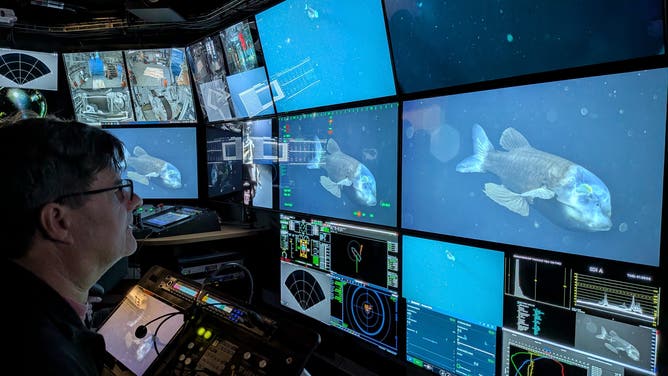
During the recent Diving Deep for Delicate Drifters expedition aboard MBARI’s flagship research vessel David Packard, Senior Scientist Steven Haddock (pictured) and team had a chance encounter with a rarely seen deep-sea barreleye fish (Macropinna microstoma).
(Kyra Schlining © 2026 MBARI / FOX Weather)
In the almost 40 years of MBARI's ocean exploration missions, they've completed 7,000 ROV dives, recorded 41,000 hours of deep-sea video, and yet they've only encountered a barreleye fish 11 times.
MBARI said the last time a barreleye was documented on one of their missions was in 2021.
The record of the barreleye is the first time MBARI was able to get the creature on 4K video, and on their newest research vessel.
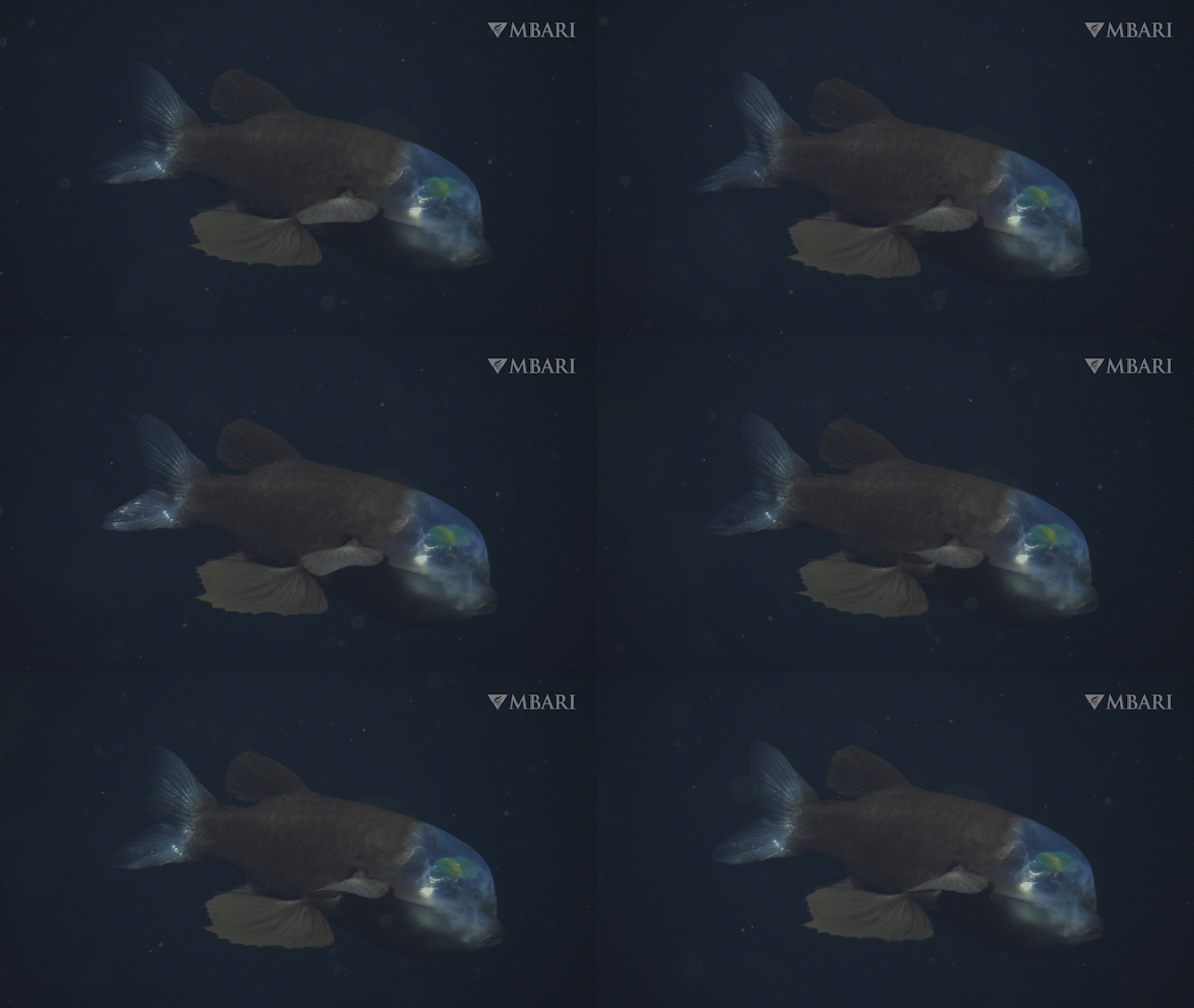
A deep-sea barreleye fish (Macropinna microstoma) observed with MBARI’s remotely operated vehicle (ROV) Doc Ricketts in the outer Monterey Canyon at a depth of approximately 600 meters during an expedition aboard MBARI’s flagship research vessel David Packard.
(© 2026 MBARI / FOX Weather)
"Seeing a barreleye fish is a rare treat. Crew from across the ship joined the science team in the control room, mesmerized by this remarkable animal. Deep-sea animals capture the imagination, creating wonder and awe that we hope will inspire stewardship of the largest living space on Earth," said Haddock.
Learn more about the barreleye on the Monterey Bay Aquarium Research Institute's website.