

Endangered weasel once thought to be extinct is spotted in Badlands National Park
Black-footed ferrets were reintroduced into Badlands National Park in the late 1990s, and the population is thriving today.

FILE: FOX Weather's Robert Ray journeys through the Badlands of South Dakota
FOX Weather's Robert Ray explores the Badlands of South Dakota and its Mars-like landscape and fossils caused by weather over millions of years.
The elusive and endangered black-footed ferret is alive and well in Badlands National Park after decades of careful conservation efforts to rebuild the population.
It all started in 1974, when the black-footed ferret wild population was deemed extinct.
These tiny little animals are completely nocturnal, sleeping up to 21 hours per day and waking up at night to hunt, eat and take care of their young, the National Park Service (NPS) said.
VENOMOUS ANIMAL WITH AN ADORABLE APPEARANCE MAKES REMARKABLE COMEBACK AFTER NEARLY 90 YEARS
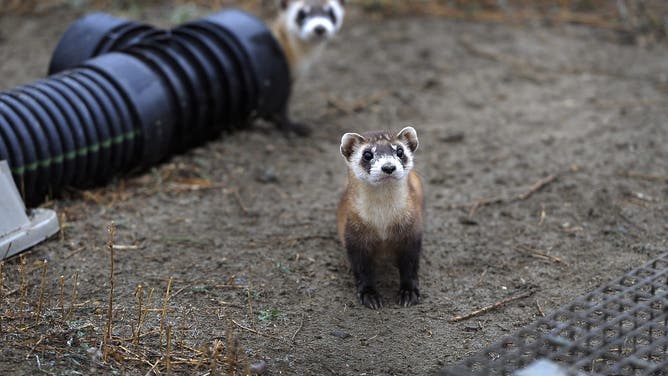
WELLINGTON, CO - Oct. 29: There are 48 outdoor pre-conditioning pens that house some ferrets.
(Kathryn Scott Osler/The Denver Post / Getty Images)
Black-footed ferrets' diet consists mostly of prairie dogs, which were heavily exterminated by ranchers and farmers, thereby impacting the black-footed ferret population in large numbers.
In 1980, the captive population was declared extinct. Therefore, the species as a whole was now completely gone, or so wildlife biologists thought.
However, a year later, in 1981, a farm dog in Wyoming named Shep killed an animal and brought it to his owners, who took it to a taxidermist.
WATCH: ORPHANED BABY WALRUS RESCUED IN ALASKA FINDS NEW HOME OVER 4,000 MILES AWAY IN FLORIDA
The taxidermist knew of the black-footed ferret, alerted them to its importance and from there a relic population of 130 black-footed ferrets was discovered on the farm and monitored closely by wildlife biologists, according to the National Park Service.
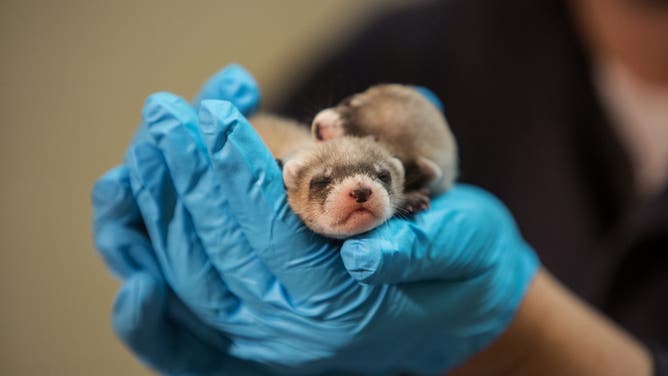
FRONT ROYAL, VA - JUL24: Paul Marinari, the senior curator of animal operations at the Smithsonian Conservation Biology Institute in Front Royal, Virginia, holds new born black-footed ferrets, July 24, 2014. via Getty Images)
(Evelyn Hockstein/For The Washington Post / Getty Images)
Unfortunately, this wild population was affected by disease, and by 1987, only 18 of the original 130 ferrets remained.
At this point, scientists intervened, capturing the remaining ferrets and bringing them into captivity.
Those 118 ferrets served as the foundation for all living black-footed ferrets today, the NPS said.
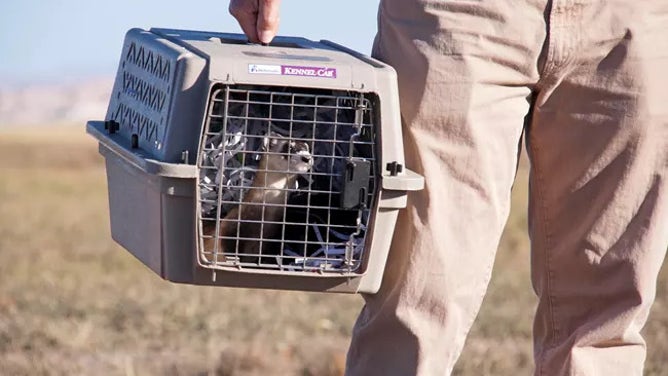
After being declared extinct, Black-footed Ferrets were reintroduced to Badlands National Park, where they thrive today.
(NPS Photo / FOX Weather)
Now, nearly 40 years later, after two decades of reintroducing the black-footed ferrets across eight U.S. states, Canada and Mexico, the population has seen some rebounding, but still remains one of the most endangered mammals on Earth.
In Badlands National Park, 147 black-footed ferrets were introduced between 1996 and 1999 at Conata Basin in the park.
MONARCH BUTTERFLIES HEAD TO MEXICO AS SCIENTISTS UNLOCK NEW WAY TO TRACK THEIR JOURNEY
The population thrived, allowing scientists to capture 33 ferrets in 2007 and take them to Wind Cave National Park, where the NPS says 60 ferrets live today.
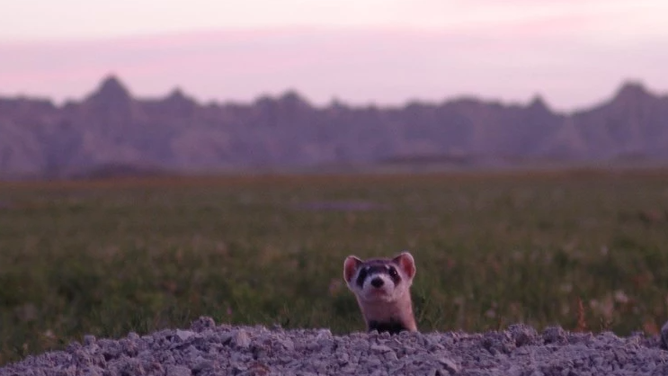
Single black-footed ferret inside a burrow with Badlands in the background.
(NPS Photo / FOX Weather)
Today, scientists estimate there are 120 black-footed ferrets living in Badlands National Park, with around 80 of them still living in Conata Basin.
It's not been without challenges to get there.
In 2008, sylvatic plague was detected in Conata Basin. It's carried by fleas, which can be extremely dangerous for the ferrets when the fleas impact prairie dogs, which are the majority of the black-footed ferret's diet.
CRITICALLY ENDANGERED RED WOLVES MAKE INTERSTATE JOURNEY IN RACE TO SAVE SPECIES
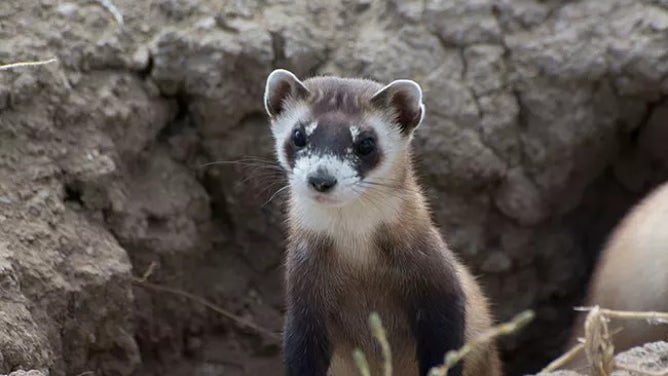
Black-footed Ferrets live in prairie dog towns, living in abandoned burrows.
(NPS Photo / FOX Weather)
In order to minimize this risk to the ferrets and prairie dogs, researchers were able to vaccinate some ferrets in addition to dusting prairie dog holes with insecticide to prevent the spread of fleas.
Since the black-footed ferret is so endangered and susceptible to decline, wildlife biologists continue to watch the Badlands population closely.
Badlands National Park remains one of the only populations of black-footed ferrets that is self-sustaining, meaning they are able to reproduce on their own and do not need to be supplemented with ferrets from captivity, the NPS said.
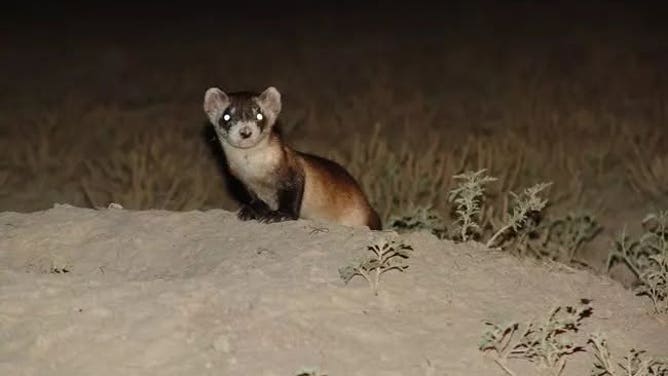
Black-footed Ferret's eyes shine a bright emerald green.
(NPS photo / FOX Weather)
In total, the National Park Service said there are about 280 ferrets living in captivity, while the wild population is between 200 and 300.
To see the species fully recovered, there needs to be about 3,000 black-footed ferrets.
The species is still at risk from disease, loss of habitat and related declines in prey.