

Second most valuable dinosaur fossil in the world is sold for over $47 million
Sotheby's said six bidders fought over the fossil with astoundingly high offers for 12 minutes.

FILE: NOAA simulates tsunami from dinosaur-killing asteroid
A 6-mile-wide asteroid struck the Earth some 66 million years ago and generated a tsunami that created waves 2.5 miles high as it crashed ashore. NOAA has now created a simulation of the event. (NOAA Video)
THE TAKEAWAY
- The second most valuable dinosaur fossil has sold for $47.3 million.
- Researchers discovered the first Nanotyrannus fossil in the summer of 1942.
- Six bidders fought over the fossil with astoundingly high offers for 12 minutes.
NEW YORK, N.Y. – Dinosaurs dominate in size, strength and money, as a bidder recently bought the second most valuable dinosaur fossil ever for over $47 million.
According to Sotheby’s, six bidders fought over the fossil with astoundingly high offers for 12 minutes. In the end, the dinosaur, known as Nanotyrannus and named Jodi, sold for $47.3 million.
'BIG CHUNKY' FOSSIL REVEALS BIZARRE NEW SQUID-LIKE SPECIES THAT LIVED 160 MILLION YEARS AGO
"One of the most exceptional and rare dinosaur fossils ever to come to auction, Jodi, is a remarkably complete specimen of Nanotyrannus, a genus whose identity has been the subject of scientific debate for nearly a century," Sotheby's said.
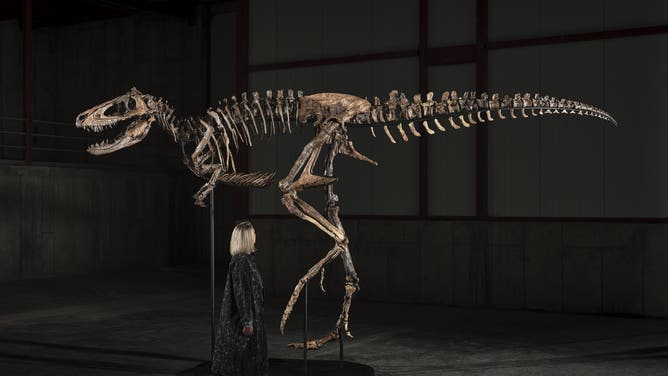
Nanotyrannus fossil compared to a human in size.
(Matthew Sherman)
The most valuable dinosaur ever sold happened in July for $50.1 million.
A Montana rancher discovered Jodi in 2019 alongside his 11-year-old son and other family members.
SCIENTISTS UNCOVER FIRST KNOWN ADULT T. REX TRACKWAY DATING BACK 66.5 MILLION YEARS
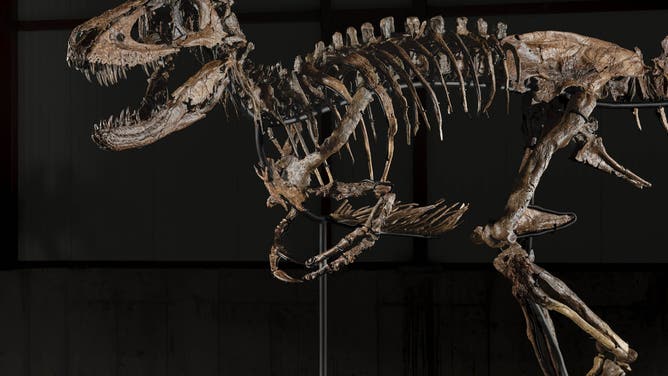
Nanotyrannus named Jodi sells for $47.3 million.
(Matthew Sherman)
For years, experts debated whether the Nanotyrannus was a teenage T. rex or a different species altogether.
Researchers discovered the first Nanotyrannus fossil in the summer of 1942.
MAN DISCOVERS MYSTERIOUS STONE OUTSIDE HOME, LEADING TO MASSIVE 3,300-YEAR-OLD EGYPTIAN TREASURE
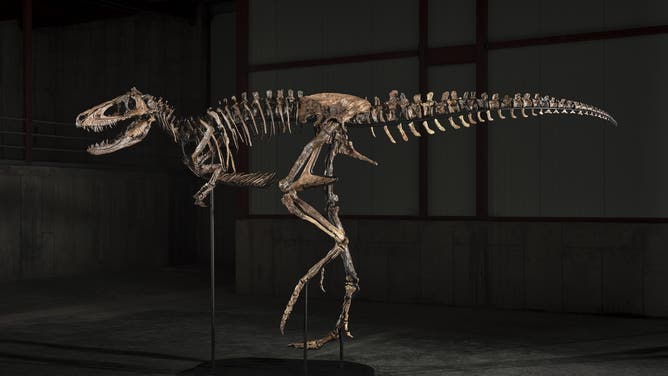
Researchers discovered the first nanotyrannus fossil in the summer of 1942.
(Matthew Sherman)
In 2025, after reviewing over 200 fossils and studying growth rings, final fusion data and developmental anatomy, researchers identified distinct age differences in the specimen, according to the North Carolina Museum of Natural Sciences.
SECTION OF 2,000-YEAR-OLD AQUEDUCT UNCOVERED IN JERUSALEM DURING EXCAVATIONS FOR A NEW NEIGHBORHOOD
Skeletal evidence also shows larger forelimbs, more teeth, fewer vertebrae and distinct skull nerve patterns, features associated with early development but biologically incompatible with T. Rex.
This settled the long debate and allows the Nanotyrannus to be separated as a completely different species.