

'Big Chunky' fossil reveals bizarre new squid-like species that lived 160 million years ago
The rare fossils revealed a new Jurassic species in present-day Wyoming.
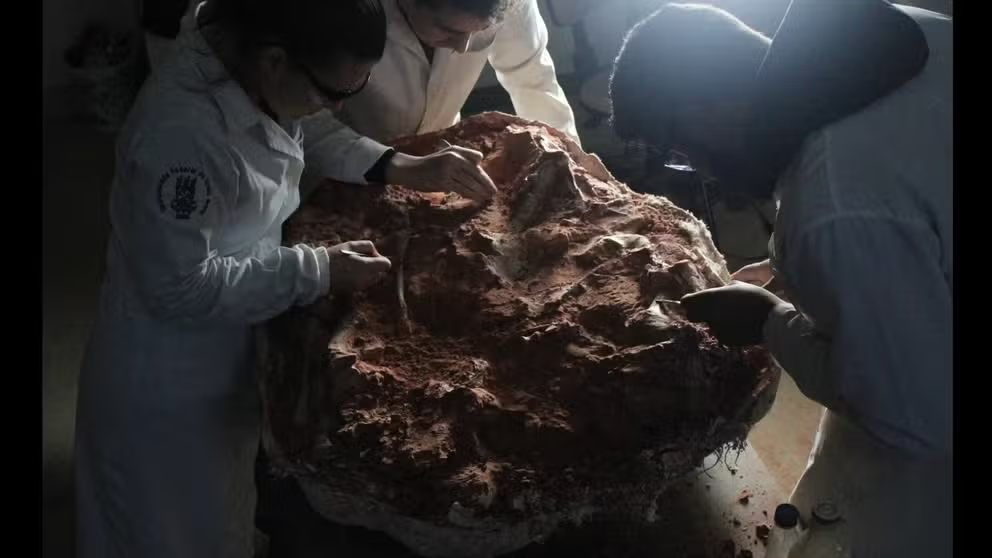
FILE VIDEO: Dinosaur fossil revealed after heavy rains in Brazil
Erosion caused by heavy rains uncovered an
THE TAKEAWAY
- Scientists identified the thickest belemnite ever discovered.
- The rare fossils revealed a new Jurassic species in Wyoming.
- The discovery shows the belemnite family survived longer than previously believed.
Scientists have identified the "chunkiest" belemnite ever discovered in the fossil record — an ancient, squid-like creature that lived in the seas covering present-day Wyoming roughly 160 million years ago.
Two exceptionally rare fossils from the Jurassic Period led researchers to identify a new species, Wyoteuthis linsterorum, according to a study published in the journal Papers in Paleontology.
The fossils were discovered in the upper part of Wyoming’s Sundance Formation, which formed in the ancient Sundance Sea.

Modern-day Wyoming is one of the world’s great fossil hunting grounds. Roughly 160 million years ago, the region was submerged beneath the shallow Sundance Sea, leaving behind fossil-rich rocks that preserve everything from squid-like belemnites to marine reptiles.
( Don and Melinda Crawford/UCG/Universal Images Group via Getty Images / Getty Images)
Their unusually thick, barrel-shaped internal skeletons measured about 60 millimeters across, making them the "fattest" belemnite ever identified, ScienceDaily reported.
Belemnites are extinct marine animals related to modern squid and octopuses.
They are best known for their distinctive, bullet-shaped internal skeletons, which are often the only parts of the animals preserved in the fossil record.
SCIENTISTS DISCOVER NEW PENGUIN SPECIES THROUGH BREAKTHROUGH GENETIC ANALYSIS
The groundbreaking fossilized rostrum discovered was about 4 inches long but measured up to 2.4 inches across, giving it a remarkably barrel-shaped appearance that stood out to researchers.
Based on comparisons with other belemnites, researchers estimated that the animal itself may have reached nearly 2 feet in length.

Andrew Rossi, a paleo technician, works on a fossil at the Wyoming Dinosaur Center in Thermopolis, Wyoming.
(Steve Johnson for The Washington Post via Getty Images / Getty Images)
Its unusually thick, barrel-shaped rostrum earned the prehistoric animal the "chunky" moniker, although researchers caution that the fossil’s unusual proportions make its overall body size difficult to determine.
Although belemnite fossils are relatively common, W. linsterorum is notable because it belonged to a rare family that had mostly disappeared millions of years earlier.
SCIENTISTS DISCOVER 57 NEW MARINE SPECIES LURKING IN THE DEPTHS OF THE SOUTH ATLANTIC
Its discovery provides evidence that the group survived in a previously unknown refuge in the northeastern Pacific.
The fossil was not the animal’s entire body, but its internal "guard", the hard, squid-like creature’s fossilized butt.
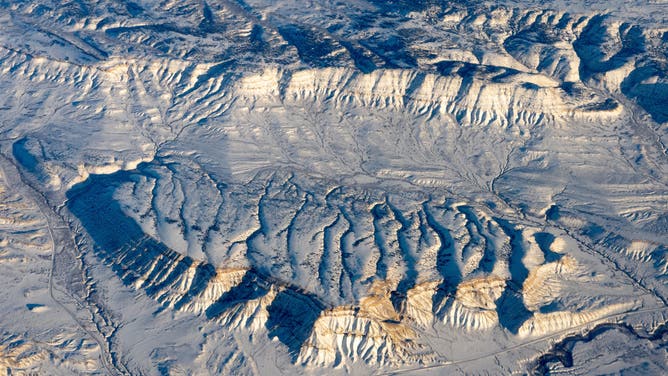
Aerial view of parallel streams on the sloping backside of a cuesta, southern Wyoming.
( Marli Miller/UCG/Universal Images Group via Getty Images / Getty Images)
The discovery shows that even familiar fossil sites can still hold scientific surprises.
The "chunky belemnite" not only discovers a previously unknown species, but also reveals that a rare branch of the belemnite family survived in the ancient Sundance Sea long after researchers thought the group had nearly disappeared.