

Solar flare event happens days before Artemis II mission. NASA said they're not concerned about it
NASA said the solar flare activity is not currently anticipated to impact the Artemis II mission, but they'll continue to monitor space weather leading up to the launch.
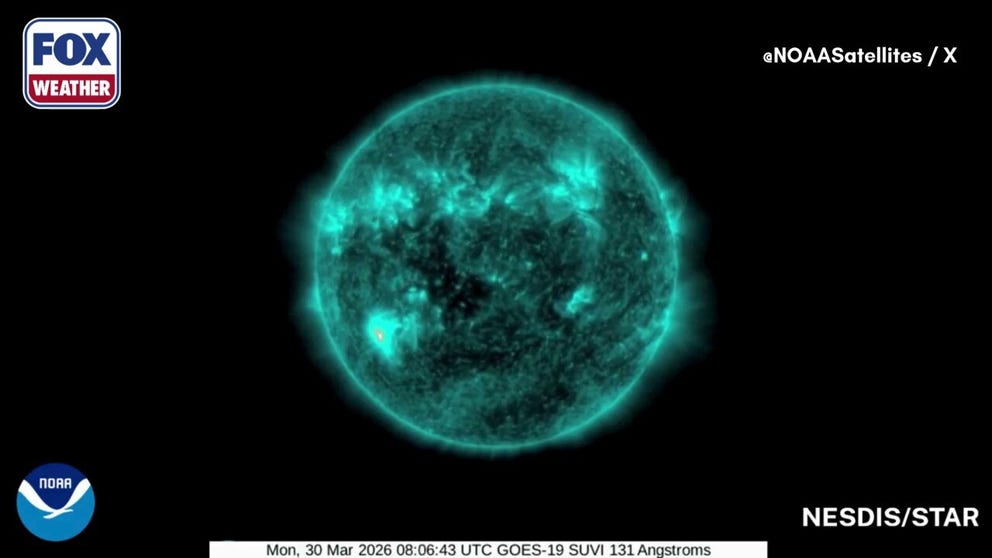
Strong solar flare eruption happens days before Artemis II launch
SEE IT ☀️: Just days before the Artemis II mission, the sun emitted a strong solar flare, catching the attention of experts.
Just days before the Artemis II mission, some other activity in space caught the attention of NASA officials.
According to NASA, a strong solar flare was emitted from the sun on Sunday night, providing the opportunity to capture a stunning image of the event.
FINAL PREPARATIONS UNDERWAY FOR THE LAUNCH OF NASA'S ARTEMIS II SPACE MISSION
The image captured by NASA’s Solar Dynamics Observatory shows bright pockets, almost like holes in the sun, followed by swooshing energy bursting out from the layer.
According to NASA, the image shows a subset of extreme ultraviolet light that highlights extremely hot material in flares, which are colorized in gold.
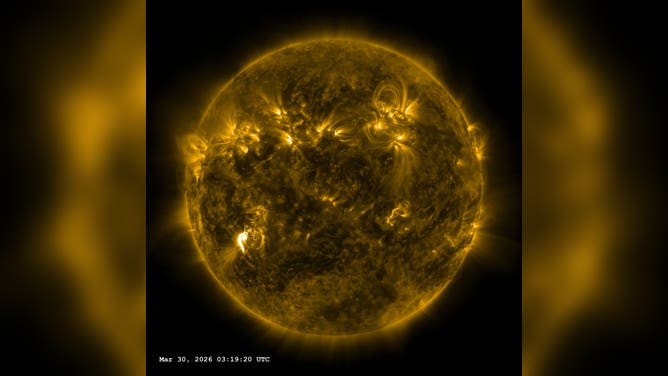
The sun emitted a strong solar flare on March 29, 2026.
Solar flares are powerful bursts of radiation or light from the sun and are the most powerful explosions in the solar system. Flares and solar eruptions can impact radio communications, electric grids, navigational signals and pose risks to spacecraft and astronauts.
'FIREBALL SEASON' EXPLAINED: WHY METEORS ARE LIGHTING UP SKIES ACROSS THE COUNTRY
Experts said the solar flare eruption, at its peak, resulted in a strong radio blackout on the sunlit side of Earth on Sunday, according to the NOAA Space Weather Prediction Center.
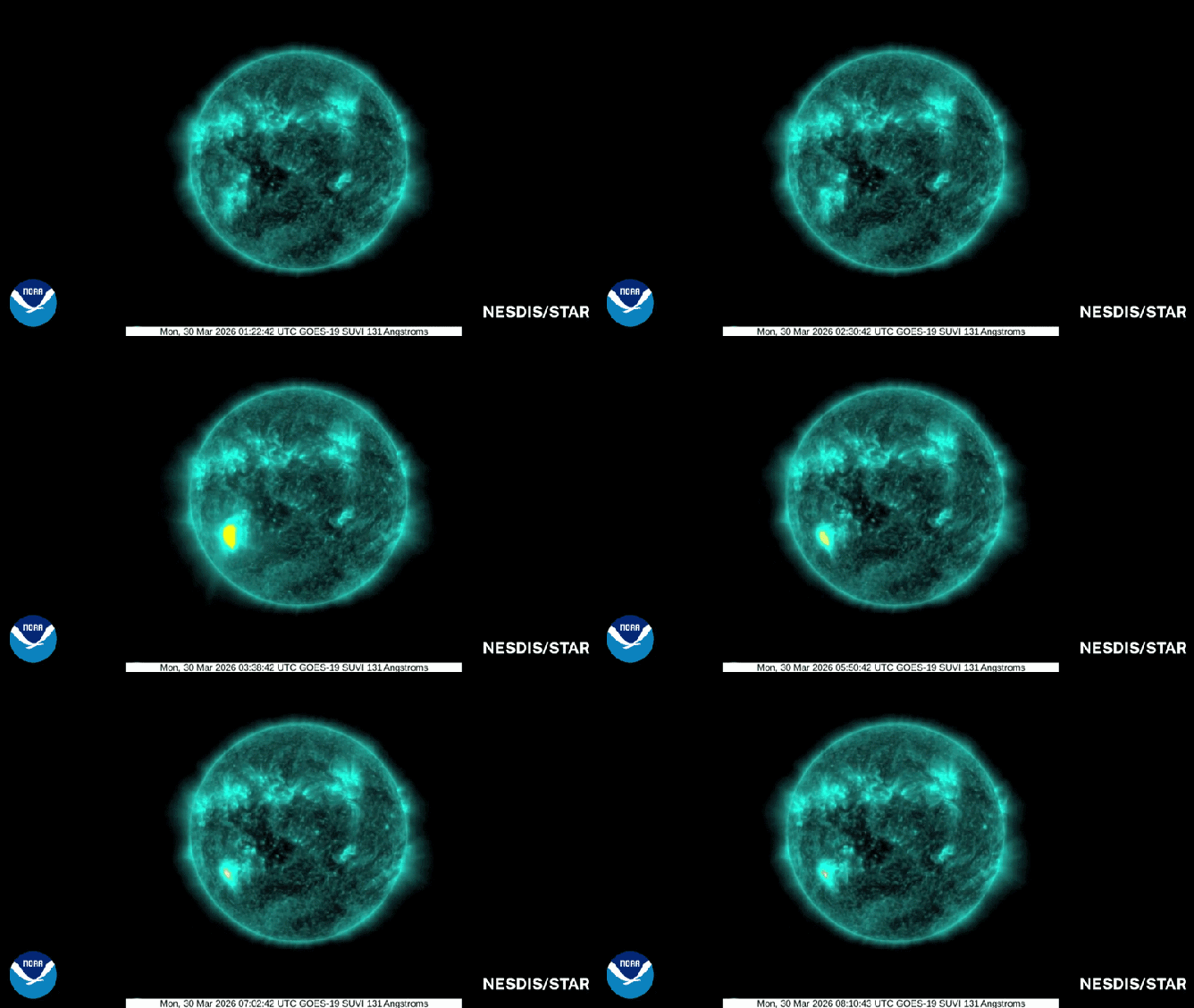
A colorful solar flare eruption caused a strong radio blackout on Sunday.
(@NOAASatellites / X)
Despite this, NASA has stated that the flaring activity is not currently anticipated to impact the Artemis II mission, and they'll continue to monitor space weather activity leading up to the launch.
Based on the predicted weather on Earth and in space, the mission is still 80% a go for launch on Wednesday.
Solar flares can be generated by a solar storm, which is when the sun creates a tangled mess of magnetic fields that twist as the sun rotates, with the equator moving faster than its poles, according to NASA experts.
When directed towards Earth, it can cause major power outages and beautiful auroras. Thankfully, our planet’s magnetic field and atmosphere protect us from the worst of these storms.
MEET THE ASTRONAUTS PREPARING FOR HUMANITY’S RETURN TO THE MOON ON THE ARTEMIS II MISSION
Otherwise known as the magnetosphere, it shields us from erosion of our atmosphere by the solar wind, cosmic rays from deep space and more.
Simply put, it is a gatekeeper for our planet, repelling damaging energy that’s harmful to life on Earth and trapping most of it at a safe distance.