

Live updates: Artemis II countdown begins as 80% ‘Go’ weather forecast holds for Florida
Live updates: Artemis II countdown begins as 80% ‘Go’ weather forecast holds for Florida
Download the AppThis LIVE blog has moved
View postCoverage for this event has ended.
The countdown for Artemis II is officially underway! As of this morning, the clock is ticking toward tomorrow's historic 6:24 p.m. ET liftoff from Kennedy Space Center.
With the mission officially in its final 36 hours, we have launched a new live coverage hub to bring you the latest "Go/No-Go" weather updates, final mission status reports, and real-time analysis from our team at the Cape.
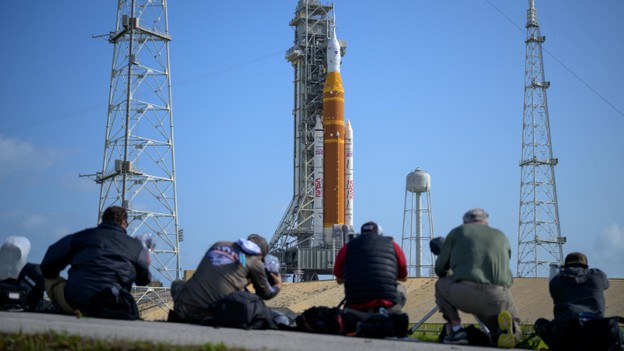
Media aim their cameras on NASA's Artemis II Space Launch System rocket and Orion spacecraft on Sunday, March 29, 2026.
With countdown officially underway, engineers are powering up flight hardware, checking communication links and preparing the rocket's cryogenic systems, according to NASA.
NASA officials said the rocket's cryogenic systems must be able to load hundreds of thousands of gallons of super-cooled liquid hydrogen and liquid oxygen in a precise fueling sequence.
At the launch pad, teams will start filling the sound suppression system's massive tank with water, which will unleash a protective deluge at liftoff to shield the vehicle from the roar of its own engines, according to NASA.
The Artemis II crew has spent the final countdown phase focused of readiness and technical verification, staying in quarantine under strict health monitoring and completing medical checks to ensure they're fit for launch, officials said.
All four crew members have been following a controlled sleep schedule and nutrition plan to maintain energy and hydration for launch, NASA said.
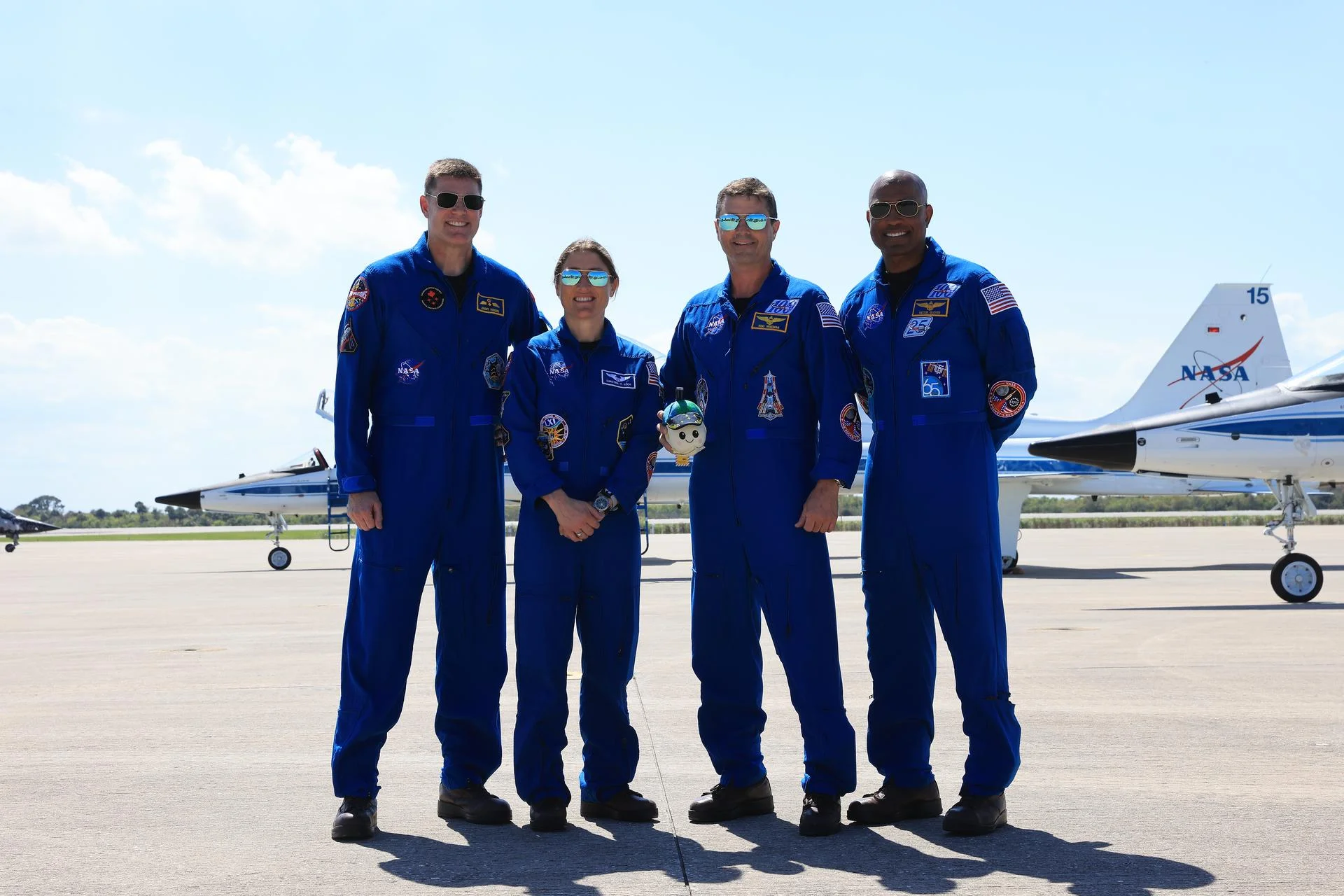
The agency, along with weather officers with the U.S. Space Force's Space Launch Delta 45, are paying close attention to weather conditions ahead of tanking operations, which are set to take place on Wednesday morning.
Currently, the forecast shows an 80% chance of favorable weather conditions with primary concerns being cloud coverage and the potential for high winds in the area.
The four crew members set to board the Orion spacecraft for the Artemis II mission are spending some time with family before final launch preparations.
Chief Flight Director Emily Nelson said crew members have spent the past year or two readying for this mission.
They're using today as an opportunity to spend time with loved ones before partaking in a few last-minute briefings and meetings tomorrow.
The crew will be traveling farther than anyone has ever gone before in their 10-day mission around the moon, according to NASA officials.
NASA readies for Artemis II launch on Wednesday.
NASA officials said the Artemis II mission remains on track to launch in approximately two days.
The Orion spacecraft, system and crew are ready to go, Associate Administrator Amit Kshatriya said during a press conference. He went on to say that the agency has "complete confidence" in the team and NASA workforce.
John Honeycutt, chairperson of the Mission Management Team, emphasized that today's L-2 meeting acted as an important checkpoint in walking through any work closed and ongoing, and to discuss any current issues.
The team unanimously decided that the spacecraft - called Integrity - is clear for launch.
There are still a lot of vehicle checks to come ahead of launch, but there haven't been any major hiccups reported and NASA officials remain confident.
The countdown to liftoff for Artemis II is now officially underway, with launch happening in just two days.
Ground teams officially began the formal 49-hour, 40-minute countdown at 4:44 p.m. ET today.
This "countdown to the countdown" involves the final activation of communication systems and the handoff of the Space Launch System rocket to the launch software that will govern every second leading up to Wednesday’s 6:24 p.m. ET launch window.
Starlink said the Artemis II launch will not be affected after they lost contact with one of their satellites on Sunday.
In a statement, Starlink said satellite 34343 experienced an anomaly on-orbit, resulting in loss of communications with the satellite at about 560 kilometers above Earth.
They said the incident poses no new risk to the International Space Station, its crew or the upcoming Artemis lI mission.
"We will continue to monitor the satellite along with any trackable debris and coordinate with NASA and the United States Space Force," Starlink said on social media.
The SpaceX and Starlink teams are actively working to determine the root cause and said they will rapidly implement any necessary corrective actions.
While NASA and the Space Force are keeping a close eye on the clouds, a reminder flashed from the sun last night that space weather is just as important as the Florida forecast.
A significant solar flare erupted late Sunday, triggering a brief but notable radio blackout on Earth just as the Artemis II mission enters its final 48-hour countdown.
The flare, categorized as a high-level event, sent a burst of X-rays toward our planet that ionized the upper atmosphere, causing temporary interference with high-frequency radio communications used by aviation and maritime channels affecting southeast Asia and Australia.
Fortunately, for the Artemis II team at Kennedy Space Center, the impact was short-lived and did not interfere with the critical ground systems or the SLS rocket currently sitting at Pad 39B.
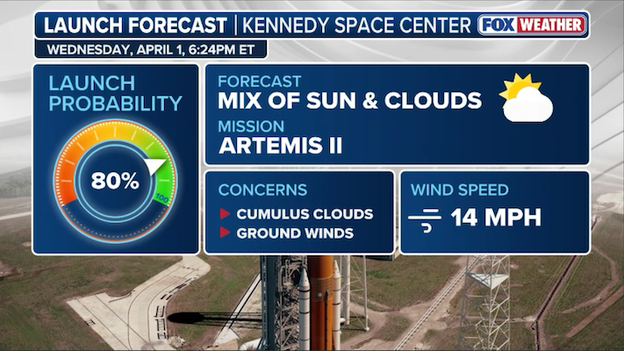
Latest Artemis II launch forecast for Wednesday, April 1
NASA’s space weather scientists are continuing to monitor the sun for any follow-up coronal mass ejections (CMEs)—clouds of charged particles that take longer to reach Earth but can be more disruptive.
While the current launch mission forecast lists solar activity as "low," mission managers will be watching these solar mood swings closely.
If a major solar storm were to occur during the flight, it could pose a risk to the Orion spacecraft's sensitive electronics or make communication with the four astronauts difficult.
For now, the sun has quieted back down, keeping the mission on track for its Wednesday evening liftoff.
As the countdown clock begins its final march toward Wednesday’s 6:24 p.m. ET launch window, it is important to remember that Artemis II is far more than just a "trip around the Moon." This 10-day flight is a high-stakes test of the most complex transportation system ever built by NASA.
From proximity dance-offs in Earth orbit to a record-breaking loop around the lunar far side, here is the step-by-step breakdown of what the crew will do once they clear the tower.
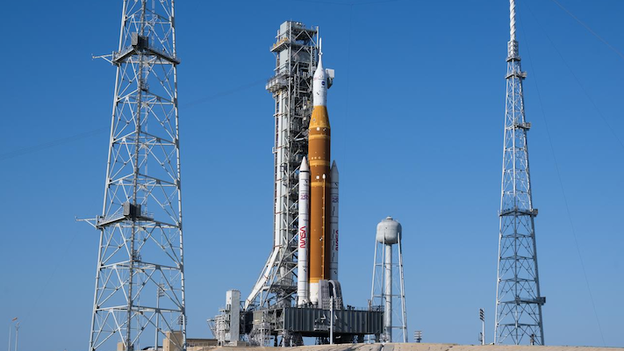
NASA’s Artemis II Space Launch System (SLS) rocket and Orion spacecraft are seen at Launch Complex 39B, Friday, March 27, 2026, at NASA’s Kennedy Space Center in Florida. (NASA/Aubrey Gemignani)
Phase 1: The high Earth orbit "check-out"
Immediately after the SLS rocket’s core stage separates, the crew won't head for the Moon just yet. Instead, they will spend their first 24 hours in a High Earth Orbit.
This is a safety-first approach designed to keep the astronauts close to home while they ensure Orion’s life-support systems—like the potable water dispenser and the carbon dioxide scrubbing system—are working perfectly.
During this phase, Pilot Victor Glover will perform a Proximity Operations demonstration. He will manually fly Orion near the spent upper stage of the rocket (the ICPS), practicing the delicate maneuvers and formation flying that future missions will need when docking with the Gateway space station or the SpaceX Starship landing system.
Phase 2: The Trans-Lunar Injection (TLI)
Once NASA is confident that Orion is a healthy ship, the crew will fire the engine one final time to break free of Earth’s gravity. This is the Trans-Lunar Injection.
This burn will set them on a free-return trajectory. This is a brilliant bit of orbital mechanics: the path is shaped like a giant figure-eight, meaning that even if Orion’s engines were to fail completely after this point, the Moon’s gravity would naturally swing the capsule back toward Earth for a safe splashdown.
Phase 3: Farther than any human in history
On Flight Day 6, the crew will reach the Moon. Unlike the Apollo missions, which went into a low orbit just 60 miles above the surface, Artemis II will perform a high-altitude flyby.
They will pass approximately 4,600 miles beyond the lunar far side. At this apex, the crew will likely break the all-time record for the farthest humans have ever traveled from Earth—surpassing the record set by the Apollo 13 crew in 1970.
From this vantage point, they will be able to see the entire disk of the Moon and the Earthrise over the lunar horizon, providing invaluable data on how the spacecraft handles deep-space radiation.
Phase 4: The high-speed homecoming
After swinging around the Moon, Orion will spend about four days falling back toward Earth, accelerating the entire way. By the time the capsule hits our atmosphere on April 10, it will be traveling at a blistering 25,000 mph.
The mission concludes with a skip reentry—where the capsule essentially bounces off the atmosphere like a stone on a pond to dissipate heat—before deploying 11 parachutes for a precision splashdown in the Pacific Ocean.
Only after the U.S. Navy recovers the crew will the mission be declared a total success, paving the way for the Artemis III landing in the years to come.
With just hours remaining until the historic Artemis II mission, NASA took to the stage on Sunday for a pivotal, pre-launch press conference, and the message was unambiguous: We are ready.
Officials from both agencies expressed unwavering confidence in the ground teams, the Space Launch System (SLS) rocket, the Orion spacecraft, and, most importantly, the four brave astronauts who will soon embark on humanity’s first journey to the vicinity of the Moon in over half a century.
Sunday’s update followed a successful, comprehensive mission readiness review that methodically went through every aspect of the complex mission, from the intricate life support systems to the detailed flight plan.
The one thing we are watching is the weather.
Shawn Quinn, the Exploration Ground Systems Program Manager at Kennedy Space Center, provided a detailed status update on the health of the launch complex.
Quinn confirmed that the mobile launcher and Pad 39B are fully prepared for the immense power of the SLS liftoff. He noted that the ground teams successfully completed final walk-downs and leak checks over the weekend, ensuring that the complex network of fuel lines and electrical connections is ready for the high-stakes "tanking" process scheduled to begin on launch day.
While all systems are "go" right now, the one thing the team is monitoring closely is the weather. Right now, the official launch forecast from the Space Force 45th Weather Squadron shows a 20% chance that weather will scrub the launch.
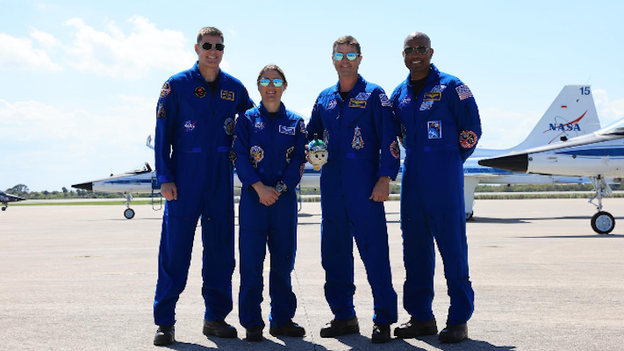
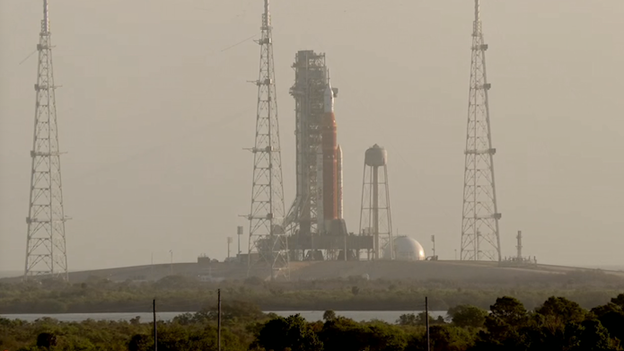
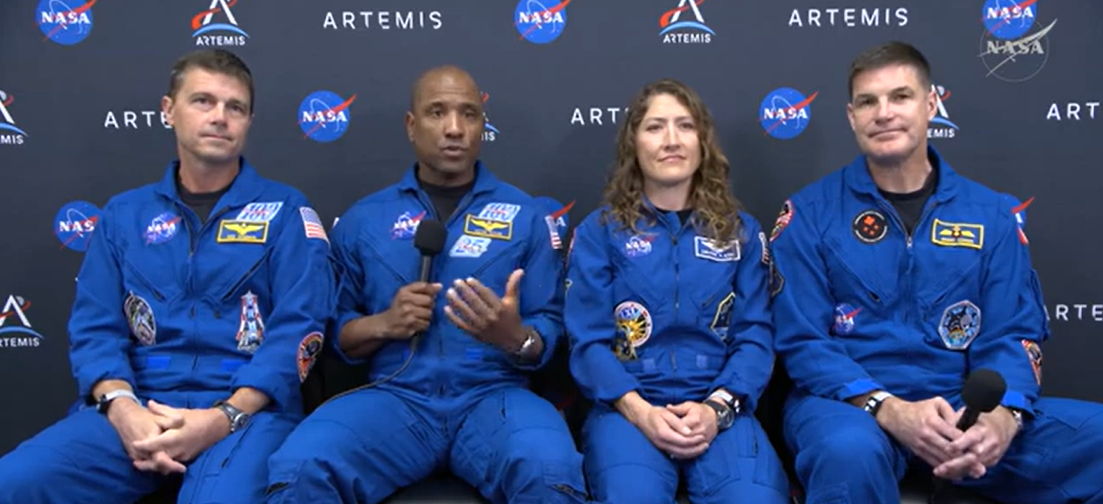
From left to right, Artemis II Mission Specialist Jeremy Hansen from CSA (Canadian Space Agency), Mission Specialist Christina Koch, Commander Reid Wiseman, and Pilot Victor Glover, arrive on Friday, March 27, 2026, at the Launch and Landing Facility at the agency’s Kennedy Space Center in Florida in preparation for the Artemis II test flight. (NASA/Kim Shiflett)
The Artemis II crew officially arrived at NASA’s Kennedy Space Center in Florida on Friday, March 27, marking their final stop before heading to the Moon.
Touching down at the Launch and Landing Facility, NASA astronauts Reid Wiseman, Victor Glover, and Christina Koch, along with CSA astronaut Jeremy Hansen, flew in from Houston aboard T-38 jets.
Upon arrival, the crew shared their excitement with the waiting crowd, with Commander Wiseman exclaiming, "Hey, let's go to the Moon!" and the team revealing "Rise"—a small, round plush mascot that will serve as the mission's zero-gravity indicator.
The four astronauts have since entered their final pre-launch quarantine in the astronaut crew quarters as they prepare for Wednesday’s scheduled liftoff.
The tension is building at Kennedy Space Center as we enter the final hours before the official Artemis II mission clock begins its march toward liftoff.
Today, ground teams will begin the formal 49-hour, 40-minute countdown at 4:44 p.m. ET.
This "countdown to the countdown" involves the final activation of communication systems and the handoff of the Space Launch System rocket to the launch software that will govern every second leading up to Wednesday’s 6:24 p.m. ET launch window.
While the rocket stands ready on Pad 39B, these early hours of the count are focused on powering up the Orion spacecraft and charging the flight batteries that will sustain the crew on their 10-day journey.
This phase is all about precision and poise, ensuring that every internal system is synchronized before the high-stakes propellant loading begins later in the week.
We are officially on the doorstep of history, and the next few hours will set the rhythm for humanity’s first crewed return to the lunar vicinity in over half a century.
The four astronauts of Artemis II represent a historic shift in lunar exploration, marking the first time in over 50 years that humans will journey to the vicinity of the Moon.
Leading the "Artemis Generation" is Mission Commander Reid Wiseman, a veteran of the International Space Station with 165 days in orbit, joined by Pilot Victor Glover, who previously served on NASA’s SpaceX Crew-1 mission.
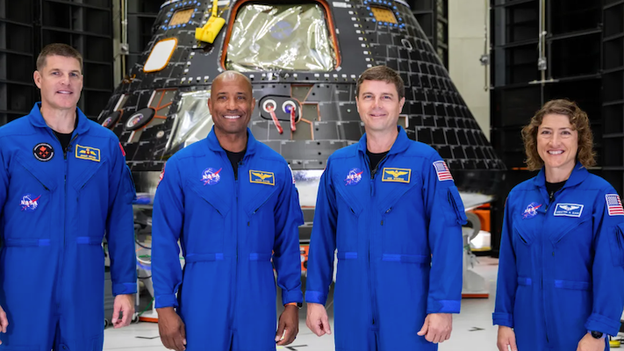
The Artemis II crew is shown inside the Neil Armstrong Operations and Checkout Building at NASA’s Kennedy Space Center in Florida in front of their Orion crew module on Aug. 8, 2023. From left are: Jeremy Hansen, mission specialist; Victor Glover, pilot; Reid Wiseman, commander; and Christina Hammock Koch, mission specialist. (NASA/Kim Shiflett)
Rounding out the crew are Mission Specialists Christina Hammock Koch, who holds the record for the longest single spaceflight by a woman, and Jeremy Hansen, a colonel in the Canadian Armed Forces making his first trip into space.
This diverse team embodies a "crew for all humanity," featuring the first woman, the first person of color, and the first Canadian to ever embark on a lunar mission.
During their 10-day flight test, the crew will push the limits of the Space Launch System rocket and the Orion spacecraft to ensure that life-support systems are ready for long-term deep space habitation.
This mission is a critical stepping stone in NASA’s "Moon to Mars" approach, validating the technologies and navigation techniques required for humans to live and work in the lunar environment.
By establishing a sustainable presence on the Moon, these four pioneers are paving the way for future scientific discoveries and the eventual goal of sending the first astronauts to the surface of Mars.
The latest Launch Mission Execution Forecast from the U.S. Space Force’s 45th Weather Squadron brings a wave of optimism for the Artemis II mission, showing an 80% chance of favorable weather for Wednesday’s historic liftoff.
Meteorologists are currently tracking a stalled front across South Florida that is expected to slowly fall apart over the coming days. While this boundary is keeping low-level moisture in the area, the bulk of the organized rain and thunderstorm activity is expected to push toward the west side of the Florida peninsula each evening, leaving the Space Coast with relatively clear windows for launch.
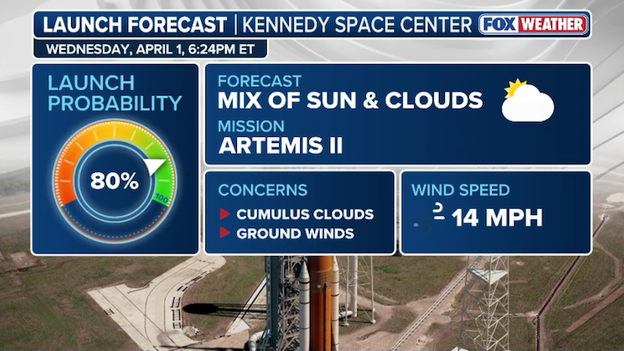
Meteorologists at the Space Force 45th Weather Squadron are calling for an 80% chance of favorable weather on Wednesday evening.
Despite the high probability of a "Go" forecast, the mission still faces a 20% risk of violating weather constraints, with the primary concerns being the Cumulus Cloud Rule and gusty ground winds.
Forecasters are keeping a close watch on onshore flow and the daily sea breeze, which could trigger intermittent showers or isolated thunderstorms near the launch pad.
During the launch window, conditions are expected to reach a high of 75 degrees with humidity around 75%, while ground winds at the 132-foot level are forecast to blow from the east-southeast at 15 to 20 knots.
Sky conditions at the time of liftoff are expected to feature scattered cumulus clouds with bases starting at 3,000 feet and tops reaching 13,000 feet, alongside high-level cirrus clouds.
Fortunately, solar activity remains low, removing one potential hurdle for the Orion spacecraft’s electronic systems.
While these breezy onshore winds and coastal clouds remain the watch items for NASA’s launch directors, the overall outlook remains very strong for a Wednesday evening liftoff.
As we hit the 48-hour mark until the scheduled liftoff, the intensity at Kennedy Space Center is ramping up for a pivotal moment in the Artemis II mission.
Following a high-level Mission Management Team meeting later today, NASA leadership will hold a news conference at 5 p.m. ET to provide the official word on exactly where the mission stands.
This critical status update serves as a final deep-dive into the technical health of the Space Launch System rocket and the Orion spacecraft to ensure no lingering snags from the weekend's preparations will interfere with the journey.
During this briefing, mission managers and meteorologists will also scrutinize the latest high-resolution data to see if that promising 80% "Go" forecast is still holding firm against those tricky cumulus clouds and upper-level winds.
We expect this meeting to result in a green light for the official 49-hour, 40-minute countdown to begin later this afternoon.
You can catch the update live on FOX Weather at 5 p.m. ET, and we will be right here to break down the technical jargon and explain what it means for your Wednesday evening launch plans.
As NASA prepares to send four astronauts around the Moon for the first time in over 50 years, all eyes aren’t just on the countdown clock—they’re on the clouds.
While the Space Launch System (SLS) is the most powerful rocket in the world, it is still at the mercy of Florida’s fickle weather. NASA’s weather criteria aren’t just suggestions; they are conservative rules designed to keep the crew safe and the hardware intact.
Here is a breakdown of the specific "Go/No-Go" conditions the FOX Weather team is watching as we approach the April 1 launch.
⚡ The "no lightning" zone
Lightning is perhaps the biggest threat at Kennedy Space Center. NASA won't even start the tanking process (filling the rocket with fuel) if there’s a 20% or greater chance of lightning within 5 nautical miles.
- The 30-minute rule: If a bolt of lightning is spotted within 10 nautical miles of the flight path, the clock resets. They must wait 30 minutes after the last flash before they can even think about clearing the tower.
- Anvil clouds: Those flat-topped clouds you see on the horizon are often detached from thunderstorms, but they can still hold a charge. If the flight path comes within 10 nautical miles of an anvil cloud, the mission could be scrubbed.
🌡️ Goldilocks temperatures: Not too hot, not too cold
Rockets are sensitive to the air around them. If it’s too cold, seals can fail (reminiscent of the Challenger disaster); if it’s too hot, internal systems can overheat.
- The floor: NASA won't start fueling if the 24-hour average temperature at the pad is below 41.4°F.
- The ceiling: Liftoff is a no-go if the temperature exceeds 94.5°F for 30 consecutive minutes.
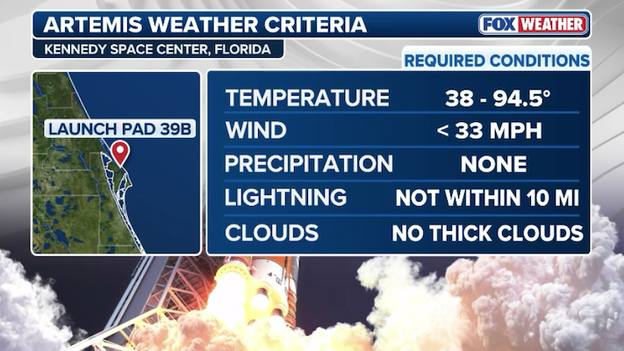
Specific criteria is used to determine whether or not Artemis II will be allowed to launch.
☁️ The "thick cloud" rule
You might look up and see a cloudy day and think, "What’s the big deal?" But for the SLS, clouds are a minefield.
- The 4,500-foot limit: NASA generally won't launch through a cloud layer that is more than 4,500 feet thick if it extends into freezing temperatures.
- Why? Flying a massive metal rocket through thick, freezing clouds can actually trigger a lightning strike, even if there isn't a thunderstorm nearby. It’s called triboelectric charging, and it’s a risk NASA won't take.
💨 Catching the wind
Wind isn't just a problem at the ground level; it's a problem miles up in the atmosphere.
- At the pad: Peak liftoff winds cannot exceed 29 to 39 knots (about 33–45 mph), depending on how high up the rocket you measure.
- Upper-level winds: Even if it’s calm on the ground, wind shear high in the atmosphere can push the rocket off course or put too much stress on the frame. If the computer models show the rocket might struggle to stay upright, the Launch Director will call a hold.
☀️ Solar storms
Believe it or not, the weather in space matters too. NASA monitors solar activity—huge bursts of energy from the sun. If a solar storm is too intense, it can fry the sensitive electronics on the Orion spacecraft or make it impossible for the astronauts to talk to Mission Control.
You’ve reached the beginning of this live coverage.