

The Geminid meteor shower peak: When to watch the highly anticipated celestial event
The Geminid meteor shower is one of the best and strongest annual celestial events in the Northern Hemisphere.
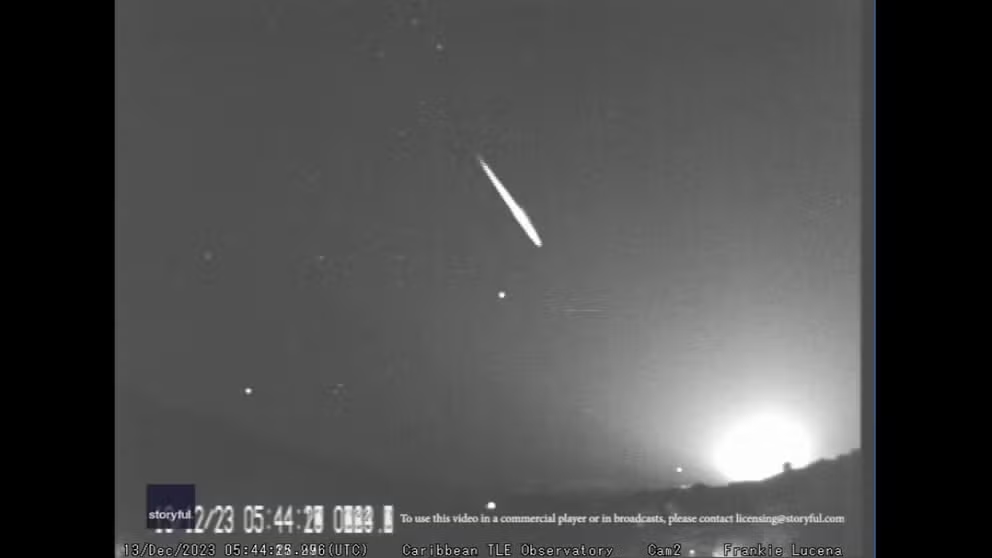
FILE: Spectacular coincidence gives appearance Geminid meteor exploded in Puerto Rico
A video shot early Wednesday morning captured the moment a meteor streaked across the sky and appeared to explode over Puerto Rico. (Courtesy: Frankie Lucena via Storyful)
Skygazers around North America will have a chance to see the Geminid meteor shower peak on the night of Dec. 13.
It is expected that observers may be able to see about 120 meteors per hour.
According to NASA, the Geminid meteor shower is one of the best and strongest annual celestial events in the Northern Hemisphere with yellow meteors that are bright and fast.
DECEMBER SKYWATCHING GUIDE: WRAP UP 2025 WITH THESE CAN'T MISS CELESTIAL EVENTS
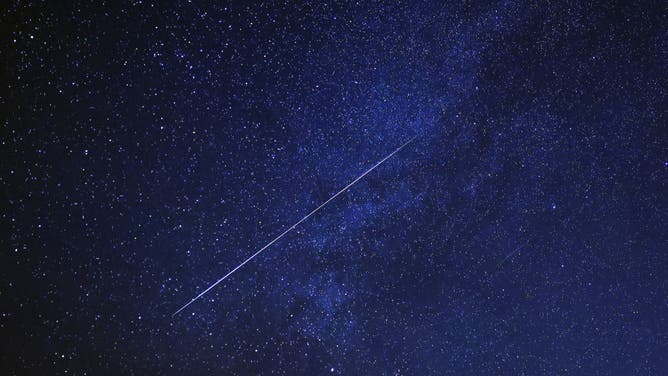
A meteor burns up in the sky over al-Abrak desert north of Kuwait City during the annual Geminids meteor shower early on December 15, 2023. (Photo by YASSER AL-ZAYYAT / AFP) (Photo by YASSER AL-ZAYYAT/AFP via Getty Images)
(Getty Images)
The Geminids began soaring through the sky at the beginning of December and will last through Dec. 21.
During non-peak times, skygazers may still be able to observe at least 40 to 50 meteors per hour.
SEE IT: WINTRY WEATHER SPARKS SPECTACULAR LIGHT SHOW IN MINNESOTA FROM LIGHT PILLAR PHENOMENON
Visible from both the Northern and Southern Hemisphere, the Geminid meteor shower happens each year in December.
This celestial event is regarded as one of the most reliable meteor showers of the year.
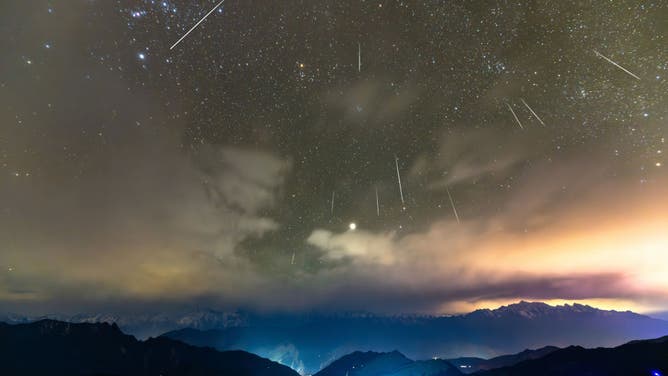
The Geminid meteor shower is being seen over Ya'an City, Sichuan Province, China, on December 14, 2023. (Photo by Costfoto/NurPhoto via Getty Images)
The Geminids first appeared in the mid-1800s but were not as noteworthy as they are today.
At first, viewers were only able to see about 10 to 20 per hour. But through the years, the meteor shower grew to become a major astronomical event.
But unlike most meteor showers, which emerge from comets, the Geminids originated from asteroid 3200 Phaethon. When Phaethon orbits around the sun every 1.4 years, bits and pieces of rock break off and form the Geminid meteoroids.
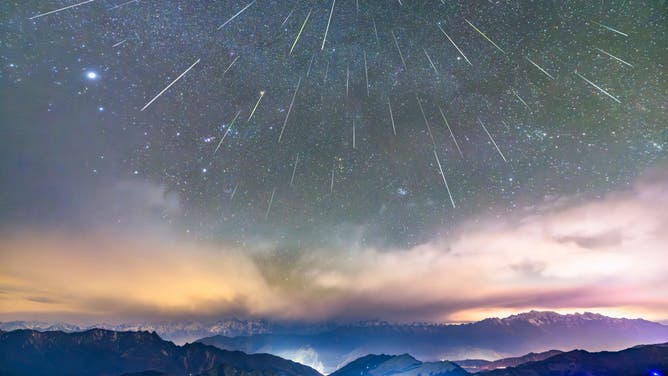
The Geminids meteor shower is seen at the top of Niubei Mountain in Ya 'an, Sichuan Province, China, Dec 14, 2023. (Photo credit should read CFOTO/Future Publishing via Getty Images)
(Getty Images)
If you plan on watching the spectacular shower, NASA said it is best to view the Geminids during the night and pre-dawn hours. The peak typically starts around 9 or 10 p.m.
To view the Geminids, it would be best to find an area that is far away from a city or streetlights. Orient yourself to the east, lie flat on your back and look up, taking in as much of the sky as possible. In less than 30 minutes in the dark, your eyes will adapt, and you will be able to see the meteors.