

Why Western Australia’s sky turned eerie red before Tropical Cyclone Narelle made landfall
Reports suggest that strong winds lifted the iron-rich red soil and dust into the atmosphere, which, combined with scattered sunlight, filtered out most wavelengths except red, producing a vivid crimson sky.
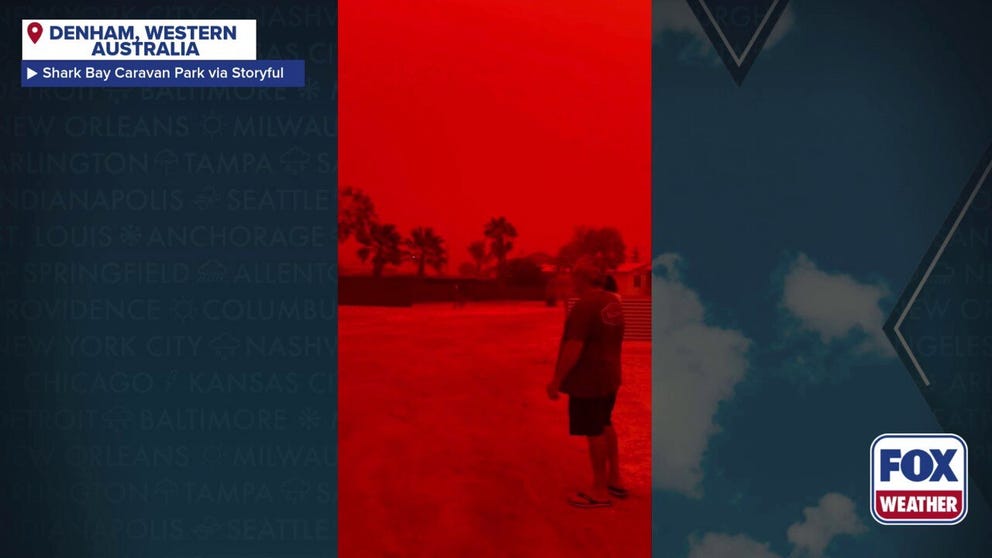
Sky turns ominous red as Tropical Cyclone Narelle moves in over Western Australia
The sky over Western Australia's Shark Bay turned blood-red on Friday ahead of the arrival of Tropical Cyclone Narelle. Thick dusk was kicked up by the system, which gave the sky its ominous color.
DENHAM, Western Australia — Tropical Cyclone Narelle has battered Australia with relentless winds and torrential rain, making landfall four times.
As it neared the western coast on Friday, residents were met with a sky that appeared to be ablaze with streaks of fiery orange and red, ahead of the storm's arrival.
WATCH: DUST TURNS SKIES EERIE RED OVER DALLAS AS 60-MPH WINDS BLAST METROPLEX
Videos captured online took the internet by surprise, with many describing them as having an ‘apocalyptic’ feel.
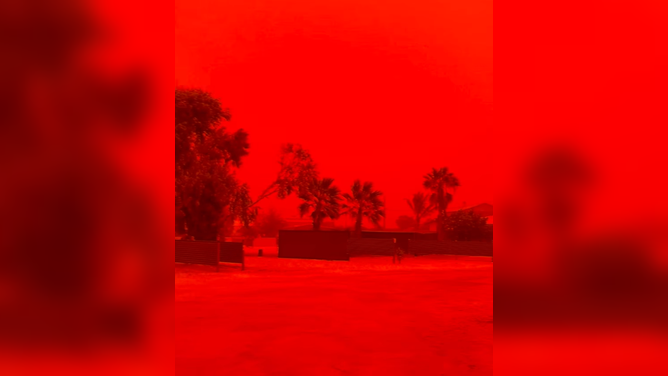
Footage from another angle highlights more eerie skies over Western Australia just before Tropical Cyclone Narelle made landfall, engulfing Denham in orange and red from dust on March 27.
(Shark Bay Caravan Park via Storyful)
In particular, Dedham’s Shark Bay Area brings us two unique perspectives showcasing the phenomenon.
In a Facebook post, the park wrote: "Incredibly eerie outside, and everything is covered in dust. Not a lot of wind yet."
THE LARGEST DOCUMENTED CORAL COLONY IN THE WORLD FOUND ON THE GREAT BARRIER REEF
Across the region, the sky also took on a softer orange hue, caused by dust swirling during the storm.

On Friday, March 27, strong winds from Tropical Cyclone Narelle kicked up dust, casting an orange hue over the skies along Western Australia’s coast
(@callmenicks via Storyful)
So, what exactly caused the sky to turn this extraordinary blood-red color during such a powerful cyclone in Australia?
The FOX Forecast Center believes it could be due to the way different wavelengths of light scatter in the atmosphere.
WHY DID THE SKY TURN PINK DURING A RECENT WINTER STORM IN IOWA?
A similar phenomenon was observed in January when the skies in Iowa turned pink during a winter storm.

FILE: Pink sky seen over Iowa during recent winter storm
The sky turned bright pink during a winter storm in Iowa last week. The FOX Forecast Center said the sky can appear pink because of how different wavelengths of light behave.
Colors like blue have shorter wavelengths, whereas red, orange and pink light have longer wavelengths.
When the sun is near the horizon at sunrise or sunset, its light passes through a greater thickness of the atmosphere.
During this journey, the shorter blue wavelengths scatter more, letting the longer red and pink wavelengths stand out and dominate the sky’s appearance.
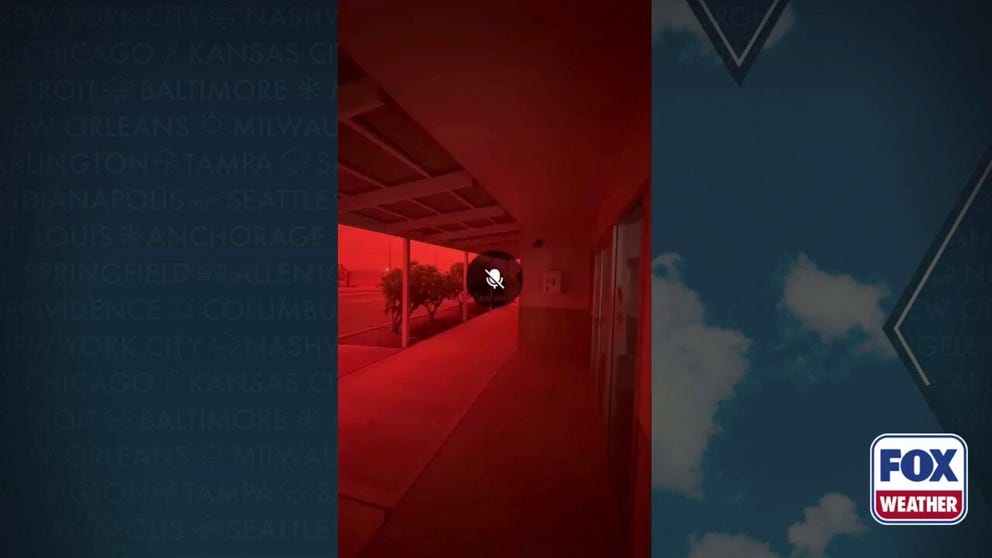
Western Australia engulfed in orange and red dust ahead of Tropical Cyclone Narelle Landfall
Footage captured highlights eerie skies over Western Australia just before Tropical Cyclone Narelle made landfall, engulfing Denham in orange and red from dust on March 27.
Reports suggest that strong winds lifted the iron-rich red soil and dust into the atmosphere, which, combined with scattered sunlight, filtered out most wavelengths except red, producing a vivid crimson sky.